
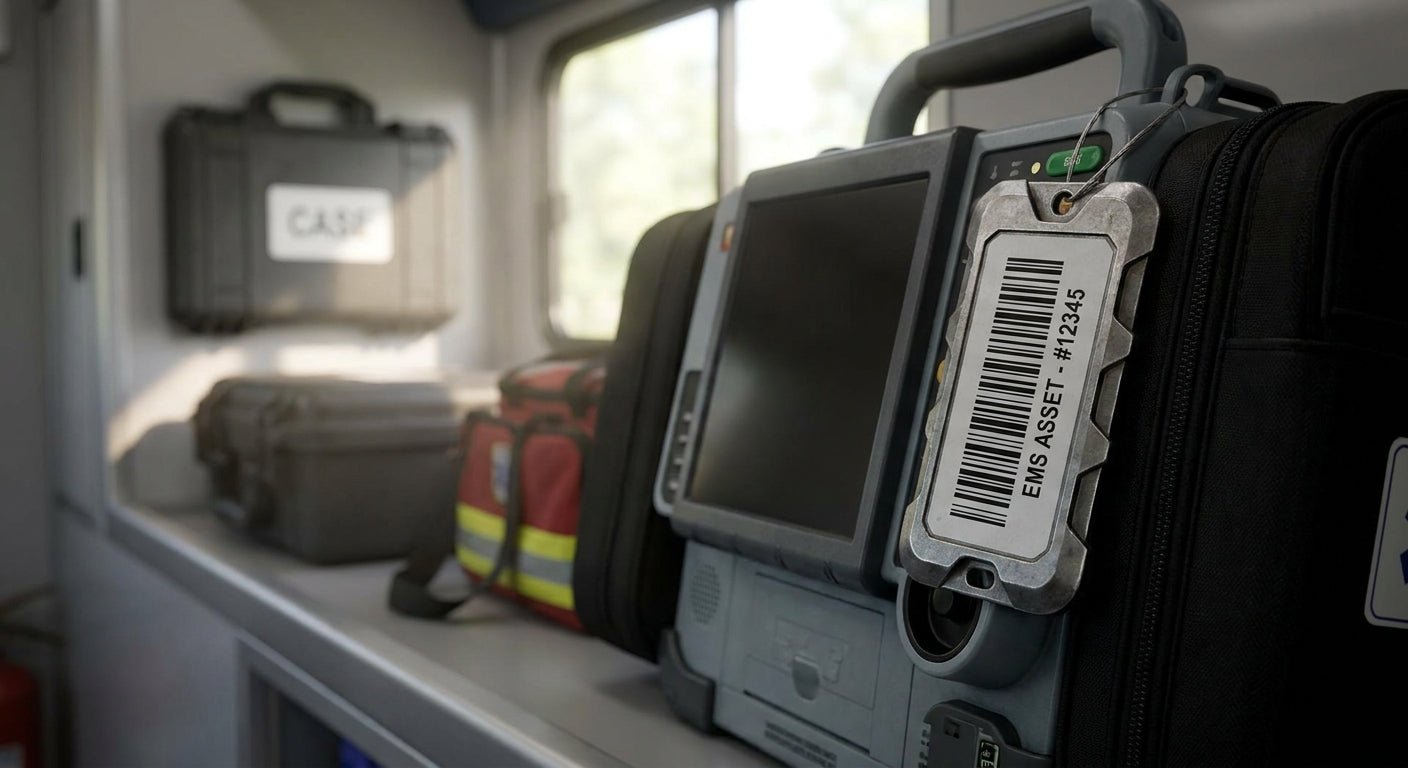
EMS agencies lose track of defibrillators, oxygen regulators, and stretcher hardware constantly — not because crews are careless, but because standard labels don't survive an ambulance bay. Asset tags for EMS equipment need to handle bleach wipe-downs, vibration, and gloved-hand scanning at 2 a.m., which rules out most off-the-shelf inventory stickers.
- 3M Heavy-Duty Silver Barcode Asset Tags at $115 survive disinfectant wipe-downs on defibrillators and monitors — Buy.
- Metalized Silver Barcode Asset Tags at $67 cover fixed cabin equipment like stretcher rails and bench mounts — Buy.
- QR Code Asset Tags in 3M Heavy-Duty Metalized at $115 work for field-scanned gear like O2 regulators and radios — Buy.
- Skip standard paper labels and non-serialized tags on any multi-ambulance fleet in 2026 — they fail within weeks.
Why this matters
An ambulance carries $40,000 to $150,000 in mobile equipment, and most of it moves between units during shift swaps, restocks, and repairs. Without a tag that survives the environment and a numbering system that survives a fleet, EMS agencies end up doing physical equipment audits by hand every quarter — a task that eats hours crews don't have.
The real failure point isn't the barcode itself. It's adhesive that lifts after three bleach wipes, or print that fades under an ambulance's interior heat in July 2026. Get the material and scan method right once, and the tag outlasts the equipment it's tracking.
Who this is for
This guide is for EMS fleet managers, fire department EMS divisions, and private ambulance operators tagging monitors, defibrillators, stretchers, oxygen regulators, radios, and bag valve masks across multiple units or stations. If you're tracking gear across more than two ambulances, or if equipment routinely moves between vehicles during restocking, the criteria below apply directly to you.
What to look for in asset tags for EMS equipment
Chemical and disinfectant resistance
Ambulance interiors get wiped down with bleach, isopropyl alcohol, or hospital-grade disinfectant multiple times a shift. A tag that isn't rated for chemical contact will delaminate or fade its print within a month, and once the barcode is unreadable, the equipment is effectively untracked.
Adhesive strength on curved and vibrating surfaces
Stretcher rails, O2 tank necks, and monitor housings are curved, and the vehicle itself vibrates constantly on the road. A tag needs adhesive rated for these surfaces, not the light adhesive found on general office labels, or it peels within a few runs.
Barcode and QR readability under low light and gloves
Crews scan equipment in poorly lit bays and while wearing nitrile gloves, which means print contrast and barcode size matter more than they would in a warehouse. A barcode that's crisp on a desk but too small to scan one-handed in a dark rig defeats the purpose.
Temperature and UV tolerance
Ambulance cabins swing from sub-freezing to well over 120°F when parked in direct sun, and equipment stored in exterior compartments takes UV exposure directly. Tags rated only for indoor use crack or yellow within a single season of that cycle.
Sequential numbering across a multi-unit fleet
If your agency runs more than one ambulance, tags need sequential or serialized numbering tied to a spreadsheet or asset system, not generic barcodes that repeat across units. Without serialization, two ambulances end up with identical tag numbers and the tracking system breaks the first time gear gets swapped between them.
Fast, on-demand reprinting
Equipment gets replaced, retired, or reassigned constantly in EMS operations, and waiting a week for a reorder to arrive stalls tagging on new gear. Agencies tagging more than a handful of units per month are better served printing tags in-house than reordering from a supplier each time.
Top picks for EMS equipment tags
The safe pick: Metalized Silver Barcode Asset Tags Built on metalized polyester, these tags run $67 for a standard order and hold up on fixed cabin equipment — stretcher rails, bench mounts, cabinet hinges — that doesn't take heavy chemical contact. The barcode format scans cleanly under a handheld reader in a dim ambulance bay. Buy for anything bolted down inside the cabin. Metalized silver barcode asset tags cover the bulk of a typical fleet's fixed-asset needs.
The workhorse: 3M Heavy-Duty Silver Barcode Asset Tags At $115, these use 3M-grade adhesive and heavy-duty polyester rated for repeated disinfectant contact, which makes them the right call for defibrillators, cardiac monitors, and suction units that get wiped down after every call. The tag resists the fading that kills standard labels within a single month of bleach exposure. Buy for any equipment that touches a patient or gets disinfected between runs — 3M heavy-duty silver barcode asset tags are the pick for anything that sees daily chemical wipe-down.
The wildcard: QR Code Asset Tags, 3M Heavy-Duty Metalized Same $115 heavy-duty material as the barcode version, but the QR format lets a crew member scan with a phone camera instead of carrying a dedicated barcode scanner — useful for oxygen regulators, radios, and other gear that moves between the ambulance and the station. Buy if your agency wants field techs scanning with phones rather than handheld readers; see the QR code asset tags in 3M heavy-duty metalized for the exact spec.
The in-house printer pick: GoDEX GE330 A 300 DPI thermal transfer printer priced at $446, the GoDEX GE330 asset tag printer lets an agency print sequential-numbered tags on demand instead of waiting on reorders every time a monitor gets replaced. Consider this once your agency is tagging more than roughly 20-30 pieces of equipment a month across multiple units — below that volume, ordering pre-printed tags is simpler.
The budget pick: Semi-Gloss White Barcode Asset Tags A lower-cost option at the same $67 price point as the metalized silver tag, these work fine on station-stored gear like radios in charging racks or supplies that never leave a climate-controlled building. They are not rated for the chemical and UV exposure a cabin sees. Consider for indoor-only, non-patient-contact equipment; Skip for anything mounted inside the ambulance itself.
What to avoid
- Standard paper or vinyl inventory labels — they look identical to heavy-duty tags in a catalog photo but delaminate after two or three bleach wipes, which is roughly one week of active EMS use.
- Non-serialized barcode tags on a multi-ambulance fleet — generic barcodes that repeat across units make it impossible to tell which ambulance a piece of equipment belongs to once it's been swapped during a restock.
- QR-only tags with no printed backup number — if a phone camera or scanner fails in the field, crews need a legible printed ID number they can log manually; a QR code alone with no visible number leaves no fallback.


Verdict comparison
| Pick | Best for | Material | Scan method | Price | Verdict |
|---|---|---|---|---|---|
| Metalized Silver Barcode Tag | Fixed cabin equipment | Metalized polyester | Barcode | $67 | Buy |
| 3M Heavy-Duty Silver Barcode Tag | Defibrillators, wipe-down gear | 3M heavy-duty polyester | Barcode | $115 | Buy |
| QR Code Tag, 3M Heavy-Duty Metalized | Field-scanned gear | 3M heavy-duty metalized | QR code | $115 | Buy |
| GoDEX GE330 Printer | In-house tagging, multi-unit fleets | 300 DPI thermal transfer | N/A | $446 | Consider |
| Semi-Gloss White Barcode Tag | Station-only, indoor gear | Semi-gloss white polyester | Barcode | $67 | Consider |
McAuley Labels ships all five of these asset tag formats direct, and the two heavy-duty options are the ones that actually belong inside an ambulance cabin in 2026 — the semi-gloss white and standard metalized versions are for equipment that never leaves a building.
FAQ
What's the best asset tag for ambulance equipment in 2026?
3M Heavy-Duty Silver Barcode Asset Tags at $115 are the best choice for defibrillators, monitors, and any gear that gets wiped down with disinfectant. For fixed cabin equipment like stretcher rails, the $67 metalized silver barcode tag holds up without the extra chemical-resistance premium.
Do EMS asset tags need to survive disinfectant wipe-downs?
Yes, any tag applied to patient-contact equipment gets wiped with bleach or alcohol multiple times a shift. Standard paper or vinyl labels delaminate within weeks under that exposure, while 3M heavy-duty polyester tags are built specifically for repeated chemical contact.
Is QR code or barcode better for EMS equipment tracking?
Barcode tags work better with dedicated handheld scanners used in fixed-location audits, while QR codes let field crews scan with a phone camera. Agencies tracking equipment that moves between the ambulance and the station often prefer QR for that flexibility.
How much do asset tags for EMS equipment cost?
Standard metalized silver or semi-gloss white barcode asset tags run around $67 per order, while 3M heavy-duty versions rated for chemical exposure run about $115. A 300 DPI in-house asset tag printer like the GoDEX GE330 costs roughly $446 for agencies tagging equipment on an ongoing basis.
Can asset tags handle the temperature swings inside an ambulance?
3M heavy-duty metalized tags are rated for the temperature extremes an ambulance cabin sees, from sub-freezing mornings to over 120°F in a parked vehicle in direct sun. Standard indoor-rated labels crack or yellow after a single season of that cycle.
Should EMS agencies print their own asset tags or order pre-printed?
Agencies tagging fewer than roughly 20 pieces of equipment a month are generally better off ordering pre-printed serialized tags. Above that volume, an in-house 300 DPI printer like the GoDEX GE330 pays for itself by letting staff print new tags the same day equipment arrives.
Do asset tags need sequential numbering for a multi-ambulance fleet?
Yes, any fleet running more than one ambulance needs sequential or serialized tag numbers tied to a tracking spreadsheet or asset system. Without serialization, two units can end up with matching tag numbers, which breaks tracking the moment gear gets swapped between them.
How long do metalized silver asset tags last on medical equipment?
3M heavy-duty metalized silver tags are built for multi-year use on equipment that sees daily chemical wipe-down and handling. Standard metalized silver tags last comparably long on fixed, low-contact surfaces like cabinet doors and bench mounts.
One last thing
Most EMS agencies apply asset tags to the flattest available surface on a piece of equipment, which is usually right where a mounting bracket or charging dock clamps down — and the bracket wears the tag's print off within months. Put the tag on an adjacent flat surface that never touches a mount, not the mounting point itself, and it outlasts the equipment by years instead of weeks.