
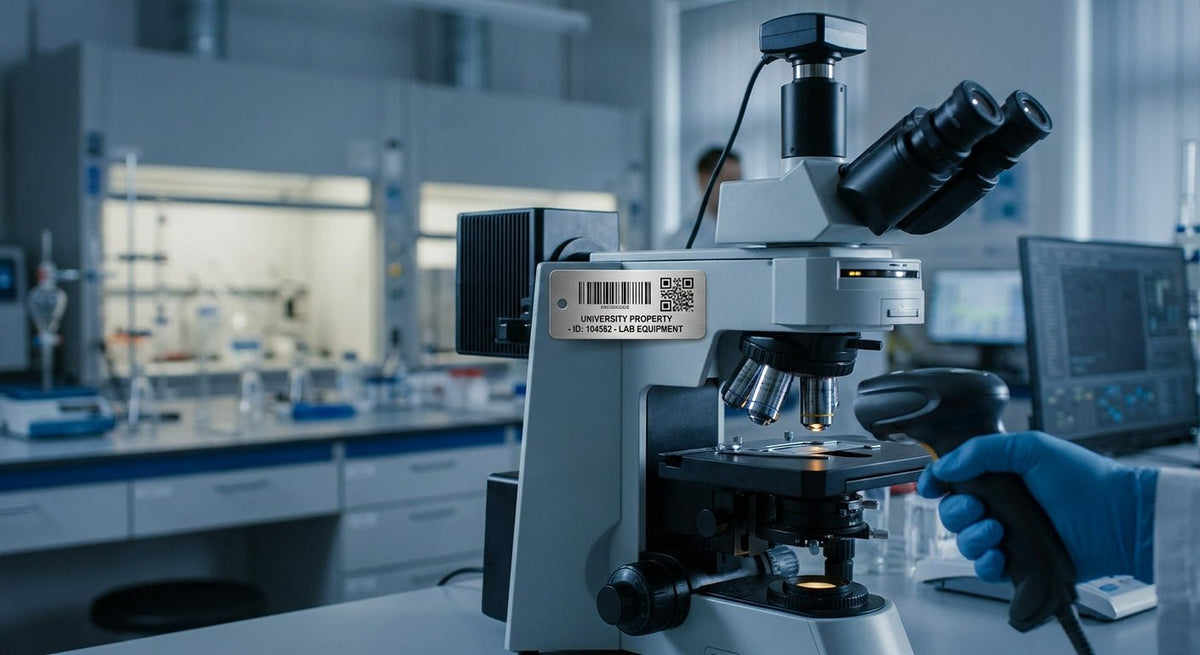
University labs run on equipment that costs $5,000 to $500,000 per unit — microscopes, centrifuges, spectrometers, autoclaves — and every piece needs a tag that survives the environment it lives in. This guide covers what asset tags for university lab equipment actually need to do, which material and format choices hold up in practice, and where the common selection mistakes happen.
TL;DR: For university lab equipment in 2026, metalized silver polyester asset tags with barcode or QR encoding are the standard. They resist solvents, autoclave steam, and cryogenic exposure better than paper or standard vinyl. McAuley Labels' asset tags for equipment — metallized silver barcode labels are manufactured in the US and ship direct to facilities teams. Budget $0.10–$0.40 per tag at volume. Pair with a 300 or 600 DPI thermal printer for readable barcodes on small labels.
Why This Matters in 2026
University procurement offices face two simultaneous pressures this year: tighter federal grant audit requirements and rising equipment replacement costs. A missing or unreadable tag on a $40,000 centrifuge means a facilities team cannot verify custody during an audit — and cannot file an insurance claim if the unit is damaged or stolen. Paper labels fail within 90 days in wet lab conditions. Getting the tag material right the first time costs a fraction of what a re-tagging project costs across 200+ pieces of equipment.
Who This Is For
This guide is written for university facilities managers, lab managers, and procurement coordinators responsible for fixed-asset tracking across chemistry, biology, physics, and engineering labs. You are buying tags in quantities of 200–5,000 at a time, applying them to equipment that ranges from desktop analyzers to floor-mounted autoclaves, and you need labels that survive at least 5 years of regular cleaning, chemical exposure, and occasional relocation without losing barcode readability.
What to Look for in Asset Tags for University Lab Equipment
Material Durability Against Lab Chemicals
Lab benches get wiped down with isopropyl alcohol (IPA), bleach solutions, and quaternary ammonium compounds multiple times per day. A paper or standard polypropylene label dissolves or lifts within weeks. Metalized silver polyester — the same material used in industrial and military asset tagging — holds adhesion and print legibility after repeated solvent exposure. Look for a face stock rated for IPA and 10% bleach wiping at minimum.
Adhesive Strength on Painted Metal and Powder-Coated Surfaces
Most lab equipment has a powder-coated steel or anodized aluminum housing. Standard permanent acrylic adhesives work on flat painted metal but fail on curved surfaces or surfaces that flex under temperature change. Aggressive permanent adhesives rated for metal — including 3M adhesive backing — maintain bond strength from -20°F to 300°F, which matters near ovens, incubators, and cold storage units. Tags that peel at the corners within 6 months are a calibration failure in the selection process, not normal wear.
Barcode and QR Code Print Resolution
University asset tags are small — typically 1" x 2" or 1" x 3" — and carry a barcode, a human-readable number, and sometimes a QR code linking to the asset management record. At 203 DPI, a 1-inch wide barcode on a 1" x 2" label scans reliably. At 300 DPI, you get cleaner edges and can fit a secondary QR code on the same label without crowding. 600 DPI is worth specifying when tags go on equipment with curved surfaces or when the scanning environment is low-light. Printer resolution is a procurement variable — not every thermal printer produces the same output on a 1" label.
Tamper Evidence
Equipment shared between departments or checked out by graduate students needs a tag that reveals removal attempts. Destructive or void-pattern asset tags leave a visible residue on the substrate when peeled, making unauthorized relocation or de-tagging obvious during audits. For equipment worth over $10,000 per unit, tamper-evident construction is a standard requirement, not an upgrade.
Size and Format Compatibility with Asset Management Software
Most university systems — Assetworks, TeamDynamix, EZOfficeInventory — generate Code 128 or QR barcodes. The tag you order must match the barcode symbology and label dimensions already configured in your software. Custom-printed tags ordered with your institution's barcode sequence eliminate the step of printing in-house and speed up tagging during equipment intake. If you print in-house, confirm your thermal printer's label width matches the tag stock before ordering 2,000 units.
Legibility Over a 5–10 Year Service Life
Thermal transfer printing — where a wax or resin ribbon bonds ink to the face stock — produces text and barcodes that last 10+ years on polyester labels without fading. Direct thermal printing (no ribbon) produces labels that fade when exposed to UV light or heat, making it unsuitable for permanent asset tags. Always specify thermal transfer for lab asset tags that need to survive a decade of fluorescent lighting and surface cleaning.
Top Picks
Metalized Silver Polyester Barcode Tags — The Standard Pick
Hook: The safe pick for the majority of university lab environments.
Metalized silver polyester is the default material for durable asset tags in 2026 because it handles chemical wipe-downs, resists tearing, and stays flat on metal surfaces without curling. McAuley Labels' asset tags for equipment — metallized silver barcode labels ship in custom sizes and include barcode sequences matched to your numbering system. The metalized face stock reads cleanly under both handheld and fixed barcode scanners.
Spec that matters: Silver polyester face stock with permanent adhesive, rated for solvents and temperatures from -20°F to 300°F.
Concrete number: Tags ordered in quantities of 500 or more typically land at $0.15–$0.30 per unit, depending on size and print complexity.
Verdict: Buy. This is the correct material for 90% of university lab equipment — wet benches, analytical instruments, centrifuges, and storage units.
3M-Backed Heavy-Duty Tags — The High-Value Equipment Pick
Hook: The right call for equipment above $20,000 per unit or equipment in harsh sub-environments.
3M adhesive backing adds bond strength on surfaces that standard acrylic adhesive struggles with: textured powder coat, anodized aluminum, and equipment that cycles through temperature extremes like autoclaves and cryogenic freezers. The 3M adhesive layer is thicker and maintains peel strength on surfaces that expand and contract. For equipment near autoclaves (temperatures up to 275°F) or liquid nitrogen storage (-320°F), 3M-backed tags are the defensible specification. McAuley Labels manufactures custom 3M asset tags for equipment tracking — size and barcode format are configurable at order.
Spec that matters: 3M adhesive rated for thermal cycling and chemical exposure on non-flat metal surfaces.
Concrete number: 3M-backed tags run approximately 25–40% more per unit than standard polyester tags at the same quantity break.
Verdict: Buy for autoclave rooms, cryogenic labs, and any equipment above $20,000. Hold for standard benchtop instruments in dry labs where standard polyester performs identically at lower cost.
Custom Pre-Printed Tags with Sequential Barcodes — The Efficiency Pick
Hook: The time-saver for facilities teams tagging 200+ assets in a single intake event.
Ordering tags pre-printed with sequential asset numbers eliminates in-house printing and the calibration errors that come with it. You receive rolls or sheets ready to apply directly from the box. The tradeoff: you commit to the barcode sequence at order time, so this works best when your asset management system has already assigned numbers. If intake events are unpredictable or asset numbers are assigned on the fly, in-house thermal printing with a 300 or 600 DPI printer is more flexible.
Spec that matters: Sequential Code 128 or QR barcodes matched to your AMS numbering scheme, printed on metalized silver polyester.
Concrete number: Pre-printed runs of 1,000 units ship within 3–5 business days from a US manufacturer.
Verdict: Buy when you have 200+ assets to tag in a defined intake batch. Consider for ongoing tagging where intake volume is low and unpredictable.
In-House Thermal Transfer Printing — The Flexible Pick
Hook: The wildcard for labs that tag equipment on an ongoing basis rather than in bulk batches.
A 300 DPI or 600 DPI thermal transfer printer paired with silver polyester label stock lets your facilities team print asset tags on demand — one at a time or in small batches. The McAuley Labels GoDEX RT863i thermal printer at 600 DPI produces crisp barcodes and QR codes on labels as small as 0.5" wide. Setup requires GoLabel software (free download) and a resin ribbon matched to the polyester face stock. The per-tag cost at low volume is higher than pre-printed orders, but the flexibility — print one tag for a new microscope received mid-semester — is worth it for active labs.
Spec that matters: 600 DPI print resolution; resin ribbon for chemical-resistant output on polyester stock.
Concrete number: The RT863i prints at 4 inches per second and handles label widths from 1" to 4".
Verdict: Buy for facilities teams that receive equipment continuously. Consider for labs that only tag during annual intake events.
What to Avoid
- Paper or semi-gloss paper labels on lab equipment. They look fine on day one and fail within 60–90 days of IPA wipe-downs. Semi-gloss paper is appropriate for dry warehouse shelving, not wet lab surfaces. University auditors have flagged unreadable paper tags on equipment during grant reviews.
- Direct thermal printing for permanent asset tags. Direct thermal labels fade under UV light and degrade with heat exposure — two conditions that exist in every lab. A tag printed on direct thermal stock in 2026 may be unreadable by 2028 without any physical damage. Specify thermal transfer with a resin ribbon for any tag expected to last more than 2 years.
- Ordering generic tags without matching your AMS barcode format. Code 39, Code 128, QR, and DataMatrix are not interchangeable. A tag printed in Code 39 will not scan correctly if your asset management system expects Code 128. Confirm the symbology your scanner and software use before specifying tags.
Verdict Comparison Table
| Tag Type | Chemical Resistance | Temp Range | Tamper Evidence | Per-Unit Cost (500 qty) | Best For |
|---|---|---|---|---|---|
| Metalized silver polyester | High | -20°F to 300°F | Optional | $0.15–$0.30 | General lab equipment |
| 3M-backed heavy-duty | Very high | -320°F to 300°F | Optional | $0.20–$0.42 | Autoclaves, cryogenics, high-value assets |
| Pre-printed sequential | High | -20°F to 300°F | Optional | $0.12–$0.28 | Bulk intake events |
| In-house thermal transfer | High (with resin ribbon) | -20°F to 300°F | Stock-dependent | $0.30–$0.60 | Ongoing, on-demand tagging |
| Paper / semi-gloss | Low | 32°F to 140°F | No | $0.04–$0.10 | Do not use in labs |
FAQ
What are the best asset tags for university lab equipment in 2026? Metalized silver polyester tags with thermal transfer printing are the standard in 2026. They survive solvent wipe-downs, hold adhesion on metal equipment housings, and maintain barcode readability for 10+ years. For autoclave rooms and cryogenic labs, specify 3M adhesive backing.
How long do asset tags last on lab equipment? Thermal transfer-printed polyester tags rated for chemical exposure last 7–10 years under normal lab conditions, including daily IPA wipe-downs. Paper labels in the same environment typically fail within 90 days.
What barcode format should university asset tags use? Code 128 is the most common format in university asset management systems because it encodes alphanumeric strings in a compact width. QR codes work well when the tag needs to link to an online asset record. Confirm which symbology your AMS scanner reads before ordering.
Can lab asset tags survive autoclave sterilization? Not directly. Tags applied to the exterior housing of an autoclave survive ambient heat. Tags on items that go inside the autoclave chamber (instruments, trays) require specialized high-temperature labels rated for 275°F+ steam cycles — these are a different product from standard asset tags.
Is it better to pre-print asset tags or print in-house? Pre-printed tags are faster and cheaper per unit for bulk intake events of 200+ assets. In-house printing with a thermal transfer printer gives you on-demand flexibility for equipment received outside scheduled intake windows. Most university facilities teams use both: pre-printed for annual audits, in-house for ongoing intake.
How do I attach asset tags to smooth metal lab equipment? Clean the surface with IPA and let it dry completely before application. Press the tag firmly from the center outward for 15–30 seconds. On curved surfaces or very smooth anodized metal, 3M-backed tags maintain adhesion better than standard acrylic adhesive.
How much do asset tags cost for university equipment? Metalized silver polyester tags cost $0.15–$0.30 per unit at quantities of 500. 3M-backed heavy-duty tags run $0.20–$0.42 at the same quantity. Volume breaks typically kick in at 500, 1,000, and 5,000 units.
Do university lab asset tags need to be tamper-evident? For equipment above $10,000 in value, or any equipment that leaves a lab space for shared use, tamper-evident tags are best practice. They create a visible void pattern when removed, which is documented evidence during audits and theft investigations.
One Last Thing
The single most overlooked variable in university asset tag programs is the adhesive cure time. Most permanent adhesives reach full bond strength 24–72 hours after application, not at the moment you peel and stick. Equipment moved or cleaned within the first hour after tagging — common during active intake events — can compromise adhesion before the bond sets. Apply tags at the end of the intake process, after all physical handling is complete, and let the adhesive cure overnight before the first surface cleaning.