600 DPI is the resolution threshold where product barcodes stop being a gamble. At 203 or 300 DPI, a 1D barcode on a 1-inch label is readable — but a dense 2D Data Matrix, a GS1-128 with fine bars, or a QR code crammed onto a 0.5-inch label starts failing scanners. This guide ranks the best 600 DPI label printers for product barcodes in 2026, with one clear top pick for businesses that need scan-reliable output at production volume.
TL;DR: The best 600 DPI label printer for product barcodes in 2026 is the GoDEX RT863i, available directly from McAuley Labels. It prints at true 600 DPI with thermal transfer, handles labels up to 4 inches wide, and holds up in warehouse and manufacturing environments where scan failure is not an option. If you only need basic 1D barcodes at moderate volume, a 300 DPI printer saves money. If you're printing GS1-128, Data Matrix, or small QR codes on product labels, 600 DPI is the correct spec.
Why resolution matters for product barcodes
A 600 DPI printer places 600 dots per linear inch. A 203 DPI printer places 203. That difference is invisible on a bold logo — it is not invisible on a barcode's quiet zone, bar width, or intercharacter gap. GS1 standards require a minimum bar width tolerance of ±0.101 mm for Code 128. At 203 DPI, one dot equals 0.125 mm — already at the edge of tolerance. At 600 DPI, one dot equals 0.042 mm, giving you three times the precision for each bar edge.
For manufacturers, distributors, and ecommerce sellers printing product labels in 2026, the practical case for 600 DPI comes down to three scenarios: labels under 1 inch, 2D symbologies (QR, Data Matrix, PDF417), and print-and-apply lines where label stock varies. In all three, 300 DPI introduces scan failure risk that 600 DPI eliminates.
How we ranked
Rankings are based on four criteria applied to printers currently available and shipping in 2026:
- Print resolution: Must be native 600 DPI, not interpolated.
- Thermal method: Thermal transfer preferred for product labels that need chemical and abrasion resistance; direct thermal noted where relevant.
- Label width and media handling: Product labeling typically requires 2–4 inch label width. Printers that max out at 2 inches are excluded.
- Connectivity and software: USB is table stakes. Ethernet and USB host matter for production floors. GoLabel or equivalent label design software compatibility is a practical requirement for most buyers.
No paid placements. Rankings reflect spec accuracy, use-case fit, and real-world reliability for barcode-critical labeling.
The ranked list
1. GoDEX RT863i — The production-floor standard
Hook: The clear buy for barcode-critical product labels.
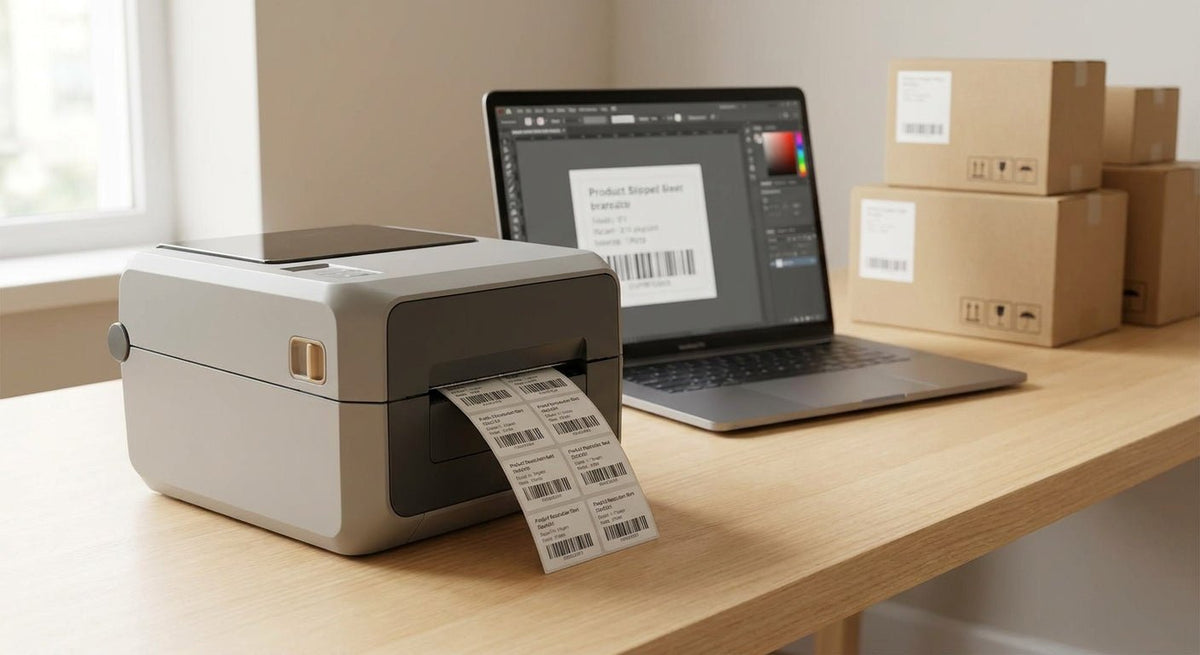
The GoDEX RT863i is a 4-inch thermal transfer printer running at native 600 DPI. Print speed is 4 inches per second at full resolution. It handles label rolls up to 5 inches in outer diameter and accepts media widths from 1 to 4.25 inches — covering the full range of product label sizes from small ingredient panels to full retail shelf labels.
Connectivity includes USB 2.0, RS-232, and Ethernet as standard. A USB host port allows standalone operation with a USB keyboard or memory stick — useful on production lines where a dedicated PC is not in the label printer's vicinity. The unit ships with GoLabel software, which supports all major barcode symbologies including GS1-128, QR Code, Data Matrix, and PDF417.
At 600 DPI with thermal transfer ribbon, bar edges on a Code 128 barcode printed at 0.25-inch height are visibly sharper than the same label at 300 DPI — and more importantly, they pass first-scan on warehouse scanners and retail receiving guns without the retry rate you see from lower-resolution output.
McAuley Labels ships the RT863i direct to business customers in the United States in 2026.
Verdict: Buy. The RT863i is the correct printer for any business where barcode scan reliability on product labels is a hard requirement, not a preference.
2. GoDEX G530 — The step-down for 4-inch needs
Hook: The budget entry into 600 DPI thermal transfer.
The GoDEX G530 prints at 600 DPI on labels up to 4 inches wide. Print speed is 5 inches per second — slightly faster than the RT863i at full resolution. The trade-off is connectivity: standard configuration is USB and serial only; Ethernet requires an optional module. For a single workstation printing product labels on demand, that is not a problem. For a networked production line, it adds cost and configuration time.
Media handling is solid: 1 to 4.25 inch label width, 5-inch OD roll capacity. GoLabel software compatibility is identical to the RT863i. The G530 is the right call when you need 600 DPI output but do not need Ethernet as a standard feature.
Verdict: Consider. Saves money upfront if you're on USB only. Step up to the RT863i if the printer connects to a network or a print server.
3. Zebra ZD621 (600 DPI model) — The enterprise incumbent
Hook: The safe pick for IT-managed print environments.
Zebra's ZD621 in the 600 DPI thermal transfer configuration is the default choice for enterprise IT departments that already run ZPL-based label design workflows. It prints at 6 inches per second at 600 DPI, accepts 4-inch wide media, and integrates with Zebra's ZSB and ZDesigner software ecosystems. Link-OS connectivity means remote management, firmware updates over the network, and printer fleet visibility through Zebra's management tools.
The purchase price is higher than the GoDEX RT863i, and replacement ribbon and media through Zebra's authorized channels carries a corresponding premium. For teams already running ZPL templates and Zebra print management, the switching cost from another Zebra unit is zero. For teams starting fresh in 2026, the ZD621's software lock-in and higher consumables cost make it a harder case versus the RT863i unless ZPL compatibility is mandatory.
Verdict: Hold. Right choice if your label workflow is ZPL-based and you're adding to an existing Zebra fleet. Not the first choice if you're buying from scratch.
4. Honeywell PC45d (600 DPI) — The mid-market contender
Hook: Strong spec sheet, limited US distribution depth.
The Honeywell PC45d at 600 DPI is a 4-inch thermal transfer desktop printer with a 5 IPS print speed and standard USB, Ethernet, and serial connectivity. It runs Honeywell's Fingerprint and Direct Protocol languages in addition to ZPL and EPL emulation, making it broadly compatible with existing label design software.
The practical limitation in 2026 is service and direct-purchase access. Honeywell's US distribution for the PC45d runs through VARs and resellers with variable stock and lead times. For operations that need a printer on-site within a few business days, that adds friction the GoDEX RT863i through McAuley Labels' direct-ship model does not.
Verdict: Consider. Technically competitive at 600 DPI, but distribution gaps make it harder to source and service compared to direct-ship options.
5. TSC TTP-346M — The value 600 DPI option for lighter duty
Hook: 600 DPI at the lowest price point, with trade-offs.
The TSC TTP-346M prints at 600 DPI on media up to 4.4 inches wide. Print speed drops to 3 inches per second at full resolution — the slowest on this list. For low-to-moderate volume product labeling (under 500 labels per day), that speed is acceptable. At production volume, it creates a bottleneck.
TSC's BarTender and TSC Console software support covers most label design workflows. Connectivity is USB, serial, and optional Ethernet. Build quality is lighter than the GoDEX RT863i or Zebra ZD621, which shows in higher wear rates on the printhead and platen roller at sustained production volumes.
Verdict: Skip for production, Consider for low-volume. The speed limitation and lighter build make it unsuitable for floor-level production labeling. For an office or lab printing 50–100 product labels per shift, it gets the job done at a lower entry cost.
Comparison table
| Printer | Resolution | Max Label Width | Print Speed | Ethernet Standard | Thermal Method | Verdict |
|---|---|---|---|---|---|---|
| GoDEX RT863i | 600 DPI | 4 in | 4 IPS | Yes | Transfer | Buy |
| GoDEX G530 | 600 DPI | 4 in | 5 IPS | Optional | Transfer | Consider |
| Zebra ZD621 | 600 DPI | 4 in | 6 IPS | Yes | Transfer | Hold |
| Honeywell PC45d | 600 DPI | 4 in | 5 IPS | Yes | Transfer | Consider |
| TSC TTP-346M | 600 DPI | 4.4 in | 3 IPS | Optional | Transfer | Skip/Consider |
Where to buy
- McAuley Labels (mcauleylabels.com): Direct-ship to US businesses in 2026. The GoDEX RT863i ships with GoLabel software included. No reseller markup, no intermediary lead time.
- Zebra authorized resellers: Required for ZD621 warranty service and ZPL software support. Expect 5–10 business day lead times from most US resellers.
- TSC and Honeywell VARs: Both require VAR sourcing. Verify stock before ordering — availability varies by region.
One rule applies to all three channels: confirm the unit ships the 600 DPI model variant, not the 300 DPI version. Both the ZD621 and PC45d exist in 300 DPI and 600 DPI SKUs with near-identical product names. The RT863i is 600 DPI only — there is no 300 DPI variant to confuse it with.
What to avoid
Direct thermal-only printers for permanent product labels. Direct thermal output fades with heat, UV exposure, and contact with certain plastics and chemicals. Product labels on items that ship, sit in warehouses, or face any environmental stress need thermal transfer output. Direct thermal is fine for shipping labels that get discarded after delivery — not for product labels that need to stay readable for months or years.
203 DPI printers rebranded or marketed for "high-resolution" barcodes. Marketing copy frequently describes 203 DPI printers as suitable for barcodes, which is true for large-format 1D codes. It is not true for 2D symbologies, small labels, or labels that need to pass GS1 verification. Verify the native DPI specification in the printer's technical datasheet, not its product listing title.
Printers without ribbon-save mode for thermal transfer. If you print variable-length labels — common in product labeling where SKU descriptions vary — a printer without ribbon-save or ribbon economy mode burns through ribbon faster than necessary, raising per-label consumable cost materially over a year's production.
FAQ
What's the best 600 DPI label printer for product barcodes in 2026? The GoDEX RT863i is the best 600 DPI label printer for product barcodes in 2026. It prints thermal transfer at native 600 DPI on labels up to 4 inches wide, includes Ethernet and USB connectivity, and ships direct from McAuley Labels to US businesses.
Is 600 DPI necessary for barcode labels, or is 300 DPI enough? 300 DPI is sufficient for standard 1D barcodes (Code 128, Code 39) printed at 0.5 inch height or taller on labels 2 inches wide or wider. 600 DPI is necessary for 2D symbologies (QR Code, Data Matrix), labels under 1 inch, and any application where labels must pass GS1 scan verification.
What's the difference between 300 DPI and 600 DPI on a thermal label printer? 600 DPI places dots at 0.042 mm intervals versus 0.084 mm at 300 DPI. For barcode bar edges, that means tighter tolerances, cleaner quiet zones, and higher first-scan rates — especially on 2D codes and small labels. For the full breakdown, see the 300 DPI vs 600 DPI guide.
Can a 600 DPI label printer also print 203 or 300 DPI jobs? Yes. A 600 DPI printer can output at lower resolutions by selecting a lower DPI setting in the label software or printer driver. Running a 600 DPI printer at 300 DPI for shipping labels is common — it increases print speed and reduces print darkness requirements on lighter label stocks.
How fast does the GoDEX RT863i print at 600 DPI? The GoDEX RT863i prints at 4 inches per second at full 600 DPI resolution. At a standard 4x2 inch product label size, that is approximately 30 labels per minute sustained.
What label software works with 600 DPI thermal printers? GoLabel (GoDEX), BarTender, NiceLabel, ZebraDesigner, and most major label design platforms support 600 DPI thermal transfer printers. GoLabel is included with GoDEX printers from McAuley Labels and handles GS1-128, QR Code, Data Matrix, and all common product barcode formats.
Does thermal transfer or direct thermal produce better barcodes at 600 DPI? Thermal transfer produces better barcodes for product labels. The ribbon-to-media transfer process creates sharper, more chemically stable bar edges than direct thermal's heat-reactive coating. Direct thermal barcodes degrade with UV exposure and temperature changes — unacceptable for product labels with any shelf life.
What's a realistic budget for a 600 DPI label printer for product barcodes? Expect to pay $400–$700 for a quality 600 DPI desktop thermal transfer printer in 2026. The GoDEX RT863i sits at the lower end of that range with no trade-off on core specifications. Enterprise units like the Zebra ZD621 run higher. Add $30–$60 per ribbon roll and label stock costs on top of the hardware price.
One last thing
One spec buyers consistently overlook in 2026: printhead life rated in linear inches, not years. Thermal printhead manufacturers rate head life in meters or linear inches of print. A printhead rated for 10 km (393,700 inches) of print sounds like a lot until you calculate that printing 500 four-inch labels per day consumes 2,000 inches per day — meaning the printhead reaches end-of-life in roughly 197 production days, under a year. The GoDEX RT863i's printhead is rated at 10 km. Budget for a replacement printhead annually if you're running it at production volume, and factor that into total cost of ownership before comparing sticker prices across brands.