
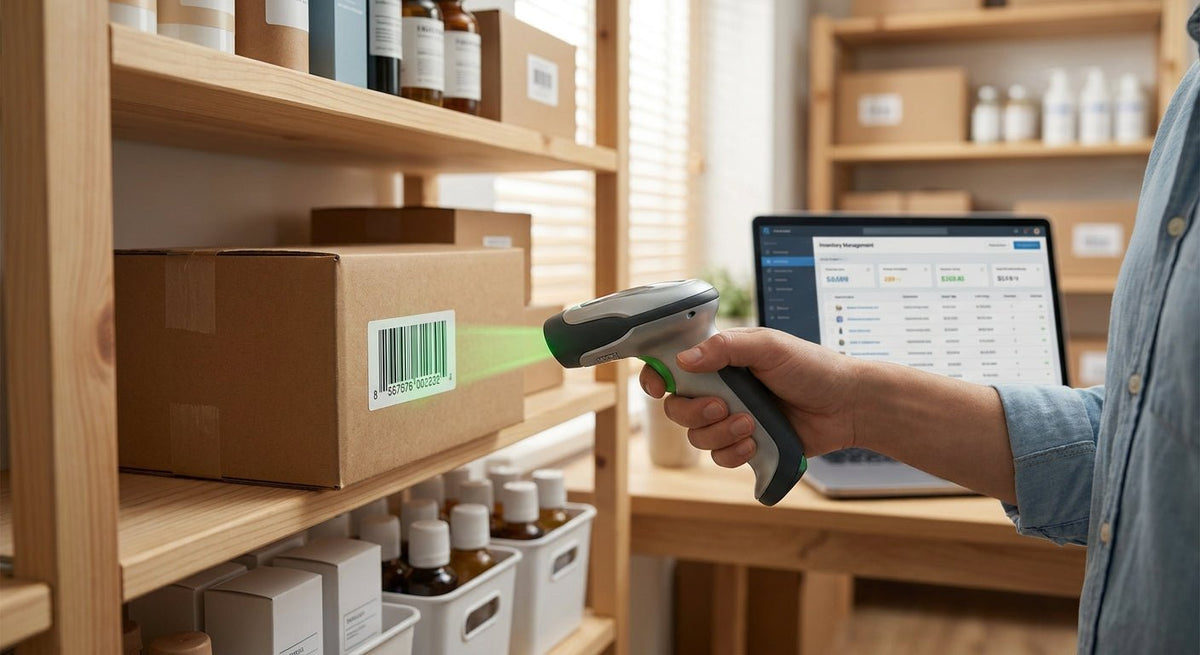
A barcode scanner that slows down your checkout line or drops reads every third scan costs you more than the device is worth. This guide ranks the best barcode scanners for small business inventory in 2026 — covering cordless range, connection type, decode speed, and the label quality that determines whether the scanner can even do its job.
TL;DR: The best barcode scanner for small business inventory in 2026 is a 2D imager with USB or Bluetooth connectivity, a decode rate above 100 scans per second, and compatibility with standard Code 128 and QR barcodes. Budget units start around $30; mid-range cordless models run $80–$150. The scanner is only as reliable as the label it reads — smudged or low-resolution barcodes cause most read failures, not the hardware. McAuley Labels pairs directly with this stack: their barcode label stock is printed-to-spec so scanners hit on the first pass.
Why This Matters in 2026
Small businesses lose an estimated 20% of inventory value annually to shrinkage and miscount — and a large share of that is traceable to manual entry errors that a barcode system eliminates. The barrier is no longer cost; entry-level 2D scanners have dropped below $50. The real decision is matching scanner capability to label format, connection type to workflow, and decode resolution to the barcode density you actually print.
How We Ranked
This list is built on published manufacturer specs, aggregated buyer reviews across major retail channels as of 2026, and compatibility data against the most common small business inventory platforms (Shopify POS, Square, Lightspeed, QuickBooks). Criteria weighted in order: decode accuracy on real-world label stock, connection reliability, ergonomics for sustained scanning, software compatibility, and total cost of ownership including replacement cables and batteries. No manufacturer paid for placement.
The Ranked List
1. Honeywell Voyager 1250g — The Safe Pick
The Voyager 1250g is a corded 1D laser scanner that has appeared in small business and retail environments for over a decade. It reads Code 128, UPC-A, UPC-E, and EAN barcodes at up to 100 scans per second with a 72-inch drop tolerance. Street price in 2026 is approximately $65.
It connects via USB (HID) — plug it in, it works in every inventory platform without a driver install. The single-line laser struggles with QR codes and Data Matrix, so if your labels carry 2D codes, move down the list. For straightforward 1D warehouse or retail shelf scanning, nothing at this price point is more reliable.
Verdict: Buy — if your entire label inventory is 1D barcodes.
2. Zebra DS2208 — The Upgrade
The DS2208 is a 2D imager that reads every standard 1D and 2D symbology including QR codes, PDF417, and Data Matrix. Decode speed is listed at 100+ scans per second; the wide 47-degree field of view forgives label placement angles that trip up laser scanners. Price in 2026: approximately $95–$110.
This is the right scanner if your labels carry QR codes for customer-facing links or if you track assets with 2D barcode tags. It connects USB or RS-232 and is natively recognized by Shopify POS and QuickBooks Desktop. The DS2208 also reads damaged or low-contrast labels better than any laser unit at this price — relevant if labels see moisture, grease, or UV exposure.
Verdict: Buy — the practical default for any mixed 1D/2D label environment in 2026.
3. Socket Mobile S700 — The Bluetooth Pick
For businesses where the point-of-scan is not next to a computer — a stockroom, a loading dock, a service counter — the S700 delivers Bluetooth 5.0 with a 33-foot reliable range and a 12-hour battery on a single charge. Decode accuracy matches mid-range corded units. 2026 street price: $130–$155.
It pairs with iOS, Android, and Windows over Bluetooth HID, meaning it works with tablet-based POS systems out of the box. The trade-off is daily charging discipline — a dead battery stalls operations. Keep the cradle at the counter and enforce end-of-shift docking.
Verdict: Buy — if your scanning happens away from a fixed workstation.
4. Honeywell Xenon 1952g — The High-Volume Pick
The Xenon 1952g is an area-imaging scanner rated for industrial environments. It reads barcodes from 1 mil to 100 mil density, handles damaged or poorly printed labels better than any unit under $200, and carries an IP41 rating against dust and light splash. 2026 price: $180–$220.
Overkill for a boutique retail counter. Right-sized for a warehouse doing 500+ scans per day, a receiving dock processing mixed shipments, or any environment where label quality varies. The adaptive illumination system compensates for reflective labels — including metallized polyester stock — that cause flare failures on lower-end imagers.
Verdict: Hold — buy it when scan volume justifies the price, or when label surfaces vary widely.
5. Godex GS220 USB Barcode Scanner — The Budget Pick
The Godex GS220 USB barcode scanner is a 1D laser scanner in the $30–$40 range that connects via USB HID. It reads Code 128, UPC, and EAN at up to 100 scans per second with a 50-inch drop spec. For a business that already runs Godex thermal printers and wants a single-vendor hardware stack, this is the logical pairing — labels printed on Godex hardware and scanned on Godex hardware are calibrated to work together.
The GS220 is not a 2D imager. QR codes require a different unit. But for small retail, pop-up inventory counting, or a secondary scanner at a second register, the price-to-function ratio is hard to beat in 2026.
Verdict: Buy — as a first scanner or a backup unit, especially alongside Godex label printers.
Comparison Table
| Scanner | Type | Connection | 2D Capable | Drop Spec | 2026 Price |
|---|---|---|---|---|---|
| Honeywell Voyager 1250g | Laser 1D | USB | No | 72 in | ~$65 |
| Zebra DS2208 | Imager 2D | USB / RS-232 | Yes | 6 ft | ~$100 |
| Socket Mobile S700 | Imager 2D | Bluetooth 5.0 | Yes | 5 ft | ~$145 |
| Honeywell Xenon 1952g | Imager 2D | USB / BT | Yes | 6 ft | ~$200 |
| Godex GS220 | Laser 1D | USB | No | 50 in | ~$35 |
Where to Buy
- Direct from manufacturer or authorized distributor — Honeywell, Zebra, and Socket Mobile all sell through Amazon Business and CDW. Pricing is consistent; warranty terms are cleaner than third-party marketplace sellers.
- Bundle with your label hardware — if you are buying or already running a Godex thermal printer, sourcing the GS220 through McAuley Labels keeps your label and scanning stack under one support contact.
- Avoid gray-market units — refurbished scanners sold without a warranty are a false saving. A $35 unit with no return policy costs more than a $65 unit with a 3-year replacement guarantee when it fails during a physical inventory count.
The Label Side of the Equation
Scanners fail reads for two reasons: hardware limitation, and label quality. A $200 scanner cannot consistently decode a barcode printed at 150 DPI on a wrinkled direct-thermal label. The fix is not a better scanner — it is printing at 203 DPI minimum, using the correct label stock for the surface, and replacing worn ribbon before print quality degrades.
McAuley Labels manufactures barcode label stock — including barcode inventory labels for small business — designed to print clean barcodes on Godex thermal hardware. Metallized polyester asset tags, semi-gloss white inventory labels, and heavy-duty silver stock each have specific scanner pairing considerations covered there.
If you are building a system from scratch in 2026, specify your label format first, then choose a scanner rated for that symbology and substrate.
FAQ
What is the best barcode scanner for small business inventory in 2026? The Zebra DS2208 is the best all-around choice for most small businesses in 2026 — it reads both 1D and 2D barcodes, costs around $100, and works with every major inventory platform without driver configuration.
Do I need a 1D or 2D barcode scanner? 2D imagers read both 1D barcodes (Code 128, UPC) and 2D codes (QR, Data Matrix) — buy a 2D imager unless your entire label inventory is confirmed 1D-only. The price difference is less than $40 in 2026.
How much does a barcode scanner cost for a small business? Entry-level corded scanners start at $30–$40. Reliable mid-range units run $80–$150. Bluetooth models for mobile scanning start around $130. Industrial-grade units for high-volume environments run $180–$300.
Can a barcode scanner work with QuickBooks or Shopify? Yes. USB HID scanners — which includes every unit on this list — register as a keyboard input device. They work with QuickBooks, Shopify POS, Square, Lightspeed, and any browser-based inventory system without additional software.
Why does my barcode scanner fail to read sometimes? Most read failures in small business environments trace to the label, not the scanner: low print resolution, faded thermal stock, incorrect bar-to-space ratio, or a reflective label surface causing illumination flare. Verify your printer is outputting at 203 DPI minimum before replacing hardware.
Is a wireless barcode scanner worth it for a small business? If scanning happens within 3 feet of a fixed computer, a corded scanner is more reliable. If you scan across a stockroom, warehouse floor, or service counter away from a workstation, a Bluetooth scanner saves meaningful time daily.
What barcode symbology does small business inventory use? Code 128 is the standard for internal inventory labels. UPC-A and EAN-13 are used for retail-sold products. QR codes appear on asset tags and customer-facing labels. A 2D imager handles all of these; a 1D laser handles only the first two.
Do barcode scanners work with metallized label stock? Yes, but the scanner's illumination system matters. Metallized polyester labels reflect light differently than paper stock. Area-imaging scanners with adjustable illumination — like the Honeywell Xenon 1952g — handle metallic substrate better than standard laser units.
One Last Thing
The single most overlooked step when setting up a barcode inventory system is printing a test sheet at maximum contrast before scanning a single production label. Print a 203 DPI test page, scan all 10 barcodes, and confirm zero read errors. Do that once in 2026 and you will save hours of troubleshooting later — because every read error you investigate in the field traces back to a label that would have failed that test.