
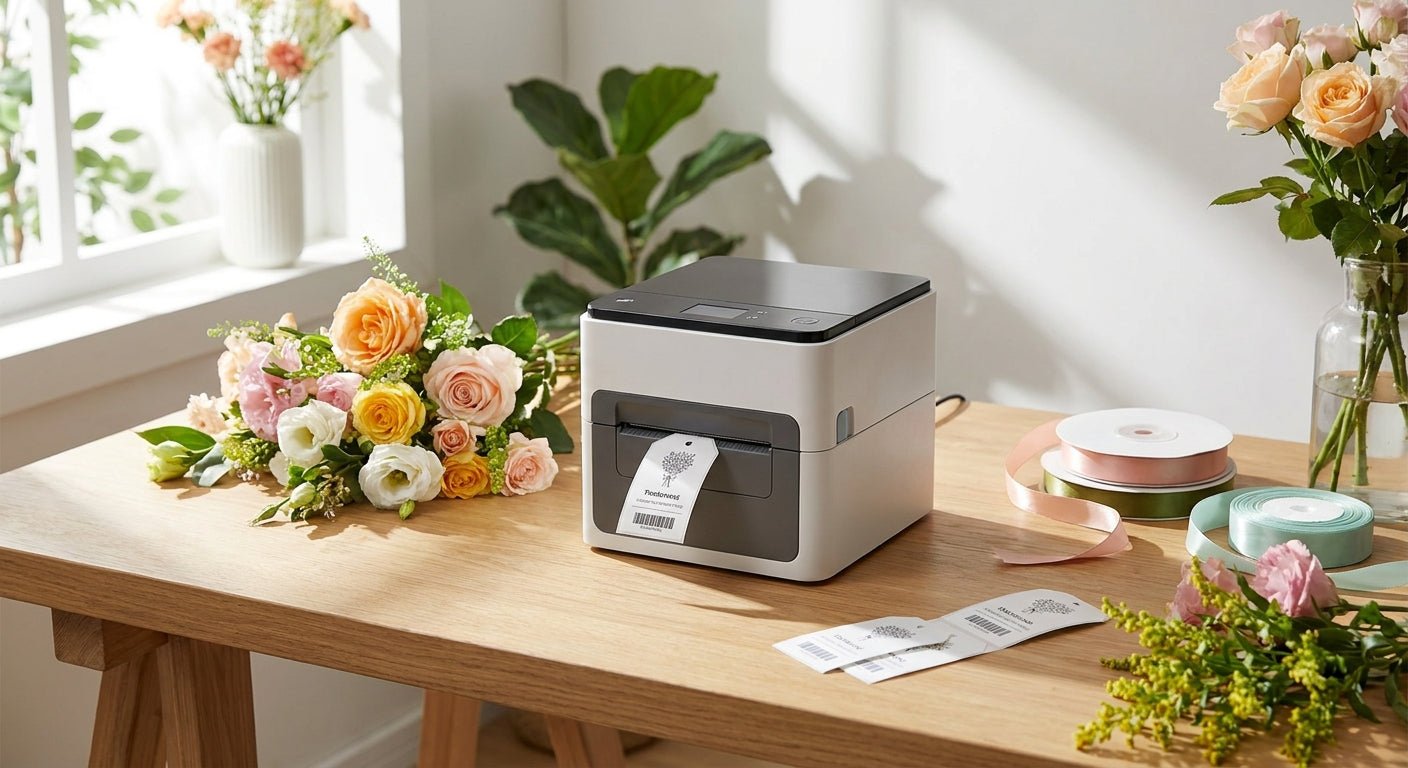
Florists need a label printer that survives cooler condensation, wet stems, and rush mornings before Mother's Day and Valentine's week — not a home-office inkjet that jams on adhesive stock. The best label printer for florists in 2026 handles care tags, price tags, and delivery labels at 203 DPI or better, runs on thermal transfer ribbon so ink doesn't smear when a cooler drips on the label, and keeps up with same-day order volume without a daily reboot.
- GoDEX RT200i is the best label printer for florists on care tags and price stickers at $traditional 203 DPI - buy it for daily counter use.
- GoDEX RT700i+ adds a color display and handles higher order volume for $581 - the workhorse pick for growing shops.
- GoDEX DT230 at 300 DPI is the sharp-QR-code option for shops linking care instructions to a webpage.
- Skip the GoDEX GE330 asset tag printer for floral work - it's built for industrial barcode tags, not flower stem tags.
Why this matters
A florist printing bouquet care tags, price stickers, and delivery labels off a $60 desktop inkjet loses hours a week to jams and smeared ink once humidity climbs above cooler temperature. Thermal printing skips ink cartridges entirely — the printhead burns the image directly onto the label or through a ribbon onto synthetic stock, which is why flower shops, grocery floral departments, and wedding-event florists have shifted to thermal over the last several years.
McAuley Labels builds and sells GoDEX thermal printers alongside the ribbon and label stock that go with them, which matters here: a printer that's wrong for the label material jams just as often as an inkjet does. Getting the pairing right — resolution, ribbon type, and label stock — is the actual decision florists are making in 2026, not just picking a brand name.
How this list is ranked
Each printer below is ranked on three factors that matter specifically for flower shop counters: print resolution against small-text care tags and barcodes, daily-volume durability (standalone keyboard entry vs. tethered to a register PC), and total cost including the ribbon and label consumables that keep it running. Industrial and warehouse-grade printers built for barcode asset tracking get flagged and downgraded here even when the DPI number looks competitive, because floral tags have different adhesive and size needs than warehouse labels. Pricing reflects 2026 listed prices; verdicts assume a single-location flower shop printing 50-300 tags a day.
The ranked list
1. GoDEX RT200i — the everyday care-tag printer
The safe pick for a counter that prints 100-200 care tags and price stickers a day. It runs at 203 DPI, which is sharp enough for care instructions, stem-care icons, and small barcodes without the printer costing four figures. Florists switching off an inkjet notice the jam rate drop first — thermal transfer stock handles cooler humidity that inkjet paper curls under. Verdict: Buy — this is the default recommendation for a single-location flower shop in 2026.
2. GoDEX G500 — the standalone counter unit
The budget-standalone option for a shop that doesn't want the printer tethered to a POS computer. It's built for direct desk use with its own keyboard entry, which matters when a designer at the workbench needs to punch out a quick price tag between arrangements. It trades some print speed for that standalone flexibility. Verdict: Consider — good for a second station or a shop still deciding on full POS integration.
3. GoDEX RT700i+ — the growing-shop workhorse
The wildcard pick once order volume climbs past a single counter. It adds a color display for faster menu navigation between label formats and lists at $581 for 2026 — a step up from entry units but still well under industrial pricing. Shops running two or three arrangement stations during holiday weeks lean on this one because it doesn't choke on back-to-back label batches. Verdict: Buy — the right upgrade once a single RT200i can't keep pace.
4. GoDEX RT730i — the wire-service overflow printer
The pick for florists filling FTD or Teleflora wire orders on top of walk-in traffic, where label volume spikes unpredictably. It's positioned as a wider-format option for shops printing larger delivery labels alongside standard care tags. It's more printer than most single-counter shops need day to day. Verdict: Hold — worth it only once wire-service volume is a real, recurring share of daily orders.
5. GoDEX DT230 — the sharp-QR-code pick
The pick for shops that print QR codes linking to care instructions or subscription reorder pages. Running at 300 DPI, it renders small QR modules and fine barcode lines more reliably than 203 DPI units, which matters once codes get scanned by customer phone cameras in low cooler light. It's the highest-resolution option on this list. Verdict: Consider — buy it specifically if QR-linked care cards are part of the plan for 2026, skip it if tags stay text-only.
6. GoDEX GE330 — the industrial mismatch
This one gets flagged, not recommended. It's built and marketed as an asset tag printer for equipment and inventory barcode tracking — a different job than floral care tags, with different label-width defaults and a workflow tuned for fixed-asset numbering, not daily retail tags. Florists who buy it because the DPI spec looks fine end up fighting label-size mismatches. Verdict: Skip — a category mismatch even at a competitive price.


Comparison table
| Printer | Resolution | Best for | Verdict |
|---|---|---|---|
| GoDEX RT200i | 203 DPI | Daily care tags, single counter | Buy |
| GoDEX G500 | Standard | Standalone second station | Consider |
| GoDEX RT700i+ | 203 DPI | Growing shop, multi-station | Buy |
| GoDEX RT730i | Wide format | Wire-service overflow | Hold |
| GoDEX DT230 | 300 DPI | QR-code care cards | Consider |
| GoDEX GE330 | Industrial | Asset tags (not floral) | Skip |
If the ribbon costs more than the labels it's printing on, the pairing is wrong for the shop.
Where to buy
- Buy the printer and its matching consumables together. A 203 DPI GoDEX unit paired with the wrong ribbon width is the single most common cause of streaky care tags in 2026 shop setups.
- Match ribbon chemistry to label stock. Wax/resin ribbon on synthetic labels holds up against cooler condensation better than paper-label combinations, which matters for anything sitting in a refrigerated case.
- Order a spare ribbon roll with the initial purchase. Running out mid-Saturday during a wedding pickup rush is the failure mode every flower shop owner learns about exactly once.
FAQ
What's the best label printer for florists in 2026?
The GoDEX RT200i is the best label printer for florists running a single-counter shop in 2026, printing care tags and price stickers at 203 DPI without the cost of an industrial unit. Shops with higher volume should look at the GoDEX RT700i+ instead.
Is a 203 DPI printer good enough for flower shop care tags?
Yes, 203 DPI is sharp enough for care instructions, price tags, and standard barcodes on floral labels. Shops printing small QR codes for care-card links should step up to a 300 DPI unit like the GoDEX DT230 instead.
How much does a florist label printer cost?
Entry-level standalone units like the GoDEX G500 sit at the budget end, while the GoDEX RT700i+ lists at $581 for 2026 with a color display and higher throughput. Total cost also depends on ribbon and label stock, which get replaced regularly.
Do florists need thermal transfer or direct thermal printers?
Thermal transfer with a ribbon holds up better against cooler humidity and handles longer-life tags without fading, which is why most flower shop setups use ribbon-based units. Direct thermal skips the ribbon but fades faster in cold, damp storage.
Can I print QR codes on care tags?
Yes, a 300 DPI printer like the GoDEX DT230 renders QR modules cleanly enough for phone-camera scanning in low cooler light. A 203 DPI unit can print QR codes too, but the modules come out less crisp at small sizes.
What labels work with a GoDEX printer for florists?
Thermal transfer paper and polyester label stock both work with GoDEX printers, with polyester holding up better against moisture from wet stems and refrigerated cases. Label width should match the printer's default carriage size to avoid alignment issues.
How often do I need to replace the ribbon?
Ribbon life depends on label volume, but a shop printing 100-200 tags a day typically works through a roll in one to two weeks. Keeping a spare roll on hand avoids a mid-rush stoppage during holiday weekends.
Is a color display necessary for a small flower shop?
No, a color display is a convenience feature for faster label-format switching, not a requirement for basic care-tag printing. Single-counter shops running one label format daily can skip it and save on the GoDEX G500 or RT200i instead.
One last thing
Most florist printer complaints in 2026 aren't about the printer at all — they're a ribbon-to-label mismatch, not a hardware failure. Before troubleshooting a smeared tag, check that the ribbon chemistry matches the label material first; that single fix resolves more service tickets than any firmware update.