
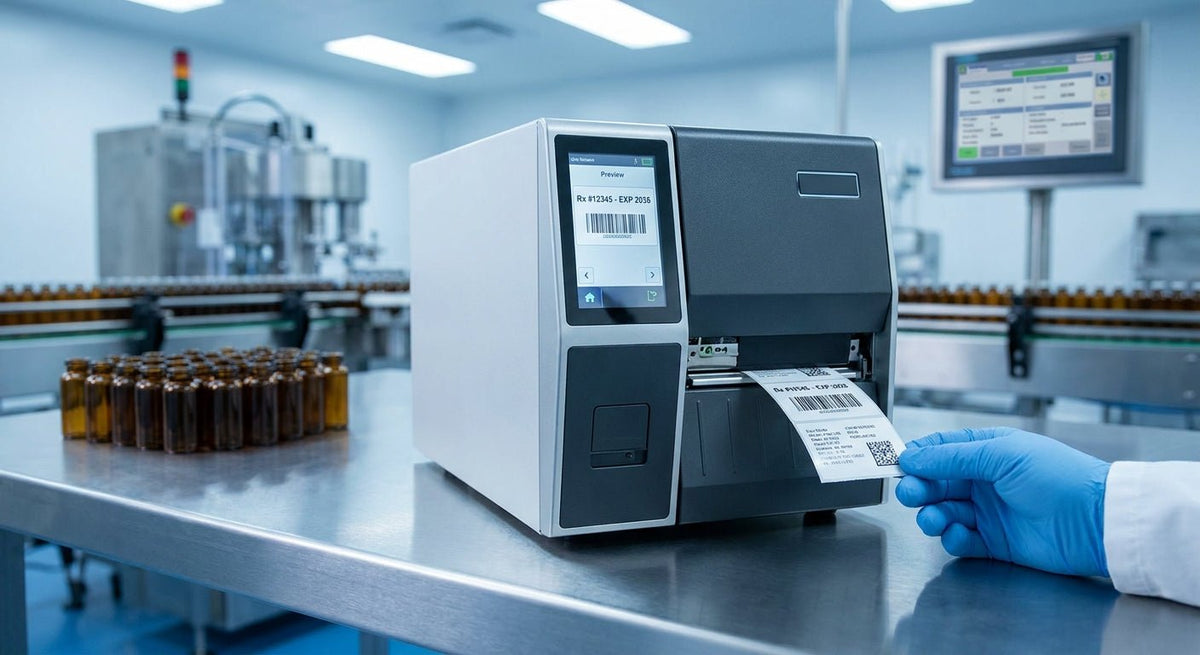
Pharmaceutical label printing has zero tolerance for errors — a smeared barcode or an illegible lot number can trigger an FDA audit, a recall, or a patient safety event. This guide ranks the best label printers for pharmaceutical manufacturing in 2026, covering print resolution, material compatibility, compliance-ready output, and throughput so you can match the right hardware to your operation.
TL;DR: For label printer for pharmaceutical manufacturing in 2026, the Godex RT863i (600 DPI) is the top pick for regulated product labeling where barcodes must pass GS1 verification. The Godex ZX1600i handles high-volume batch runs at 600 DPI with industrial throughput. The Godex RT230i (300 DPI) covers mid-volume needs at a lower entry cost. The Godex AG1000F bottle applicator prints and applies simultaneously — the right call for round-container lines. All four ship from McAuley Labels with US-stocked supply.
Why Resolution and Material Choice Are Compliance Issues
FDA 21 CFR Part 211 and GS1 DataMatrix standards require barcodes to scan at a specific grade. At 203 DPI, a 10-point font on a vial label is marginal at best. At 300 DPI, small-format drug labels become readable. At 600 DPI, GS1-128 and DataMatrix barcodes hit Grade A scan quality on labels as small as 0.5" × 1". That resolution gap is not cosmetic — it determines whether your labels pass incoming QC at a pharmacy or hospital. Separately, pharmaceutical environments demand chemical-resistant media: polyester thermal transfer labels survive isopropyl alcohol wipe-downs; standard paper direct thermal labels do not. Material selection is therefore not a sourcing decision — it is a GMP decision.
How These Printers Were Ranked
Rankings are based on four criteria weighted to pharmaceutical manufacturing requirements: print resolution (DPI) and barcode scan grade, media compatibility (polyester and synthetic thermal transfer support), throughput (inches per second and maximum roll capacity), and form-factor fit (benchtop production line, mobile, or integrated applicator). Printers without thermal transfer capability are excluded — direct thermal output degrades under UV, solvents, and autoclave heat, which are common pharmaceutical conditions. All models listed are available through McAuley Labels in 2026.
Ranked: Best Label Printers for Pharmaceutical Manufacturing in 2026
1. Godex RT863i — 600 DPI Industrial Thermal Transfer
The compliance anchor. The Godex RT863i prints at 600 DPI on a 4-inch print width, producing GS1-128, DataMatrix, and QR codes that hold scan grade on polyester labels as narrow as 0.5 inches. Print speed reaches 4 inches per second at full 600 DPI — fast enough for production-line labeling without dropping resolution. The built-in color display simplifies label template switching between SKUs without a connected PC, which matters on a GMP floor where computer access is controlled.
Pharmaceutical buyers running serialization programs under DSCSA (Drug Supply Chain Security Act) will find the RT863i's resolution non-negotiable for 2D DataMatrix codes on unit-of-use packaging. The RT863i supports ribbon widths up to 110mm and handles media thickness up to 0.254mm — covering metalized polyester and synthetic stocks used for chemical-resistant vial and bottle labels.
Verdict: Buy — the correct choice for any operation printing serialized pharmaceutical labels in 2026.
2. Godex ZX1600i — 600 DPI High-Volume Industrial
The batch-run workhorse. The Godex ZX1600i matches the RT863i on resolution (600 DPI) and adds a larger external roll capacity — up to 8-inch OD rolls — for extended batch runs without re-loading media. Print speed at 600 DPI is 4 IPS. The ZX1600i is engineered for industrial duty cycles, making it the right choice for contract manufacturers or compounding pharmacies printing hundreds of thousands of labels per shift.
The ZX1600i supports Ethernet, USB, and serial connectivity, integrating cleanly into MES or ERP systems that push label data automatically. That matters when human data entry on a GMP floor is a deviation risk.
Verdict: Buy for high-volume pharmaceutical lines printing serialized or regulated labels continuously.
3. Godex RT230i — 300 DPI Mid-Volume Thermal Transfer
The practical mid-range pick. The Godex RT230i runs at 300 DPI on a 2-inch print width, which covers the common 1" × 2" and 1" × 3" label formats used for vials, ampules, and sample tubes. At 5 IPS print speed, throughput is solid for mid-volume operations. 300 DPI produces GS1-128 barcodes that scan reliably on labels down to roughly 0.75 inches wide — adequate for most secondary packaging and unit-dose labels.
For operations that do not require 2D DataMatrix serialization but still need chemical-resistant output, the RT230i paired with polyester thermal transfer media hits GMP requirements at a lower hardware cost than the RT863i. It is not the right call for DSCSA serialization — that needs 600 DPI — but for internal WIP tracking labels, reagent labels, or secondary carton barcodes, the RT230i is purpose-built.
Verdict: Buy for mid-volume pharmaceutical labeling where 2D DataMatrix serialization is not required.
4. Godex AG1000F — Integrated Bottle Applicator at 203 DPI
The round-container specialist. The Godex AG1000F combines a 203 DPI thermal transfer printer with a built-in label applicator designed for cylindrical containers — bottles, vials, and tubes. The integration eliminates the separate applicator station, reducing footprint and the risk of misapplication on round surfaces. At 203 DPI it is limited to larger-format barcodes and Code 39 or Code 128 symbols; it is not suitable for DataMatrix serialization.
For pharmaceutical operations labeling round bottles in 2026 where the primary variable is application accuracy rather than code density, the AG1000F solves a specific production line problem. The same label placed off-center on a round bottle fails automated vision inspection — the AG1000F's applicator mechanism addresses that directly.
Verdict: Buy for round-container pharmaceutical lines; Hold if you need 300 DPI or higher for small-format barcodes.
5. Godex ZX430i — 300 DPI Compact Industrial
The space-constrained line pick. The Godex ZX430i delivers 300 DPI in a compact industrial chassis, fitting cleanly into cleanroom or restricted-space production areas. Print speed is 6 IPS, the highest in this list at 300 DPI. Supports ribbons up to 110mm and media rolls up to 5-inch OD. Ethernet standard.
For pharmaceutical manufacturers with space-restricted filling lines who need 300 DPI thermal transfer output and fast throughput, the ZX430i outpaces the RT230i on speed without stepping up to a 600 DPI system.
Verdict: Buy for space-constrained lines needing 300 DPI at production speed; Hold if 600 DPI serialization is on your roadmap.
Comparison Table
| Printer | DPI | Print Width | Max Speed | Roll Capacity | Best For |
|---|---|---|---|---|---|
| Godex RT863i | 600 | 4 in | 4 IPS | 5 in OD | DSCSA serialization, DataMatrix |
| Godex ZX1600i | 600 | 4 in | 4 IPS | 8 in OD | High-volume batch runs |
| Godex RT230i | 300 | 2 in | 5 IPS | 5 in OD | Vials, ampules, WIP labels |
| Godex AG1000F | 203 | 4 in | 4 IPS | Standard | Round bottle application |
| Godex ZX430i | 300 | 4 in | 6 IPS | 5 in OD | Space-constrained lines |
What to Avoid
Direct thermal printers for any regulated pharmaceutical label. Direct thermal output fades under UV light, heat, and chemical exposure — conditions routine in pharmaceutical storage and distribution. A label that fades in a stability chamber or smears under an IPA wipe is a GMP deviation.
203 DPI printers for serialization. DSCSA unit-level serialization using 2D DataMatrix requires a minimum 300 DPI; 600 DPI is the production standard. A 203 DPI printer cannot produce a DataMatrix code small enough to fit on a vial label and still scan at GS1 Grade C or better.
Printers without Ethernet or serial connectivity. On a GMP floor, wireless-only data paths introduce audit complexity. Printers that cannot integrate directly with an MES or ERP via Ethernet require manual label template management — a human error risk that 21 CFR Part 211 auditors flag.
Where to Source
- McAuley Labels stocks all five printers listed above with US-based fulfillment. Compatible thermal transfer ribbons and polyester label stocks ship alongside hardware — ordering both from one source eliminates media compatibility guesswork.
- Pair any thermal transfer printer with white polyester thermal transfer labels or glossy white polyester stock for chemical resistance. Paper labels are not appropriate for pharmaceutical use.
- For custom-sized pharmaceutical labels or regulated print specifications, McAuley Labels handles custom quote requests directly.
FAQ
What DPI do I need for pharmaceutical label printing? 300 DPI is the minimum for standard Code 128 barcodes on pharmaceutical labels. 600 DPI is required for 2D DataMatrix codes used in DSCSA serialization and for any label smaller than 1 inch wide.
Is thermal transfer better than direct thermal for pharmaceutical labels? Yes. Thermal transfer labels printed with resin or wax-resin ribbon resist chemicals, heat, UV, and moisture. Direct thermal labels degrade under the same conditions and are not suitable for pharmaceutical environments under GMP.
Which label printer meets FDA pharmaceutical labeling requirements in 2026? No printer is FDA-approved by itself — compliance depends on the printer, the label material, the ribbon, and the label management system combined. The Godex RT863i at 600 DPI with polyester media and a resin ribbon produces output that meets GS1 barcode quality standards required under 21 CFR Part 211 and DSCSA.
Can I use a label printer for pharmaceutical manufacturing without connecting it to a PC? Yes. The Godex RT863i and RT700i series include color displays and onboard template storage. On GMP floors where computer access is restricted, standalone operation using pre-loaded templates is a supported workflow.
What label material should I use for pharmaceutical vial labels? White polyester thermal transfer labels with a resin ribbon are the standard. They survive IPA wipe-downs, autoclave proximity, and cold-chain storage. Paper labels are not chemical-resistant and should not be used on pharmaceutical containers.
How fast do pharmaceutical label printers need to be? For manual or semi-automated lines, 4–6 IPS is sufficient. For high-speed automated filling lines, throughput depends on the applicator speed — the printer should print faster than the line moves. The Godex ZX1600i at 4 IPS with an 8-inch roll eliminates frequent media changeovers on continuous runs.
What is DSCSA and which printers support it? DSCSA (Drug Supply Chain Security Act) requires unit-level serialization of prescription drug packages using 2D barcodes (DataMatrix). Printers that support DSCSA serialization need at minimum 300 DPI, and 600 DPI in practice. The Godex RT863i and ZX1600i are the correct hardware choices in 2026.
Do I need a separate label applicator for bottle labeling? For flat-surface labels, a standard thermal transfer printer with a peel-and-present mode is sufficient. For cylindrical bottles and vials, a dedicated applicator or an integrated print-and-apply unit like the Godex AG1000F produces consistent placement and reduces misapplication errors.
One Last Thing
The most common pharmaceutical labeling failure in FDA inspections is not printer hardware — it is media. A 600 DPI printer running paper labels instead of polyester produces output that fails chemical resistance testing and degrades in stability storage. Specify the label stock and ribbon alongside the printer. McAuley Labels supplies polyester thermal transfer media sized for pharmaceutical formats, so hardware and consumables are matched before the first label runs.