
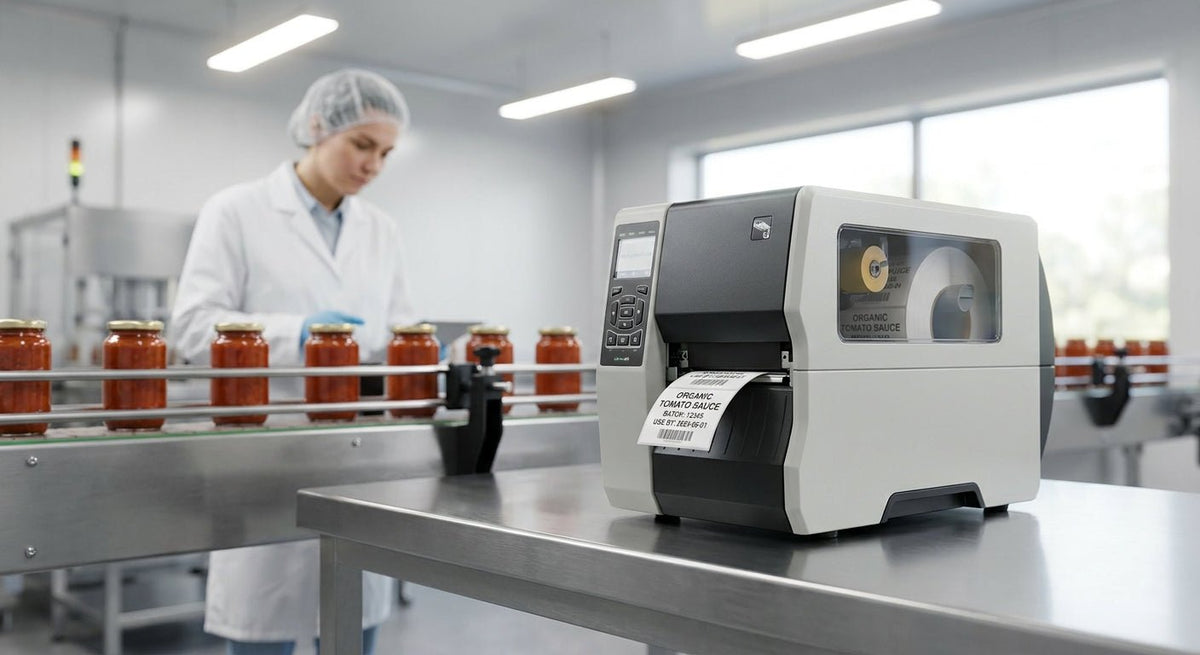
Choosing the right thermal label printer for food manufacturing comes down to three hard requirements: print resolution sharp enough for Nutrition Facts panels and allergen declarations, media handling that survives cold storage and washdown environments, and throughput that keeps pace with a production line.
TL;DR: For thermal label printer for food manufacturing use in 2026, the GoDEX RT863i is the top pick at 600 DPI for high-resolution compliance labels; the GoDEX RT230i at 300 DPI covers mid-volume operations printing ingredient and date-code labels; and the GoDEX RT200 at 203 DPI handles basic date-coding and routing labels on tighter budgets. McAuley Labels carries all three with US-based support and compatible label stock.
Why This Matters in 2026
FDA food labeling rules require legible allergen declarations, net quantity statements, and nutrition information — all on labels that may be 2 inches wide or smaller. A 203 DPI printer that works fine for a shipping carton will produce blurry text at that size. Food facilities also face condensation, humidity, and cleaning chemicals that degrade direct thermal prints faster than most buyers expect. Picking the wrong printer means reprinting, relabeling, or failing an audit. The printers below are ranked on resolution, media compatibility, duty cycle, and connectivity — the four specs that actually matter on a food production floor.
How We Ranked
Every printer on this list is a GoDEX model sold through McAuley Labels in 2026. Rankings weight four criteria:
- Print resolution — minimum 203 DPI considered; 300 DPI and 600 DPI favored for small-format compliance text
- Media width — 4-inch max width accommodates most food packaging label sizes
- Connectivity — USB standard; Ethernet and serial ports valued for line-side integration
- Duty cycle — higher-volume models ranked above light-duty desktop units
Direct thermal and thermal transfer both appear. For food labels that need to survive refrigeration or moisture, thermal transfer (ribbon-based) produces a more durable print than direct thermal. That distinction is called out for each pick.
Ranked: Best Thermal Label Printers for Food Manufacturing
1. GoDEX RT863i — Best for High-Resolution Compliance Labels
The precision pick. The GoDEX RT863i runs at 600 DPI, which is three times the dot density of a standard 203 DPI unit. At that resolution, a 6-point font on a 2-inch nutrition label is readable without a magnifier — and scannable barcodes down to 5-mil width print cleanly.
The RT863i is a thermal transfer printer, meaning it uses ribbon to fuse ink onto the label surface. That matters for food: labels printed with ribbon resist condensation, oils, and the temperature swings between a walk-in cooler and a ambient packing area. The 4-inch print width covers most food product label sizes including jam jars, sauce bottles, and dry goods bags.
Why now in 2026: FDA enforcement of allergen labeling under FALCPA has not relaxed. Any facility co-packing products with tree nuts, sesame, or other major allergens needs legible, durable declarations. A 600 DPI thermal transfer printer is the lowest-risk way to meet that bar in-house.
Verdict: Buy — the right tool if your labels carry Nutrition Facts panels, allergen warnings, or ingredient lists smaller than 8-point type.
2. GoDEX RT230i — Best Mid-Volume Production Printer
The production workhorse. The GoDEX RT230i at 300 DPI hits the practical midpoint for most food manufacturers: resolution high enough for date codes, lot numbers, and ingredient panels at standard label sizes, with a duty cycle suited to continuous line-side use.
300 DPI produces clean Code 128 and GS1-128 barcodes at label widths down to 1 inch — common on portion cups, condiment packets, and individual-serve packaging. The RT230i is a thermal transfer model, so ribbon cost is a factor, but the print longevity on cold-chain labels justifies it. Connectivity includes USB and serial; network options allow integration with ERP or WMS systems that push label data to the printer automatically.
Why now in 2026: Ingredient traceability requirements under FSMA Section 204 took full effect for many food categories. Lot-coded labels tied to your receiving and production records need to be readable at every step — including after time in a refrigerated truck. 300 DPI thermal transfer holds up where direct thermal fades.
Verdict: Buy — the default recommendation for facilities printing date codes, lot numbers, and ingredient labels at production-line volumes.
3. GoDEX RT200 — Best Entry-Level Option
The budget-conscious pick. The GoDEX RT200 at 203 DPI is a thermal transfer desktop printer suited to lower-volume food operations: a cottage food producer scaling up, a small-batch preserves maker, or a secondary labeling station handling case-level routing labels.
203 DPI is adequate for case labels, pallet labels, and simple date-code stickers where text is large enough — typically 10-point and above. It is not recommended for small-format nutrition panels or fine-print allergen declarations. The RT200 supports USB connectivity and standard 4-inch label stock.
Why now in 2026: Entry-level thermal transfer at this price point is the fastest way to bring label production in-house without a significant capital outlay. If your labels are case-level only, the RT200 gets the job done.
Verdict: Buy for case and routing labels; Hold if your SKUs require Nutrition Facts panels at less than 3-inch label width.
4. GoDEX GX4200i — Best for High-Volume Lines
The heavy-duty pick. The GoDEX GX4200i at 203 DPI is built for sustained output at industrial print speeds. The 203 DPI resolution limits it to larger-format labels, but its duty cycle and print speed make it the right choice at packaging lines running hundreds of units per hour.
At this volume, per-label throughput matters more than pixel density. The GX4200i handles wide label stock and runs at speeds suited to automated applicator integrations. Food facilities using case-level SSCC labels or pallet tags will get better uptime from this unit than from a desktop model pushed beyond its rated duty cycle.
Verdict: Buy for high-speed case or pallet labeling; Skip if your primary need is small-format product labels with fine print.
5. GoDEX RT200i — Best for Direct Thermal Date Coding
The no-ribbon option. The GoDEX RT200i at 203 DPI is a direct thermal printer — no ribbon required. Direct thermal works by heat-activating the label coating itself, which lowers consumable cost and reduces changeover time.
The trade-off: direct thermal prints fade when exposed to heat, UV light, or moisture. For food manufacturing, that limits it to applications where labels do not need to survive refrigeration or extended shelf time — think short-date in-plant routing tickets, batch sheets, or internal WIP labels. Do not use direct thermal for any label that ships with the product or sits in cold storage for more than a few days.
Verdict: Consider for internal production routing; Skip for any consumer-facing or cold-chain label.
Comparison Table
| Model | DPI | Print Method | Best Use | Verdict |
|---|---|---|---|---|
| GoDEX RT863i | 600 | Thermal Transfer | Compliance labels, allergen panels | Buy |
| GoDEX RT230i | 300 | Thermal Transfer | Date codes, ingredient labels, line-side | Buy |
| GoDEX RT200 | 203 | Thermal Transfer | Case labels, entry-level production | Buy / Hold |
| GoDEX GX4200i | 203 | Thermal Transfer | High-speed case and pallet labeling | Buy |
| GoDEX RT200i | 203 | Direct Thermal | Internal routing, WIP tickets | Consider / Skip |
What to Avoid
203 DPI on small-format product labels. A 2-inch jar label with a Nutrition Facts panel at 203 DPI produces text that technically exists but fails a legibility check. The FDA does not specify DPI, but it does require "prominent" and "conspicuous" labeling. 203 DPI at small sizes routinely fails that standard in practice.
Direct thermal for refrigerated or frozen products. Direct thermal prints fade at low temperatures and when exposed to condensation — conditions that are constant in cold-chain food production. Any label going into a cooler, freezer, or refrigerated transport needs thermal transfer.
Underpowered duty cycles on high-volume lines. Desktop-class printers rated for light office use will overheat and fail when run continuously on a production line. Check the printer's rated duty cycle (labels per day) against your actual line speed before purchasing.
Where to Buy
- McAuley Labels stocks GoDEX thermal label printers with compatible label stock, including thermal transfer ribbon. All printers are available at mcauleylabels.com.
- Match your printer purchase with the correct ribbon type (wax, wax-resin, or full resin) for your label material — resin ribbon on polyester stock gives the best resistance to moisture and cleaning chemicals in food environments.
- For custom label stock sized to your product, use the custom quote form to specify material, size, and adhesive type before ordering.
FAQ
What is the best thermal label printer for food manufacturing in 2026? The GoDEX RT863i at 600 DPI is the best option for food manufacturers printing compliance labels with Nutrition Facts panels and allergen declarations. For mid-volume date coding and ingredient labels, the GoDEX RT230i at 300 DPI is the practical standard.
Is direct thermal or thermal transfer better for food labels? Thermal transfer is better for food manufacturing. Direct thermal prints fade when exposed to moisture, refrigeration, or heat — all conditions common in food production. Thermal transfer uses ribbon to bond ink to the label surface, producing a print that resists those conditions.
What DPI do I need for a Nutrition Facts panel? 300 DPI is the minimum for a legible Nutrition Facts panel at standard food label sizes. 600 DPI is recommended if your label is under 3 inches wide or if you print 6-point type for fine print disclosures.
Can I use a thermal label printer for GS1 barcodes on food packaging? Yes. GoDEX printers at 300 DPI and above produce scannable GS1-128 and GS1 DataBar barcodes suitable for food retail and distribution. 203 DPI can work for larger barcode sizes but is not reliable at narrow bar widths.
Do thermal label printers work with food-safe label materials? The printer itself does not contact the food — the label stock determines food safety compliance. Use label materials rated for indirect food contact if labels will touch packaging that contacts food. Specify this requirement when ordering label stock.
How fast do thermal label printers print for production lines? Print speed varies by model. Desktop thermal transfer printers typically run 4–6 inches per second. Industrial models like the GoDEX GX4200i run at higher speeds suited to automated line integration. Check the rated IPS (inches per second) against your line output before selecting a model.
What software do GoDEX printers use for food label design? GoDEX printers are compatible with GoLabel software, which supports variable data fields for date codes, lot numbers, and barcodes. They also integrate with Bartender, NiceLabel, and most ERP-connected label management systems via standard printer drivers.
How do I choose between the RT230i and RT863i? Choose the RT863i if your labels are small-format (under 3 inches wide) or include fine-print compliance text. Choose the RT230i if your labels are standard size with readable ingredient and date-code text — it costs less to run and handles most food manufacturing use cases at 300 DPI.
One Last Thing
Thermal transfer ribbon chemistry matters more than most buyers realize. Wax ribbon is cheapest but softens at temperatures above 150°F — a problem if labels pass through a heat tunnel or sit near cooking equipment. Wax-resin handles moderate heat and moisture. Full resin ribbon on polyester label stock is the right spec for any food label that will contact condensation, cleaning agents, or wide temperature swings. Specifying the wrong ribbon costs nothing upfront and everything when labels fail inspection.