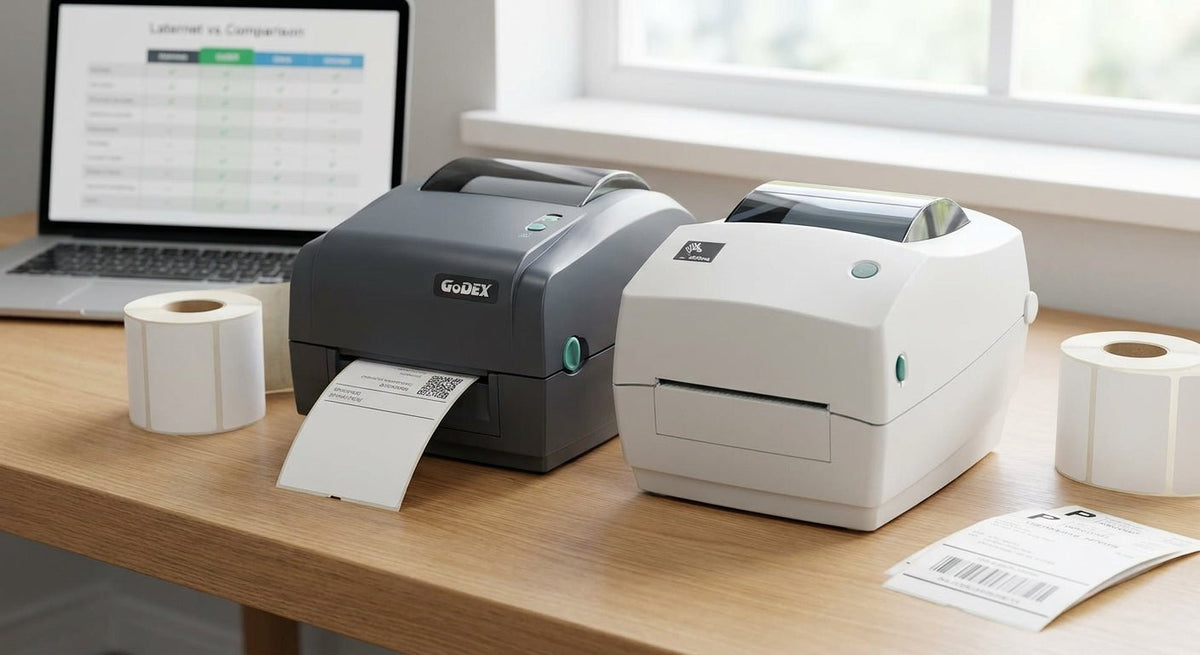
GoDEX and Zebra both make thermal label printers that work — the difference is who pays for that performance and whether the feature set matches what your operation actually needs in 2026.
TL;DR: For the godex vs zebra label printer decision in 2026, GoDEX wins on price-to-spec ratio for most small and mid-size operations — 203, 300, and 600 DPI options available, lower hardware cost, and GoLabel software included. Zebra wins on enterprise ecosystem depth and ZPL compatibility when you're already locked into Zebra's infrastructure. If you're starting fresh or scaling a single-site warehouse, automotive shop, or lab, GoDEX delivers the specs without the enterprise price tag.
Why This Comparison Matters in 2026
Zebra has dominated the enterprise thermal printer market for decades. That reputation carries a premium — hardware, supplies, and support contracts all cost more. GoDEX, a Taiwan-based manufacturer with a growing US distribution presence, now covers virtually the same DPI range (203 to 600), the same media widths (up to 8 inches on wide-format models), and adds features like color touchscreen displays and Ethernet connectivity at price points that undercut Zebra's comparable SKUs. The question isn't which brand is "better" — it's which one fits your volume, budget, and existing software stack.
How We Ranked
This comparison is built on published hardware specifications, software compatibility documentation, and publicly available pricing for 2026 models. Five criteria drove the ranking: print resolution, print speed, connectivity, software ecosystem, and total cost of ownership. Each criterion is weighted against three buyer profiles: light commercial (under 500 labels/day), mid-volume (500–2,000 labels/day), and industrial (2,000+ labels/day). No manufacturer paid for placement.
The Ranked Comparison
1. GoDEX RT230i — Best Mid-Range Pick for Most Buyers
The safe pick for 80% of businesses.
The GoDEX RT230i at 300 DPI prints at 4 inches per second, handles thermal transfer and direct thermal media, and ships with USB, serial, and Ethernet connectivity standard. The 300 DPI output is sharp enough for GS1 barcodes, QR codes, and fine-print compliance labels without requiring any label material upgrades. Zebra's nearest equivalent — the ZD421 at 300 DPI — carries a higher list price for comparable throughput.
For asset tagging, warehouse bin labels, or automotive service stickers printed on-site in 2026, the RT230i hits every spec that matters without the Zebra premium.
Buy.
2. GoDEX RT863i — The Industrial Challenger at 600 DPI
The wildcard for precision-critical applications.
Six hundred DPI is where GoDEX pulls away from Zebra's mid-market line. The GoDEX RT863i at 600 DPI produces print density that rivals much more expensive Zebra industrial models. Pharmaceutical labeling, electronics component marking, and fine-detail product branding all benefit from 600 DPI — at 203 DPI, those same labels look pixelated at small sizes. Zebra offers 600 DPI only in its ZT600 series, which targets enterprise budgets.
If your labels carry dense barcodes, small fonts below 6pt, or regulatory fine print, the RT863i is the only printer in this price band that delivers it. Read more on when 600 DPI is the right call in the 300 DPI vs 600 DPI resolution guide.
Buy for precision applications. Hold for general warehouse use where 300 DPI is sufficient.
3. GoDEX GE300 / GE330 — Entry-Level Asset Tag Printers
The budget entry point that doesn't cut corners on durability.
At 203 DPI and 4-inch print width, the GE300 and GE330 are purpose-built for asset tagging and barcode label workflows where volume is moderate and label complexity is low. Both support thermal transfer printing, which means the output survives heat, moisture, and abrasion — critical when labels go on equipment that lives in warehouses, outdoors, or in vehicle bays. The GE330 adds parallel port connectivity for legacy system compatibility.
Zebra's GK420t covers similar ground but at a higher price per unit. For a school IT department tagging laptops, a facilities team tracking equipment, or a small manufacturer printing inventory labels, the GE300/GE330 pair delivers in 2026 without overspending.
Buy for asset tag and barcode-only workflows.
4. Zebra ZD-Series (ZD421 / ZD621) — The Enterprise Standard
The enterprise default — worth it only if the ecosystem already exists.
Zebra's ZD-series printers are the benchmark for enterprise IT environments running ZPL-based label software. If your ERP, WMS, or shipping platform generates ZPL natively — and your IT team manages a fleet of Zebra printers with remote device management — switching to GoDEX introduces a migration cost that may outweigh hardware savings. Zebra's Link-OS platform, remote management via Zebra's DNA suite, and ZPL/ZPL II language support are deeply embedded in large logistics operations.
For new deployments in 2026 with no legacy ZPL dependency, the price premium is hard to justify on specs alone.
Hold if ZPL ecosystem exists. Wait for new deployments — evaluate GoDEX first.
5. GoDEX ZX1600i — Wide-Format Industrial Option
The niche pick for wide-format and compliance labels.
At 600 DPI with 6-inch print width, the GoDEX ZX1600i at 600 DPI handles compliance panel labels, chemical drum labels, and large-format product identification that 4-inch printers cannot produce. This is a category where Zebra's ZT610 competes — at a significantly higher price point. The ZX1600i supports Ethernet, USB, and serial; runs on GoDEX's EZPL language (which accepts ZPL commands for migration compatibility); and handles media up to 6.5 inches wide.
Buy for wide-format compliance or industrial labeling. Skip for standard 4-inch label workflows.
Comparison Table
| Model | DPI | Print Width | Connectivity | Best For | Verdict |
|---|---|---|---|---|---|
| GoDEX RT230i | 300 | 4 in | USB, Serial, Ethernet | General commercial | Buy |
| GoDEX RT863i | 600 | 4 in | USB, Serial, Ethernet | Precision/pharma | Buy |
| GoDEX GE300/GE330 | 203 | 4 in | USB, Serial (+Parallel GE330) | Asset tags, entry-level | Buy |
| Zebra ZD421 | 203/300 | 4 in | USB, Bluetooth, Ethernet | ZPL-dependent enterprise | Hold/Wait |
| GoDEX ZX1600i | 600 | 6 in | USB, Serial, Ethernet | Wide-format compliance | Buy |
What to Avoid
Buying GoDEX if your WMS outputs ZPL exclusively. GoDEX's EZPL language accepts basic ZPL commands, but complex ZPL templates with advanced field mapping may not translate cleanly. Test your label templates before committing hardware.
Buying Zebra for a single-site operation under 1,000 labels per day in 2026. The hardware cost, ribbon supply cost, and optional support contracts add up fast. The specs don't justify it unless the ecosystem lock-in is already there.
Choosing 203 DPI for fine-print labels. Both brands offer 203 DPI entry models. At 203 DPI, barcodes smaller than 0.5 inches and fonts below 8pt lose scannability and legibility. If your labels include dense data, start at 300 DPI minimum — or 600 DPI for pharmaceutical, electronics, or regulatory applications.
Where to Buy
- GoDEX printers through McAuley Labels: Full GoDEX lineup stocked in the US, with matching label media (direct thermal, thermal transfer paper, and polyester) available in the same order. McAuley Labels manufactures compatible label stock for every GoDEX model, which eliminates the supply chain friction of sourcing printer and media separately.
- Zebra: Available through Zebra's authorized reseller network and major distributors. Factor in the reseller margin — street price often varies 15–25% from list.
- Both brands: Confirm warranty terms before buying. GoDEX units sold through McAuley Labels carry US-based support access.
FAQ
What's the main difference between GoDEX and Zebra label printers? GoDEX delivers comparable DPI options (203, 300, 600) at lower hardware cost. Zebra's advantage is its ZPL language ecosystem and enterprise device management tools — relevant only if you're already running ZPL-based software.
Is GoDEX compatible with ZPL software? GoDEX printers run EZPL, which accepts a subset of ZPL commands. Basic label templates migrate without issue. Complex ZPL with advanced field logic should be tested before a full fleet deployment.
Which printer is better for asset tags in 2026? For asset tag printing, the GoDEX GE300 or GE330 at 203 DPI handles the job cleanly. If your asset tags include dense barcodes or QR codes at small sizes, step up to the RT230i at 300 DPI.
How much does a GoDEX printer cost compared to Zebra? Published pricing varies by model and reseller. As a category, GoDEX thermal transfer printers at comparable DPI and media width typically cost less than equivalent Zebra models — the gap is widest in the industrial 600 DPI tier.
Can GoDEX printers handle thermal transfer and direct thermal? Most GoDEX desktop and industrial models support both modes. The RT and ZX series are thermal transfer-capable; the DT series is direct thermal only. Confirm the specific model before ordering if ribbon-free printing is a requirement.
What DPI do I need for barcodes and QR codes? 203 DPI works for standard barcode labels at 1 inch and above. 300 DPI is the right starting point for QR codes and GS1 barcodes at smaller sizes. 600 DPI is required for pharmaceutical fine-print labels, electronics component marking, and any label with text below 6pt.
Does McAuley Labels sell Zebra printers? McAuley Labels stocks GoDEX printers and compatible label media. The site does not list Zebra hardware.
Which printer wins for a warehouse operation running 1,000 labels per day in 2026? The GoDEX RT230i at 300 DPI or the GoDEX GE330 at 203 DPI covers that volume without issue. At 1,000 labels per day, neither printer approaches its duty cycle limit, and the hardware savings over a comparable Zebra unit compound across a multi-printer deployment.
One Last Thing
GoDEX printers support EZPL, Zebra's ZPL, and Eltron's EPL — meaning if you already have label templates built for a Zebra printer, there's a real chance they print on a GoDEX unit without redesign. That compatibility layer is often the tipping point for buyers who assumed switching brands meant rebuilding their entire label library from scratch in 2026. Test one template first. The answer is usually faster than you expect.