
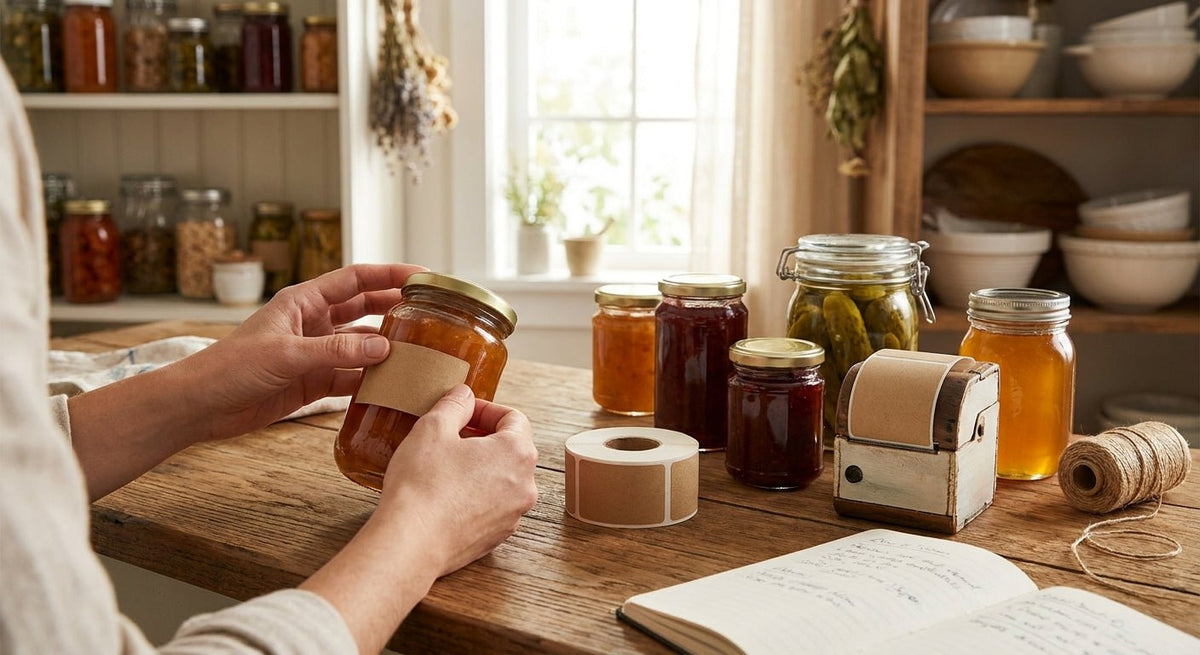
Cottage food labeling laws vary by state, but the core required elements and practical printing approach are consistent across all 50 states in 2026. This guide covers exactly what must appear on your jar labels, how to format them, and how to print them without ordering a new batch every time your recipe or address changes.
TL;DR: To label jars for a cottage food business in 2026, you need at minimum: product name, your full name and home address, net weight or volume, ingredient list in descending order by weight, allergen statement, and the required cottage food disclosure statement (exact wording varies by state). Print on waterproof or water-resistant label stock — condensation destroys paper labels on jam and pickle jars within days. A direct thermal or thermal transfer printer gives you on-demand, per-batch printing without design minimums or reorder delays.
Why This Matters
Cottage food enforcement has increased across the country since 2022. In 2026, at least 14 states require a specific statutory disclosure phrase on every label — missing it is the most common reason cottage food producers get flagged at farmers markets. Beyond compliance, a poorly printed label peels, smears, or fades in a refrigerator, which hurts customer trust and repeat sales. Getting the label right the first time saves you both legal and reputational exposure.
What You'll Need
- Your state's current cottage food law (search "[your state] cottage food law 2026" — laws change annually)
- Label design software (free options: Canva, Avery Design & Print, or the GoLabel software that ships with Godex thermal printers)
- A printer capable of printing on food-safe, water-resistant label stock
- Waterproof or water-resistant label stock in a size that fits your jar lid or body (2" x 4" covers most mason jar bodies; 2" x 2" round fits standard lids)
- A kitchen scale accurate to 0.1 oz for net weight measurements
- Access to your state's required disclosure statement text
Time estimate: 2–4 hours to set up design and print first batch; 15 minutes per reprint run after that.
The Steps
1. Pull Your State's Required Label Elements
Every state has a cottage food statute — some are one page, others run several sections. Download or bookmark the current 2026 version. Create a checklist of the mandatory label fields your state requires. The fields below are required in the majority of states; treat any additional state-specific fields as additive.
Common mistake: Using a label template from a blog post written before 2022. Several states updated their disclosure language in 2023 and 2024. Go directly to your state agriculture department's website.
2. Build Your Label Content Block
Draft the full text of your label before opening any design software. Required elements in most states:
- Product name — descriptive and accurate ("Strawberry Jam," not just "Jam")
- Your full legal name and home address — P.O. boxes are rejected in most states
- Net weight or volume — express in both U.S. customary and metric (e.g., "8 oz (227 g)")
- Ingredient list — all ingredients in descending order by weight, including sub-ingredients of compound ingredients
- Allergen statement — must call out the Big 9: milk, eggs, fish, shellfish, tree nuts, peanuts, wheat, soybeans, sesame
- Cottage food disclosure statement — example from California 2026: "Made in a home kitchen that has not been inspected by the state or local health department." Your state's exact wording is non-negotiable; paraphrasing it fails inspection.
- Best by or use by date (required in some states, best practice everywhere)
Expected outcome: A complete text block you can paste directly into your label design. No scrambling for content mid-design.
Common mistake: Listing ingredients by volume instead of weight. If your jam recipe calls for 2 cups sugar and 1 lb strawberries, strawberries go first on the label because 1 lb (454 g) outweighs 2 cups of sugar (roughly 400 g).
3. Choose Your Label Size and Shape
Measure the jar surface where the label will sit — not just the jar diameter. Mason jars have a curved surface; labels wider than 4" on a standard quart jar will bubble at the edges. For a standard 8 oz mason jar:
- Body label: 2" x 4" rectangle works on most Ball and Kerr jars
- Lid label: 2" circle fits a regular-mouth lid; 2.75" circle fits a wide-mouth lid
If you're selling at a farmers market in cold conditions, account for condensation. Waterproof polyester label stock handles cold and wet environments; standard paper stock does not survive a cooler.
Common mistake: Designing on a 4" x 6" label because that's what's available, then printing text too small to read. Font size below 6pt on a jar label fails both readability and some states' minimum font-size requirements.
4. Design the Label
Keep the layout in two zones: a brand/product zone (top 40% of the label) and a compliance zone (bottom 60%). The compliance zone holds all mandatory text. Resist the urge to shrink the ingredient list to fit a larger logo — inspectors read the ingredient list, not the logo.
Font minimums by element:
- Product name: 14pt minimum
- Ingredient list and allergen statement: 6pt minimum, though 8pt is easier to read
- Disclosure statement: match the ingredient list size — it cannot be smaller than other required text in most states
Use a contrasting background behind all required text. White text on a kraft background fails in low light.
Expected outcome: A print-ready design file (PDF or PNG at 300 DPI minimum) that you can send to a thermal printer or an online label printer.
5. Select a Printing Method
Two practical paths for cottage food operations in 2026:
Option A — On-demand thermal printing. A direct thermal or thermal transfer label printer lets you print 1 label or 500 labels in a single run, change the batch date in seconds, and update your recipe without reordering from a print shop. Thermal transfer printing on polyester stock produces waterproof labels that survive refrigerator condensation. McAuley Labels carries the Godex DT4x direct thermal printer and direct thermal label stock with no ribbon required — both suited to small-batch food labeling where batch dates and ingredient lists change regularly.
Option B — Online custom label printing. Viable for established products with locked recipes and large print runs (500+ labels). Minimum order quantities and 1–2 week lead times make this impractical during the product-development phase. Cost per label drops below $0.10 at quantities of 1,000+, but you absorb the full run cost if the recipe or law changes.
Common mistake: Printing on inkjet or laser paper labels and applying them to jars that will be refrigerated. Inkjet ink runs; toner labels peel in moisture. Neither survives a cold case.
6. Print, Apply, and Inspect
Print one test label before running a full batch. Apply it to a jar, refrigerate for 24 hours, and check for:
- Edge lifting (adhesive failure)
- Smearing (ink not cured or wrong media type)
- Bubbling (label wider than the flat surface area of the jar)
When applying labels to curved jars, start at the center of the label and press outward toward each edge. Remove air bubbles with a credit card edge. Labels applied to clean, dry glass adhere far better than labels applied to jars that still have condensation from washing.
Expected outcome: A label that stays flat, stays readable, and stays on through the product's full shelf life.
7. Keep a Label Version Log
Every time you change a recipe, ingredient source, or address, the label must change. Date-stamp every design file and keep the prior version. If a customer raises a concern about a batch sold six months ago, you need to show exactly what was on that label. Store files as PDFs named with the product name and effective date: strawberry_jam_label_2026-03-01.pdf.
Common mistake: Overwriting the old design file. Keep every version — cottage food enforcement sometimes involves reviewing past batches.
Troubleshooting
Label peels off the jar within 48 hours. The jar surface was wet, oily, or dusty at application. Wipe jars with isopropyl alcohol and let them dry fully before labeling. Also verify you're using a permanent-adhesive label stock, not removable.
Text is blurry or smeared on thermal labels. For direct thermal: you're using the wrong side of the label (thermal coating is on one side only). Flip the stock. For thermal transfer: the ribbon isn't tracking correctly, or print speed is set too high — reduce print speed by one increment in the printer settings.
Disclosure statement doesn't fit on the label. Reduce the logo or product image to make room. The disclosure statement is legally required; the logo is not. If space is genuinely constrained, use a second label on the lid.
Ingredient list is too long for the label. Switch to a taller label format (e.g., 2" x 5" instead of 2" x 4"). Do not abbreviate ingredient names or use shorthand — "HFCS" instead of "high fructose corn syrup" is non-compliant in most states.
Label design prints fine on screen but crops at the printer. Your design canvas size doesn't match the label stock size. In GoLabel or Canva, set the canvas to the exact physical label dimensions before designing — do not resize after the fact.
State inspector says the label is non-compliant but you can't find the error. Contact your state's department of agriculture directly. Most states have a cottage food coordinator who will review a label before you go to market. This costs nothing and prevents a market-day shutdown.
Tools and Resources
- State cottage food law database — Forrager.com maintains a regularly updated map of cottage food laws by state (2026 edition)
- Label design: GoLabel software (free, included with Godex printers), Canva, or Avery Design & Print
- Printer for on-demand jar labels: Direct thermal printers like the Godex DT4x handle label runs from 1 to several hundred without ribbon changes
- Label stock: Waterproof polyester thermal transfer labels or direct thermal labels on a water-resistant liner — see direct thermal printer labels (no ribbon needed) for compatible stock options
- Net weight reference: FDA's food labeling guide, Chapter 5 (available free at FDA.gov)
- Related reading: Custom jar labels for food and beauty products covers label material selection in more depth
What to Do Next
Once your jar label is compliant and printing cleanly, the next step is building a consistent batch documentation system: batch number, production date, label version, and sales channel. That documentation protects you if a customer has a concern and is required for some state cottage food permits that allow direct-to-retailer sales. The same label printer setup used for jar labels handles batch tags and inventory stickers for your storage system.
FAQ
What must be on a cottage food label by law? At minimum: product name, producer's full name and home address, net weight or volume, ingredient list in descending weight order, allergen statement covering the Big 9, and your state's required cottage food disclosure statement. Some states also require a best-by date and the permit or registration number.
Can I handwrite my cottage food jar labels? Yes, in most states — handwritten labels are technically legal as long as all required information is present and legible. In practice, handwritten labels look unprofessional at markets and are harder to reproduce consistently. Printed labels take the same information and make it readable, consistent, and credible.
What size label fits a standard mason jar? A 2" x 4" rectangle fits most standard-mouth 8 oz and 16 oz mason jar bodies. A 2" circle fits a regular-mouth lid; 2.75" fits a wide-mouth lid. Always measure your specific jar and check the label against a curved surface before printing a full batch.
Do cottage food labels need to be waterproof? Not legally required in most states, but practically necessary. Labels on jam, pickle, salsa, or any refrigerated product will encounter condensation. Paper labels soak through and peel within days in a cooler. Waterproof polyester or vinyl label stock on a thermal transfer printer solves this permanently.
Is there a font size requirement for cottage food labels? Some states specify a minimum font size for certain fields. Even where no minimum is codified, FDA food labeling guidance recommends nothing below 6pt for ingredient lists. Use 8pt as a practical floor — anything smaller is illegible on a curved jar surface.
How often do I need to update my cottage food label? Every time the recipe changes (any ingredient added, removed, or substituted), your address changes, or your state updates its required disclosure language. In 2026, several states are mid-cycle on cottage food law revisions — check your state's department of agriculture website at least once per year.
Can I sell cottage food jars online with shipped delivery? Depends entirely on your state. As of 2026, roughly half of states allow internet sales with direct-to-consumer shipping; the other half restrict cottage food to in-person sales only. Your label does not change based on sales channel, but your permit or registration may.
What's the cheapest way to print cottage food jar labels? For small batches (under 100 jars), a direct thermal printer and compatible label stock costs less per label than ordering from an online print shop, and you print on demand. For large, locked batches (500+ jars of an unchanged product), online print shops drop below $0.10 per label at volume.
One Last Thing
The single most overlooked item on cottage food labels in 2026 is the allergen statement for sesame. The FASTER Act added sesame as the 9th major allergen, effective January 1, 2023. Many cottage food label templates still circulating online predate that change and list only 8 allergens. If sesame or sesame oil appears in your product — tahini, some spice blends, certain baked goods — it must be declared. Even if your product contains no sesame, review your template to confirm it was updated post-2023.