
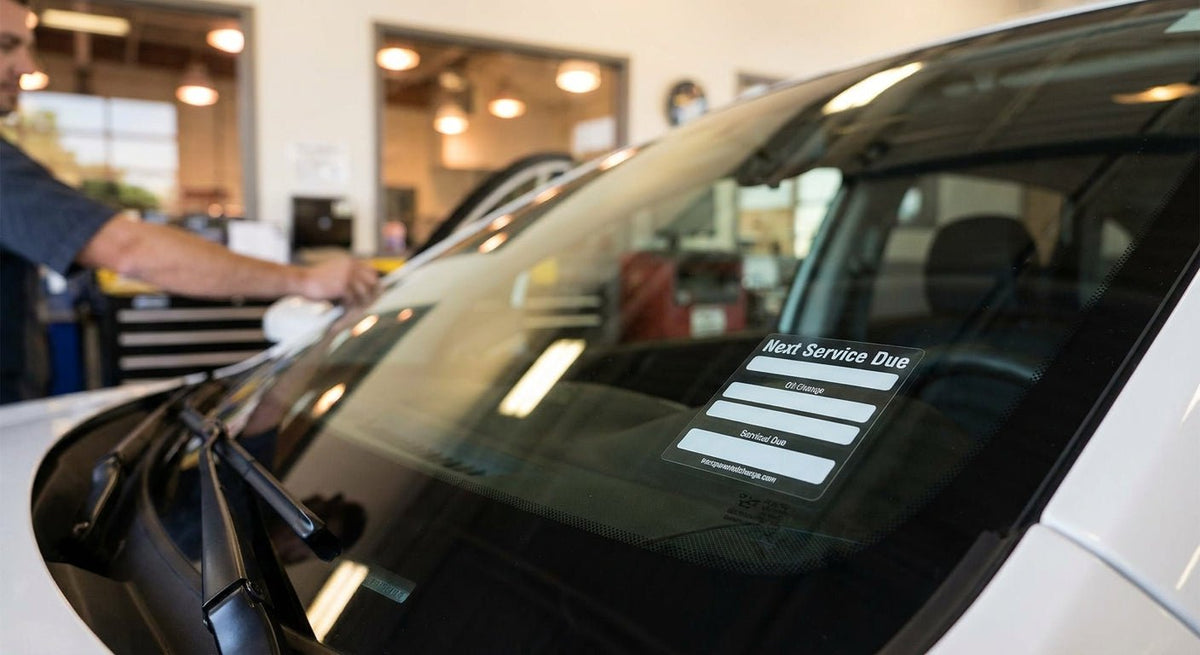
Oil change stickers for quick lube shops serve one job: remind the customer when to come back and make your shop look like the professional operation it is. This guide covers what to look for in a sticker, what options McAuley Labels offers in 2026, and what to avoid when you are buying for a high-volume quick lube environment.
TL;DR: Quick lube shops need oil change stickers that stick to cold glass, print fast, carry your brand, and survive a car wash. In 2026, the strongest options are custom-printed static cling or adhesive windshield stickers with your logo and a preprinted mileage/date field. McAuley Labels manufactures both oil change stickers with custom text and a dedicated oil change sticker printer system built for shops that want to print in-house. If you do more than 30 oil changes a day, print in-house. If you do fewer, pre-printed rolls shipped to you are fine.
Why This Matters in 2026
The average driver forgets their next oil change interval within 3 weeks of leaving your shop. A windshield sticker at eye level — top-left corner of the glass — is the only retention tool that costs less than $0.10 per car and works every time the driver looks through the windshield. For quick lube shops competing against chains like Jiffy Lube and Valvoline Instant Oil Change, a branded sticker is also the cheapest brand impression you will ever buy: every time a customer drives, your logo rides with them.
Who This Is For
This guide is written for quick lube shop owners and managers running 20 to 200+ oil changes per day. You are not a full-service garage doing occasional oil changes — you are a volume operation where throughput is the business model. Every extra second per car costs money. You need stickers that go on fast, print fast, and do not require a technician to stop and think.
What to Look for in Oil Change Stickers for Quick Lube
Adhesion to Cold, Dirty Glass
A sticker that lifts off the windshield after one cold morning is useless. Look for stickers rated for temperatures from -20°F to 150°F. Static cling versions avoid the residue problem but need clean glass; pressure-sensitive adhesive versions grip better in all conditions. For quick lube volumes, pressure-sensitive adhesive on the upper-left windshield corner is the standard.
Legibility at a Glance
The sticker must be readable in 2 seconds from the driver's seat. That means a minimum font size of 14pt for the mileage number, high contrast (black on white or dark ink on a colored field), and no more than 4 data fields on the face. Shops that cram in 8 fields of small text see customers ignore the sticker entirely.
Print Speed Compatibility
In a quick lube bay, a sticker should be ready before the car is done draining. In 2026, direct thermal and thermal transfer printers can produce a finished oil change sticker in under 4 seconds per label. If you are hand-writing stickers or running a slow inkjet, you are creating a bottleneck. A purpose-built printer system — the kind McAuley Labels manufactures — pairs a Godex thermal printer with preloaded label stock so your tech just enters the mileage and hits print.
Custom Branding
Your shop name, phone number, and logo on the sticker keep your brand in the customer's line of sight until the next service. Generic pre-printed stickers with no branding do the reminder job but give away the brand impression to nobody. In a quick lube market where repeat business drives profitability, that brand impression is the point of the sticker.
QR Code Capability
In 2026, QR codes on oil change stickers let customers book their next appointment directly from the windshield. Shops that have added QR codes to their stickers report higher online booking rates compared to phone-only reminders. The QR code links to your scheduling page, a loyalty program, or a Google review prompt. McAuley Labels offers oil change stickers for windshield with QR code and custom logo for shops that want this capability pre-printed.
Durability Through a Car Wash
A quick lube customer will run their car through a wash within 30 days of service in most markets. Your sticker needs to survive water, soap, and brushes. Look for a laminated face or a polyester substrate rather than uncoated paper stock. Uncoated paper yellows and peels within 2 weeks in a hot car, which makes your shop look careless.
Top Picks for Quick Lube Shops
The In-House Printing System — Best for High Volume
The operational pick. If your shop does 50+ oil changes per day in 2026, printing stickers in-house pays for itself faster than most shop owners expect. McAuley Labels builds a complete oil change sticker printer system that ships with 1,000 custom labels preloaded, a thermal transfer ribbon, and a standalone keyboard so no computer is needed at the bay. The tech types in the mileage and date, presses print, and the sticker is done in under 5 seconds.
- Best for: shops with 2+ bays and consistent daily volume
- Substrate: thermal transfer on a durable label stock
- Verdict: Buy if you are doing more than 30 cars a day
Custom Text Pre-Printed Rolls — Best for Single-Bay Shops
The simple pick. If you do not want to manage a printer at the bay, pre-printed rolls with your shop name, phone number, and blank fields for date and mileage work well. A technician fills in the two fields by hand in under 10 seconds. McAuley Labels' oil change stickers with custom text ship on rolls sized for quick application.
- Best for: shops under 30 oil changes per day
- Substrate: pressure-sensitive adhesive
- Verdict: Buy for low-volume operations, Consider upgrading to in-house printing above 30 cars per day
QR Code Windshield Stickers — Best for Shops Pushing Digital Booking
The forward-looking pick. Adding a QR code to the sticker converts a passive reminder into an active booking tool. A customer sitting at a light can scan the code and book their next appointment in under 60 seconds. This matters most in 2026 for shops competing with chains that have aggressive app-based booking. The sticker does double duty: reminder plus re-acquisition.
- Best for: shops with an online booking system or loyalty program
- Substrate: laminated face for car-wash durability
- Verdict: Buy if you have the booking infrastructure to back it up
What to Avoid
- Generic white paper stickers with no lamination. They peel within 2 weeks in summer heat, which tells the customer your shop cuts corners. If the sticker looks cheap, your shop looks cheap.
- Multi-field sticker designs crammed with data. More than 4 fields — next date, next mileage, shop name, phone — and the sticker becomes unreadable at a glance. Customers stop looking at it.
- Inkjet-printed stickers. Inkjet ink fades and bleeds when wet. A car wash in the first month can render the sticker unreadable. In 2026, direct thermal or thermal transfer is the only print technology worth using for oil change stickers.
Comparison Table
| Option | Best Volume | Branding | QR Code | Durability | Verdict |
|---|---|---|---|---|---|
| In-house printer system | 30–200+/day | Full custom | Optional | High | Buy |
| Custom text pre-printed rolls | Under 30/day | Full custom | No | Medium-High | Buy |
| QR code windshield stickers | Any volume | Full custom | Yes | High (laminated) | Buy with booking system |
| Generic unbranded stickers | Any | None | No | Low | Skip |
FAQ
What are oil change stickers for quick lube shops made of? Most are made from pressure-sensitive adhesive label stock in either paper or polyester. Polyester lasts longer and handles heat and moisture better. In 2026, thermal transfer printing on polyester stock is the most durable combination available for quick lube environments.
How long do oil change windshield stickers last? A laminated or polyester sticker lasts 12 months or longer on a windshield. Uncoated paper stickers typically degrade within 4 to 8 weeks in high-heat or high-humidity climates.
Can I print oil change stickers in my quick lube shop? Yes. A thermal transfer printer paired with the right label stock prints a finished sticker in under 5 seconds. McAuley Labels sells a complete printer system preloaded with 1,000 custom labels and a standalone keyboard — no computer required at the bay.
What information should an oil change sticker include? Four fields cover everything a customer needs: next service date, next service mileage, shop name, and shop phone number. Adding a QR code for online booking is the most useful fifth element in 2026. Skip oil type, viscosity grade, and technician initials — customers do not act on that information from the windshield.
What size are oil change stickers for windshields? The standard is 2.5" x 1.5" or 3" x 2" for windshield corner placement. Larger formats up to 3" x 4" are used by some shops for easier readability, especially for QR codes.
Are static cling or adhesive oil change stickers better for quick lube? Adhesive stickers are more reliable for quick lube volumes because they do not require perfectly clean glass to stick. Static cling works well in controlled environments but can fall off if the glass has any road film. For a shop turning cars quickly, adhesive is the safer default.
How many oil change stickers come on a roll? Typically 250 to 1,000 per roll depending on label size and supplier. McAuley Labels' in-house printer system ships with 1,000 labels preloaded.
Can I put my logo on oil change stickers? Yes. McAuley Labels offers custom logo options on both pre-printed rolls and in-house printable stock. Your logo, shop name, phone number, and color scheme can all be incorporated.
One Last Thing
The placement of the sticker matters almost as much as the sticker itself. The top-left corner of the windshield, inside the vehicle, is where the driver's eye naturally travels before pulling into traffic. Shops that place stickers low on the windshield or on the door jamb see significantly lower customer recall at service interval. Train every tech to place it in the same spot, every car, every time — consistency in placement is what builds the habit in the customer's memory.