
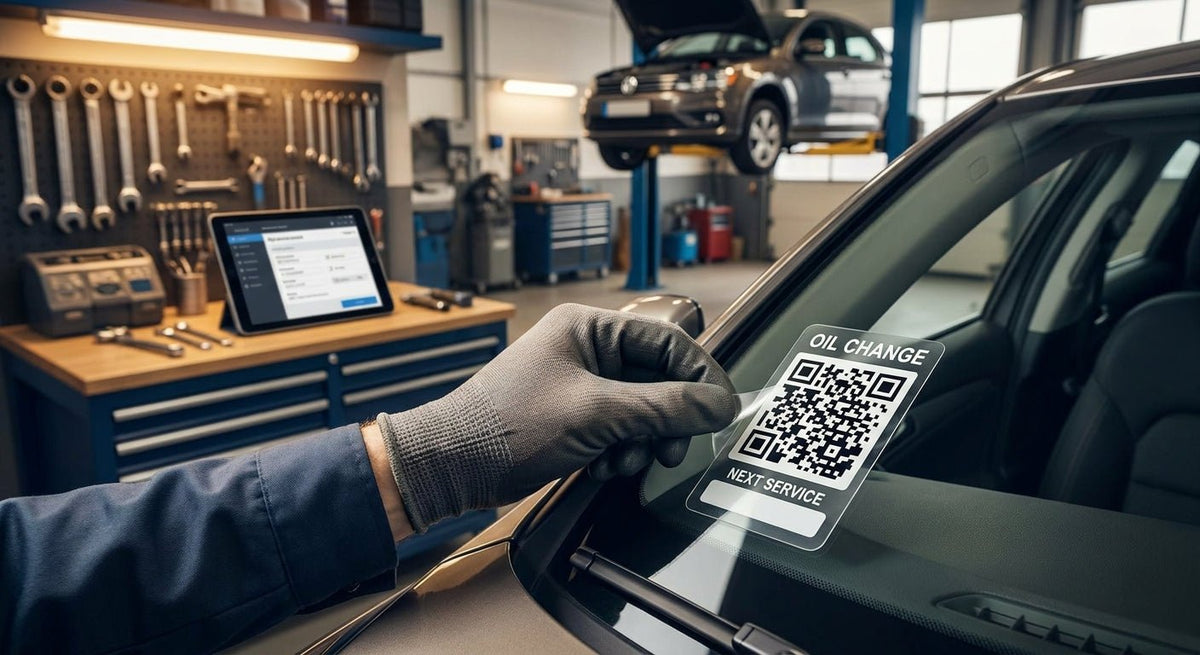
QR code oil change stickers give independent mechanics a way to brand every windshield, log service data digitally, and remind customers when they're due back — all from a sticker the size of a business card. This guide covers who benefits most, what specs matter, and which options from McAuley Labels fit a one- or two-bay shop in 2026.
TL;DR: Independent mechanics get the most value from QR code oil change stickers when the QR encodes a live service URL and the sticker carries the shop logo. McAuley Labels' oil change stickers for windshield with QR code print at 300 DPI minimum, adhere to glass year-round, and include custom logo placement — the right choice for a solo shop competing on professionalism in 2026.
Why This Matters for Independent Shops in 2026
Chain lube operations spend thousands on branded touchpoints. An independent mechanic's most visible branded asset after the car leaves the lot is the windshield sticker. A plain sticker says you changed the oil. A QR code oil change sticker for independent mechanics says you run a trackable, tech-forward shop — and gives the customer a tap-to-book return visit. The difference costs less than a cent per sticker.
Who This Is For
This guide is for the owner-operator running 1–4 bays: you do the work, you order supplies, and you want stickers that look sharp without a design degree or a $500 printer. You're not buying 50,000 stickers a month, but you want every sticker to carry your logo, your phone number, and a QR code that links to your booking page, Google review profile, or service record. You care about adhesion (stickers that fall off are worse than no sticker), print clarity, and turnaround time from a US supplier.
What to Look for in QR Code Oil Change Stickers for Independent Mechanics
Print Resolution: 300 DPI Minimum for Scannable QR Codes
A QR code printed below 203 DPI will scan unreliably in direct sunlight on a curved windshield. 300 DPI is the practical floor for a module size under 3mm. If you're encoding a long URL with error correction, 600 DPI gives you margin. McAuley Labels' thermal printers print at 203, 300, and 600 DPI — match the resolution to your QR code's data density before ordering.
Adhesive Type: Permanent Adhesive for Glass, Not Repositionable
Windshield stickers face 140°F dashboard heat in summer and sub-zero flex in winter. Repositionable adhesives yellow, curl, and drop off within 90 days. Permanent adhesive rated for glass holds through temperature swings without leaving residue when the customer peels it at the next service. Specify glass-rated adhesive when ordering — it is not the default on all label stock.
Material: Semi-Gloss White or Clear Film for Windshield Use
Semi-gloss white is the standard for oil change stickers: high contrast for text and QR code, opaque enough to block glare bleed-through from outside. Clear film is the right call if you want the sticker to look "embedded" in the glass. Avoid matte stock on windshields — it traps dirt in the texture and the QR code contrast drops over weeks.
Custom Logo Placement: Your Brand, Not a Generic Template
A QR code sticker with no logo is a missed brand impression on every car you service. For an independent shop in 2026, the logo is the differentiator. McAuley Labels prints your logo directly on the sticker — not a sticker-over-sticker workaround. Confirm that logo placement is included in the base order, not an add-on SKU.
QR Code Destination: Dynamic vs. Static
A static QR code encodes a fixed URL at print time — if your booking page URL changes, the sticker is useless. A dynamic QR code points to a redirect URL you control; update the destination without reprinting. For a shop ordering 500–2,000 stickers at a time, dynamic QR codes are worth the small monthly cost of a QR management service. Print the QR code at 300 DPI or higher regardless of which type you use.
Minimum Order Quantity and Turnaround
A single-bay shop goes through roughly 20–40 stickers a week — around 1,000–2,000 per year. Ordering in bulk drops per-unit cost, but only if you have storage and don't redesign the sticker mid-year. McAuley Labels ships from the US, which cuts transit time vs. overseas printers. Check whether the minimum order matches your 90-day usage so you're not warehousing six months of stock.
Top Picks for Independent Mechanics
The Direct Buy: Pre-Printed Custom QR Code Stickers from McAuley Labels
The practical pick for shops that don't want to manage a printer.
McAuley Labels manufactures oil change stickers for windshield with QR code and custom logo purpose-built for this use case. You supply the logo and QR code destination; they handle layout, print quality, and US shipping. Semi-gloss white stock, permanent glass adhesive, logo placement included. No template fee on standard orders in 2026.
- Spec that matters: QR code printed at resolution sufficient for reliable windshield scanning
- Concrete detail: Ships from the US — no 3–4 week overseas wait
- Verdict: Buy. This is the lowest-friction path for a shop that wants professional stickers without managing print hardware.
The In-House Option: Custom Logo Stickers + Thermal Printer
The right move if you want same-day reprints and full control.
Pairing oil change stickers with custom logo stock with an in-house thermal printer lets you update the next-service date and QR code destination on demand. A 300 DPI thermal printer handles QR codes cleanly at oil change sticker dimensions. The upfront cost is higher, but per-sticker cost drops significantly at volume. In 2026, in-house printing makes sense at roughly 150+ stickers per month.
- Spec that matters: 300 DPI minimum for scannable QR output
- Concrete detail: In-house setup eliminates reorder lead time entirely
- Verdict: Consider if your monthly volume justifies the printer investment. Skip if you run fewer than 100 stickers a month.
The Wildcard: Static Cling Format
For shops that serve customers who want sticker-free glass.
Static cling oil change stickers use no adhesive — they cling electrostatically to the inside of the windshield. The customer removes them cleanly without residue. QR codes print fine on static cling stock at 300 DPI. The tradeoff: static cling repositions, so a bump or vibration can shift the sticker. This is the right format for high-end detailing adjacent shops or customers who explicitly object to adhesive stickers on their glass.
- Spec that matters: Interior-mount placement (driver-side upper corner) reduces vibration shift
- Concrete detail: No adhesive residue at removal — relevant for customers with new vehicles
- Verdict: Consider for specific customer segments. Not a replacement for permanent adhesive as the shop default.
What to Avoid
-
Generic thermal labels not rated for windshield use. Standard shipping label stock (4×6 direct thermal) will yellow and delaminate on glass within 30 days. The adhesive is not formulated for the thermal cycling a windshield sees. Windshield sticker stock is a distinct product — don't substitute.
-
QR codes generated at low resolution and scaled up. A 100×100 pixel QR code stretched to 1.5 inches looks pixelated and fails on curved glass in low light. Generate at final print size from the start: 300 DPI at 1.5 inches means a 450×450 pixel source image minimum.
-
Stickers without your shop name or phone number. A QR code is useful but not sufficient. If the customer's phone is dead or the QR link returns a 404, the sticker needs a human-readable fallback — your name and number. Treat the QR code as the primary CTA and the text as the backup.
Verdict Comparison Table
| Option | Logo Included | QR Code Ready | Adhesive Type | Best For | Verdict |
|---|---|---|---|---|---|
| McAuley Labels pre-printed QR stickers | Yes | Yes | Permanent glass | Shops avoiding printer hardware | Buy |
| In-house thermal + custom logo stock | Yes | Yes (at 300+ DPI) | Permanent glass | High-volume shops (150+/mo) | Consider |
| Static cling QR stickers | Yes | Yes | None (static) | Residue-sensitive customers | Consider |
| Generic thermal labels (non-windshield) | No | Marginal | Standard paper | Nothing on a windshield | Skip |
FAQ
What's the best QR code oil change sticker for an independent mechanic in 2026? McAuley Labels' windshield QR stickers with custom logo are the direct answer — permanent glass adhesive, logo placement, and US shipping. For shops at 150+ stickers per month, pairing their custom logo stock with an in-house 300 DPI thermal printer lowers per-unit cost over time.
Will a QR code on an oil change sticker actually scan from a windshield? Yes, at 300 DPI or higher with a minimum module size of 3mm. The scan angle through glass is not an issue for modern smartphone cameras. Low resolution (under 203 DPI) and dirty windshield glass are the two most common failure points.
How much do QR code oil change stickers cost for a small shop? Pre-printed custom stickers from a US manufacturer run roughly $0.10–$0.25 per sticker at quantities of 500–2,000 units. In-house printing with a thermal printer drops that closer to $0.03–$0.05 per sticker at volume, excluding the one-time printer cost.
Do I need a special printer to print QR code oil change stickers? Yes — a thermal printer rated at 300 DPI minimum. Standard inkjet or laser output on adhesive stock works but fades faster and is not rated for windshield heat exposure. Direct thermal or thermal transfer on windshield-rated label stock is the reliable setup in 2026.
Can I put my shop logo on QR code oil change stickers? Yes. McAuley Labels includes custom logo placement on their windshield QR sticker product. You supply the logo file; they handle layout and print. No separate design fee on standard orders.
What should the QR code on my oil change sticker link to? A booking page, Google Business profile, or a short URL you control. Use a dynamic QR code (via a redirect service) so you can update the destination without reprinting the sticker run. A static QR linking to a URL you can't change is the most common mistake shops make in 2026.
How do static cling stickers compare to adhesive for QR codes? Static cling prints QR codes at the same quality as adhesive stock. The difference is adhesion: permanent adhesive holds through heat cycles, static cling can shift. Use static cling when customers object to adhesive residue; use permanent adhesive as the shop default.
What's the minimum order for custom QR code oil change stickers? This varies by supplier. McAuley Labels ships direct to US shops — check the product page for current MOQ and per-roll pricing. A solo-bay shop typically orders 500–1,000 at a time to balance per-unit cost against storage.
One Last Thing
The QR code on a windshield sticker is scanned most often while the customer is sitting in the waiting area or parked at home a week after service — not in the shop. That means your QR destination should load fast on mobile with no login wall. A Google Business profile or a direct-to-booking URL clears that bar. A website homepage that loads in 4 seconds on mobile does not. The sticker is only as useful as the page it points to.