
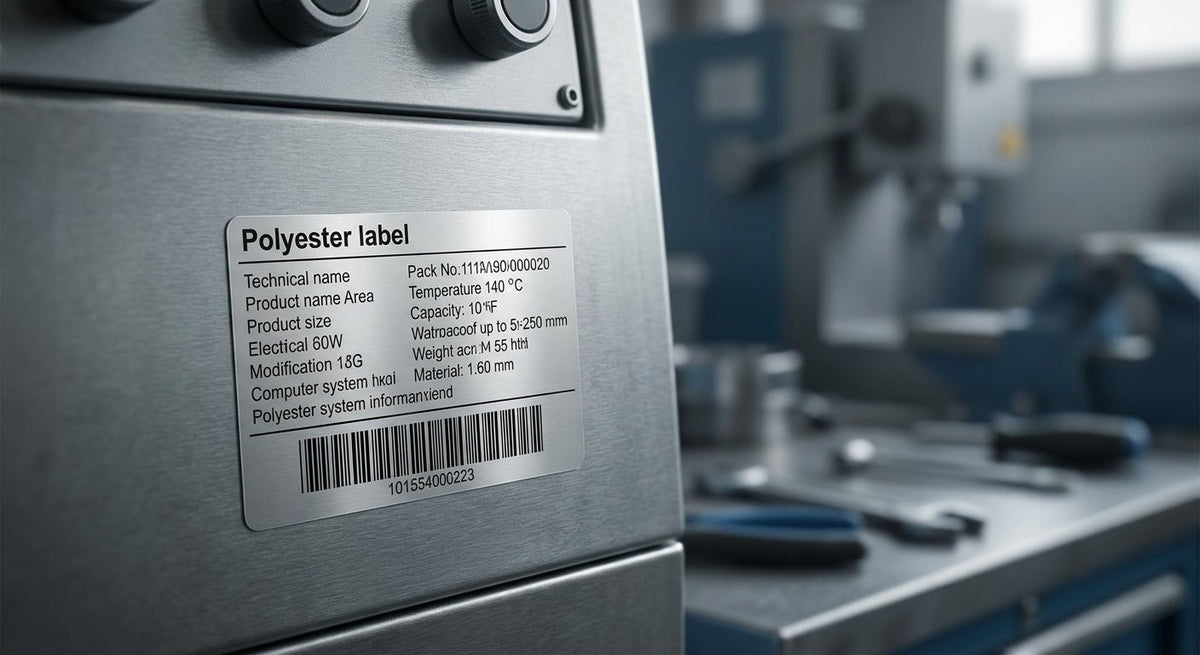
Silver polyester labels for industrial equipment are the go-to choice when paper labels fail — and in manufacturing, they fail fast. This guide covers who needs metallized silver polyester, what specs actually matter, which McAuley Labels products fit which use case, and the mistakes that send buyers back to square one.
TL;DR: Silver polyester labels for industrial equipment outperform paper on abrasion, chemicals, and heat. In 2026, the right pick depends on three variables: surface type, scan requirement (barcode vs. QR vs. ID-only), and whether the asset lives outdoors. McAuley Labels' metallized silver asset tags cover all three scenarios with pre-cut stock ready to apply or print. If you're labeling metal equipment, custom QR code asset tags in metalized silver polyester are the most versatile starting point in 2026.
Why This Matters
In a manufacturing facility, a failed label is not a minor inconvenience — it's a broken audit trail. OSHA and ISO 55000 both require assets to be identifiable throughout their lifecycle. Paper labels on a CNC machine, a forklift, or an outdoor compressor typically degrade within 90 days of installation. Metallized silver polyester, by contrast, is rated for 5 to 10 years of indoor or sheltered outdoor use, and heavy-duty variants with 3M adhesive handle direct moisture and UV exposure beyond that.
The 220 monthly searches for "silver polyester labels for industrial equipment" are almost entirely from ops managers, facilities leads, and IT asset coordinators who already know paper failed them. This page gives them the comparison they need to buy correctly the first time.
Who This Is For
This guide is written for operations managers, facilities coordinators, and IT asset teams in manufacturing, warehousing, and heavy industry. If you're tagging machinery, production-floor equipment, server racks, HVAC units, or outdoor infrastructure — and you need those tags to survive heat cycling, cleaning solvents, and rough handling for years without reprinting — you're in the right place. This is not for light-duty office labeling or short-run retail use.
What to Look for in Silver Polyester Labels for Industrial Equipment
Facestock Material: Metallized vs. Heavy-Duty
Standard metallized silver polyester is a thin, flexible film laminated with a metallic finish. It reads cleanly under barcode scanners and holds thermal transfer printing without smearing. Heavy-duty variants add a thicker gauge — sometimes with a 3M pressure-sensitive adhesive backing — for surfaces that flex, vibrate, or reach temperatures above 150°F. If your equipment runs hot or gets power-washed, heavy-duty is not optional.
Adhesive Strength and Surface Compatibility
The adhesive matters as much as the facestock. Smooth powder-coated steel takes standard acrylic adhesives well. Raw metal, textured paint, or low-surface-energy plastics need aggressive permanent adhesives. In 2026, 3M-backed asset tags set the benchmark for industrial adhesive performance — they bond on contact and resist plasticizer migration that causes cheaper adhesives to fail within months.
Scan Format: Barcode, QR Code, or ID-Only
All three formats work on silver polyester, but they serve different workflows. Linear barcodes (Code 128, Code 39) are fastest for handheld scanner workflows in high-throughput environments. QR codes allow more data density and work with smartphone cameras — useful when field technicians don't carry dedicated scanners. ID-only labels (sequential numbering, no scan element) suit assets tracked in a manual logbook or CMMS by visual lookup. Pick the format your existing system reads, not the one that looks best.
UV and Chemical Resistance
Indoor equipment near wash-down stations, outdoor machinery, and anything in a chemical plant needs labels rated for UV exposure and solvent resistance. Metallized polyester inherently resists water and most mild chemicals. For aggressive environments — battery acid, machine oils, industrial cleaners — confirm the topcoat spec. Labels without a protective topcoat will lose print clarity within 12 months in those conditions.
Print Method Compatibility
Silver polyester requires thermal transfer printing — a ribbon deposits ink that bonds permanently to the facestock. Direct thermal printing does not work on metallized polyester because the heat-sensitive coating that produces an image is absent. If you're printing on-site, you need a thermal transfer printer with a resin or wax-resin ribbon rated for polyester substrates. McAuley Labels sells both the labels and compatible Godex thermal transfer printers, which removes the guesswork on ribbon-to-label compatibility.
Tamper Evidence
Some industrial asset programs require destructible or void labels to detect unauthorized equipment removal. Standard silver polyester tears before it releases cleanly — making it moderately tamper-evident by default. If your compliance program explicitly requires void-pattern labels, note that before ordering; standard metallized polyester is not a certified tamper-evident material.
Top Picks
The workhorse — Metallized Silver Barcode Asset Tag Best for: High-throughput facilities running handheld barcode scanners. One spec that matters: pre-printed sequential barcodes eliminate the need for an on-site printer for initial deployment. The asset tags for equipment — metallized silver barcode label ships ready to apply. Verdict: Buy if your CMMS is already barcode-driven and you don't need custom fields.
The flexible identifier — Metallized Silver ID Label Best for: Mixed environments where some assets get barcodes and others get visual ID only. The format leaves room for handwritten or pre-printed sequential numbers without a scan element. Verdict: Buy for facilities with a mix of tracked and non-tracked assets, or where mobile scanning is inconsistent.
The field-ready option — Custom QR Code Asset Tags, Metalized Silver Polyester Best for: Teams using smartphones instead of dedicated scanners, or assets that link to digital maintenance records. QR codes encode URLs, maintenance histories, or CMMS asset IDs in a single scan. The custom QR code asset tags in metalized silver polyester support custom data per tag. Verdict: Buy in 2026 if your technicians carry phones and your CMMS has a mobile portal.
The high-abuse pick — Heavy-Duty Silver Barcode Asset Tag Best for: Outdoor equipment, construction machinery, forklifts, or anything exposed to wash-down. Heavier gauge facestock and aggressive adhesive. Verdict: Buy when the asset lives outside or in a wet process area. Skip the standard metallized option for these applications — it will not last.
The budget-conscious alternative — Semi-Gloss White Barcode Asset Tag Best for: Indoor equipment in clean, dry environments where silver aesthetics are not required. Lower material cost, same barcode scan performance indoors. Verdict: Consider only for climate-controlled IT rooms or clean offices. Do not use outdoors or near solvents.
What to Avoid
- Ordering paper or semi-gloss labels for outdoor or wet environments. They look identical in a product photo. The difference shows up in 60 days when the label edge-lifts and the barcode fails to scan.
- Choosing QR code labels without confirming your scanner can read them. Older fixed-mount barcode readers don't decode 2D QR codes. Verify scanner compatibility before switching formats across a large asset base.
- Buying unlaminated polyester for chemical environments. Polyester resists water but the print layer on an unprotected label is vulnerable to acetone, MEK, and similar solvents. Check the product spec sheet before deploying in a chemical processing area.
Comparison Table
| Label Type | Adhesive | Scan Format | Outdoor-Rated | Best Use |
|---|---|---|---|---|
| Metallized Silver Barcode | Standard acrylic | 1D barcode | Sheltered | Indoor equipment, IT assets |
| Metallized Silver ID | Standard acrylic | ID-only | Sheltered | Mixed tracking programs |
| QR Code — Metalized Silver Polyester | Standard acrylic | QR (2D) | Sheltered | Smartphone-based CMMS workflows |
| Heavy-Duty Silver Barcode | 3M aggressive | 1D barcode | Yes | Outdoor, forklifts, wash-down areas |
| Semi-Gloss White Barcode | Standard acrylic | 1D barcode | No | Clean indoor environments only |
FAQ
What are silver polyester labels for industrial equipment? They are asset identification labels made from metallized polyester film, designed to survive heat, chemicals, abrasion, and UV exposure that destroy paper labels. They accept thermal transfer printing and carry barcodes, QR codes, or sequential ID numbers for asset tracking.
How long do silver polyester labels last on industrial equipment? Standard metallized silver polyester is rated for 5 to 7 years in sheltered industrial environments. Heavy-duty versions with 3M adhesive and thicker gauge facestock extend that range to 10 years or more in direct outdoor exposure.
Can I print silver polyester labels on a standard label printer? No. Silver polyester requires a thermal transfer printer and a compatible resin or wax-resin ribbon. Direct thermal printers cannot image metallized polyester. McAuley Labels carries Godex thermal transfer printers sized for asset tag printing if you need an on-site solution in 2026.
Are silver polyester labels better than aluminum foil labels for equipment? For most industrial use cases, yes. Metallized polyester is more flexible (it doesn't crack on curved surfaces), accepts finer print resolution, and is lighter. Aluminum foil labels are useful when you need a fully metallic feel or extreme heat resistance above 300°F — but for standard asset tracking, polyester wins on durability-to-cost ratio.
What adhesive do I need for smooth metal surfaces versus textured paint? Smooth powder-coated or bare metal takes a standard acrylic pressure-sensitive adhesive cleanly. Textured paint, rough steel, or low-energy plastics need an aggressive permanent adhesive — 3M-backed heavy-duty labels are the right call there. Applying a standard adhesive to a rough surface leaves air pockets that accelerate edge-lift.
Can silver polyester labels be removed without damaging equipment? Not cleanly, in most cases — that's by design. Industrial asset tags are meant to be permanent. Attempting removal typically leaves adhesive residue or tears the label face. If you need repositionable labels for temporary asset assignments, silver polyester is the wrong material; use a removable adhesive paper label instead.
Do silver polyester asset tags work with all CMMS software? Yes — the label itself is format-agnostic. Whether your CMMS uses Code 128 barcodes, QR codes, or plain sequential numbers, the tag just needs to carry the identifier your system is configured to read. Confirm the scan format your CMMS expects before choosing barcode vs. QR format.
How many labels should I order for an initial equipment tagging project? Count active assets, add 15% for reprints and new equipment added within 12 months, then round up to the nearest pack size. Ordering short means a second purchase run at higher per-unit cost. McAuley Labels offers custom quotes for large-volume orders.
One Last Thing
The single most common reason silver polyester label programs fail is not material quality — it's surface prep. Even the best 3M adhesive loses 40% of its rated bond strength on a surface with oil contamination or residual release agent. Wipe surfaces with isopropyl alcohol and let them dry completely before applying any label. That 30-second step is the difference between a label that lasts a decade and one that fails a quarterly audit.