
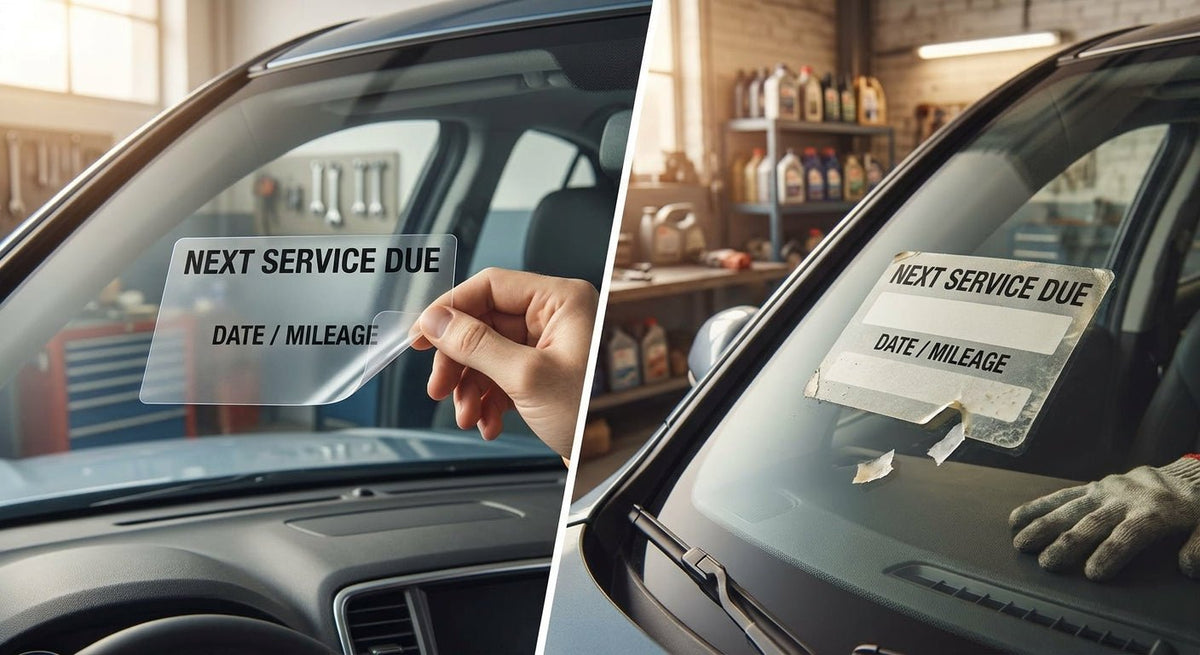
Static cling and adhesive oil change stickers look nearly identical in the visor corner — until one falls off at highway speed and the other tears the tint on removal. Choosing the wrong format costs shops time, money, and customer trust. This guide breaks down exactly when to use each type, how to apply both correctly, and which format fits your operation in 2026.
TL;DR: Adhesive oil change stickers bond directly to glass and last 3,000–5,000 miles without lifting. Static cling stickers require zero adhesive, leave no residue, and work best for customers who rotate vehicles or object to anything permanent on their windshield. For most independent shops and quick-lube operations printing in-house in 2026, adhesive is the default — static cling is the right call only in specific scenarios covered below.
Why This Matters
The format you choose affects more than sticker longevity. It determines how your customers interact with the reminder, whether your branding survives a car wash, and whether your shop absorbs complaints about residue or peeling. In 2026, more shops are printing custom stickers in-house, which means the substrate — static cling film vs. pressure-sensitive adhesive stock — is a decision made at the supply level, not at the counter.
What You'll Need
- Oil change sticker printer (thermal transfer, not direct thermal — heat degrades static cling film faster)
- The correct label stock: static cling polyester film or pressure-sensitive adhesive windshield stock
- Lint-free cloth for glass prep
- Isopropyl alcohol (70% or higher) for adhesive installs
- Squeegee or credit card for bubble removal on static cling
- Your shop's next-service interval data (mileage + date)
If you are sourcing stickers pre-printed rather than running an in-house printer, McAuley Labels manufactures both oil change stickers with custom text and custom-logo variants sized for windshield placement.
The Steps
Step 1: Identify the Installation Surface
Look at where the sticker will live — upper-left corner of the windshield interior is standard in the US. Confirm whether the vehicle has aftermarket tint on that section. Tint film and aggressive pressure-sensitive adhesives are a bad combination: removal at the next service interval can lift tint edges or leave adhesive ghosting. If the vehicle has tinted glass in the sticker zone, static cling is the safer choice. On bare OEM glass, adhesive performs better in every durability metric.
Step 2: Prep the Glass
For adhesive stickers: wipe the target area with isopropyl alcohol and a lint-free cloth. Let it dry fully — 30 seconds minimum. Any oil, dust, or cleaning-product residue cuts the bond strength by 40–60% in the first week. Adhesive failures that shops blame on "bad stickers" are almost always a prep failure.
For static cling stickers: the glass still needs to be clean, but the mechanism is electrostatic, not chemical. Wipe with a damp cloth, dry completely. Avoid glass cleaners with ammonia immediately before application — ammonia disrupts the static charge temporarily. Wait 5 minutes after any spray cleaner before placing a static cling sticker.
Step 3: Print the Sticker
If you are printing in-house, confirm your printer is loaded with the correct stock. Static cling film and adhesive label stock run through the same thermal transfer printer but require different media settings — static cling film is typically 0.003–0.004 inches thick vs. 0.002 inches for standard label stock. A misconfigured media thickness setting causes feed jams and wasted rolls.
For 2026 print quality on windshield stickers, 300 DPI is the minimum for readable text at arm's length. At 203 DPI, the mileage and date fields are legible but fine-print service notes blur. If your current printer tops out at 203 DPI and you are printing logos or QR codes, that is a hardware limitation worth addressing — not a label stock issue.
Step 4: Apply the Sticker Correctly
Adhesive application: Peel the liner, position the sticker in the upper-left corner (or per the customer's preference), press firmly from center outward. Apply light pressure for 10 seconds. The bond reaches full strength after 24 hours — do not test adhesion by pulling an edge the same day.
Static cling application: Hold the sticker by the edges, position it, then press the center first and smooth outward with a squeegee or card to push air out. The sticker is repositionable — if bubbles persist, peel back and reapply. Static cling stickers should be applied to the inside of the glass, not the outside. UV exposure and rain degrade the electrostatic charge of exterior-mounted static cling within 30–60 days.
Step 5: Record and Verify
Write or print the next service date and mileage before applying — not after. Ink on an already-applied sticker smears on adhesive film and static cling film alike. If you are using a QR code variant, scan it once post-application to confirm the code reads correctly through the glass at the angle a driver would hold a phone.
Step 6: Communicate the Format to the Customer
For static cling: tell the customer it is removable and repositionable. Customers who do not know this will try to peel it incorrectly, stretching the film. A 5-second verbal note at service delivery eliminates nearly all "my sticker fell off" callbacks.
For adhesive: warn customers with tinted windows that removal at the next service may require a plastic scraper — never a metal blade. Most shops that offer a fresh sticker at each visit absorb the removal step without issue.
Step 7: Store Unused Stock Correctly
Static cling rolls degrade faster than adhesive rolls in storage. Keep static cling stock at 60–75°F and away from direct sunlight. Static charge dissipates in high-humidity environments above 70% relative humidity — a shop floor in summer in a humid climate is not the right storage spot. Adhesive stock is more forgiving: cool, dry, and away from direct heat is sufficient. Both formats have a practical shelf life of 18–24 months when stored correctly.
Troubleshooting
Static cling sticker won't stay on the glass. The glass was not clean enough, or the sticker was applied to the exterior. Move it inside and reclean the surface with a lint-free cloth. If the film has lost its charge from sun exposure, the sticker is past service life — replace it.
Adhesive sticker left residue on tinted glass. This is an adhesive-to-tint compatibility issue, not a defective sticker. Switch to static cling for tinted vehicles. Use a plastic scraper and isopropyl alcohol to remove residue without scratching the tint film.
Printed text is faded or smearing. For thermal transfer printing: the ribbon is either the wrong type for the substrate (resin ribbon for polyester film, wax-resin for paper-based stock) or the print head pressure is too low. Confirm ribbon-to-media match before blaming print head wear.
Sticker falls off after one car wash. Pressure washers aimed directly at the sticker edge will defeat adhesive on any windshield label. Standard automatic car washes are not an issue. If the customer hand-washes with a high-pressure nozzle under the sticker edge, no adhesive label survives it.
Static cling sticker bubbles and will not lie flat. The film is wrinkled or the glass is not flat in that area (some curved windshields at the corners). Reposition to a flatter section. Bubbles in the center of a flat glass panel are always a prep issue — clean and reapply.
Printed QR code does not scan through the glass. Angle of the phone camera and interior glass coating are the most common causes. Test the scan from a 45-degree angle rather than dead-on. If the code consistently fails, increase the QR code module size at print time — a minimum 1-inch QR code at 300 DPI scans reliably through standard windshield glass.
Quick-Reference Comparison
| Factor | Static Cling | Adhesive |
|---|---|---|
| Leaves residue | No | Possible on tint |
| Repositionable | Yes | No |
| Durability (months) | 3–4 interior | 4–6 interior |
| Exterior use | Not recommended | Short-term only |
| Tinted glass safe | Yes | Risk of lifting tint |
| Best for | Fleets, tinted vehicles, customer objections | Standard shops, daily volume |
Tools and Resources
- In-house printer: The oil change sticker printer system from McAuley Labels is preloaded for windshield sticker stock and handles both adhesive and static cling film rolls.
- Static cling sticker variants: McAuley Labels stocks oil change stickers for windshield in formats suited to interior glass placement.
- Background reading: The static cling oil change stickers for windshield article covers format-specific design considerations in detail.
- Plastic scraper (any auto parts supplier)
- Isopropyl alcohol, 70%+ (any hardware or auto parts supplier)
- Lint-free microfiber cloths
What to Do Next
If your shop is still using pre-printed generic stickers, the single highest-leverage change in 2026 is switching to in-house printing with your logo, phone number, and next-service data printed at the time of service — not filled in by hand. That shift alone closes the loop between the sticker in the window and the customer calling your number when the mileage hits.
FAQ
What is the difference between static cling and adhesive oil change stickers? Static cling stickers adhere to glass through electrostatic charge and leave no residue when removed. Adhesive stickers use a pressure-sensitive bond that is stronger and more durable but can leave residue, especially on aftermarket tint.
Which type lasts longer on a windshield? Adhesive stickers last 4–6 months on interior glass under normal conditions. Static cling stickers last 3–4 months interior before the electrostatic charge weakens. Neither type is rated for exterior long-term use.
Can I use static cling stickers on tinted windows? Yes. Static cling is the recommended choice for tinted glass because removal carries zero risk of lifting the tint film. Adhesive removal on tinted glass — especially aftermarket tint — is the most common cause of customer complaints in this category.
Do oil change stickers work on the outside of the windshield? Not reliably. Static cling fails outdoors in 30–60 days due to UV and moisture degrading the electrostatic charge. Adhesive holds longer but still degrades under direct sun and rain. Both formats are designed for interior glass placement in the upper-left corner.
Can I print both static cling and adhesive stickers on the same printer? Yes, if the printer supports multiple media thicknesses. Thermal transfer printers handle both substrates. You need to swap roll stock and adjust media settings between runs. Confirm your printer's media thickness range before ordering static cling film rolls.
How do I remove an adhesive oil change sticker without damaging tint? Use a plastic scraper at a shallow angle to lift the edge, then peel slowly. Apply isopropyl alcohol to the adhesive residue and let it soak for 30 seconds before wiping. Never use a metal blade on tinted glass.
What size are standard windshield oil change stickers? 2.5" x 1.5" and 3" x 2" are the two most common US formats. The smaller format fits the upper-left corner without blocking the driver's line of sight past the mirror mount. Larger formats are common in fleet applications where additional service data fields are needed.
Is static cling or adhesive better for a quick-lube shop doing 80+ cars per day? Adhesive is faster to apply at volume — no repositioning step, no static discharge concerns in humid shop environments. Static cling makes sense only when a meaningful portion of your daily volume involves tinted glass or customer requests for non-permanent placement.
One Last Thing
Static cling film loses electrostatic charge faster in low-humidity environments — the opposite of what most shop owners expect. A dry winter in a heated shop can cut effective static cling hold time from 4 months down to 6–8 weeks on the interior glass. If you see an uptick in static cling callbacks in January and February, humidity is the cause, not a bad batch of stickers. Switching to adhesive stock for winter months solves the problem entirely.