
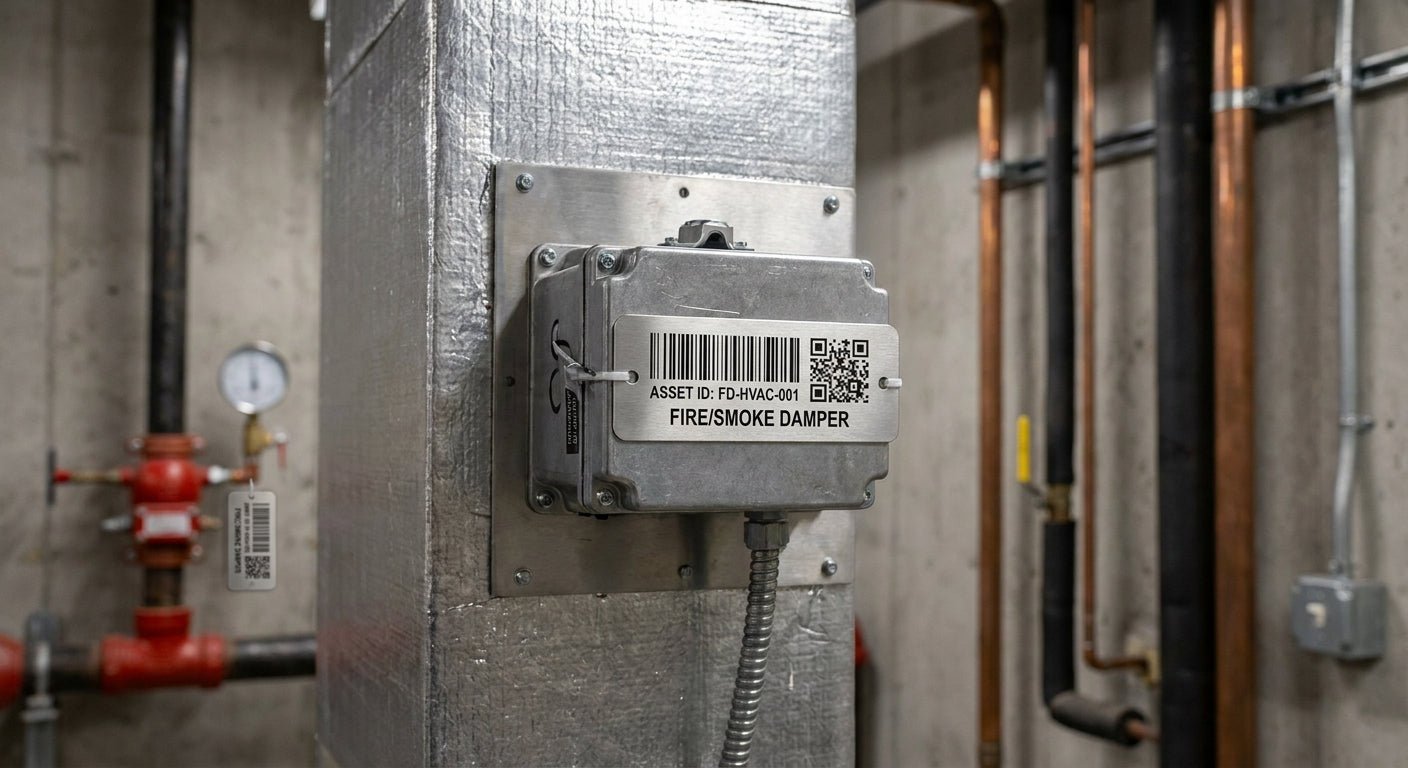
Fire extinguishers, sprinkler valves, alarm panels, and rooftop HVAC units all get inspected on a schedule — and every inspector needs a tag that's still readable when they show up. This guide covers what to look for in asset tags for fire safety equipment and HVAC systems, plus which McAuley Labels tags actually hold up in mechanical rooms and on rooftops.
TL;DR: For fire safety and HVAC asset tags, the Heavy Duty Silver Barcode Asset Tag is the safe pick for extinguishers and panels that get scanned during compliance walks, while the Custom QR Code Asset Tags Heavy Duty Metalized option wins when techs need to pull maintenance history from a phone on the spot. Skip standard paper labels entirely — they fail in mechanical rooms within a single 2026 inspection cycle. Verdict: heavy-duty metalized polyester, Buy.
Why this matters
Fire code inspectors and HVAC service contractors both work off the same principle: if the tag isn't legible, the equipment reads as non-compliant, even if the unit itself passed. A faded barcode on a rooftop condenser or a peeling ID tag on an extinguisher bracket forces a manual re-entry of the asset ID, which slows down every inspection after it.
This isn't a cosmetic issue. Fire safety equipment tags sit in stairwells, boiler rooms, and outdoor cabinets where humidity and temperature swings are constant. HVAC tags face direct sun, condensation, and grease from nearby motors. A Heavy Duty Silver Barcode Asset Tag is built for exactly that kind of environment — 3M-backed adhesive on a metalized surface that doesn't lift when the equipment heats up.
Who this is for
This guide is for facilities managers, fire protection contractors, and HVAC service companies who tag equipment for compliance tracking, preventive maintenance schedules, or insurance audits. If you're tagging extinguishers, sprinkler risers, alarm panels, air handlers, or rooftop units and need the label to survive years of exposure without a reprint, this is your buying criteria.
What to look for in asset tags for fire safety equipment
Adhesive strength on curved and painted metal
Fire extinguisher brackets and HVAC housings are rarely flat. A tag needs adhesive that grips curved cylinders and painted sheet metal without peeling at the edges within the first year. Weak adhesive is the number-one reason tags fall off before an inspection ever happens.
Barcode scan reliability at distance
Inspectors and technicians scan from arm's length, sometimes with gloves on and a flashlight in the other hand. A barcode printed at 300 DPI holds its edges sharp enough for first-pass scans, where lower-resolution prints blur at smaller barcode sizes.
Resistance to heat and grease
HVAC compressors and rooftop units run hot, and mechanical rooms accumulate oil film over time. A metalized polyester tag resists both without the print rubbing off, unlike a standard paper label that discolors within months.
Legibility after years outdoors
Rooftop HVAC tags face UV exposure and freeze-thaw cycles every year. The tag needs to still be readable in 2026 for equipment installed back in 2022 — that's the real test, not how it looks on day one.
QR code vs. barcode for maintenance history
A barcode gets you an asset ID. A QR code can point a phone straight to a service log or maintenance form, which matters more for HVAC contractors juggling multi-site service schedules than for a single-building fire panel.
Tamper resistance for insurance and audit trails
Fire safety tags tied to insurance compliance sometimes need to show if they've been removed and reapplied. Look for a tag substrate that shows visible damage on removal instead of coming off clean.
Top picks for fire safety and HVAC asset tags
The compliance workhorse: Heavy Duty Silver Barcode Asset Tag Metalized polyester with 3M heavy-duty adhesive, built for barcode scanning on extinguishers, risers, and panels. One spec that matters: it's rated for the kind of humidity and temperature swings a mechanical room throws at it year after year. Verdict: Buy for any fire safety asset that gets scanned on a recurring inspection cycle.
The ID-only option: Metallized Silver ID Label Same metalized surface, no barcode — just a printed asset number and text. This works for smaller fire safety components where a full barcode field won't fit, like pull stations or small valve tags. Verdict: Consider if your system doesn't need barcode scanning, only visual ID. See the Metallized Silver ID Label
The wildcard for HVAC service contractors: Custom QR Code Asset Tags Heavy Duty Metalized Same rugged metalized base, but the QR code links a technician's phone directly to service history instead of just an asset number. For HVAC companies running multi-site maintenance contracts in 2026, that's the difference between a five-second scan and a callback to the office. Verdict: Buy if your team already uses QR-based service tracking. Check the Custom QR Code Asset Tags Heavy Duty Metalized
The budget-conscious option: Semi-Gloss White Barcode Asset Tag Costs less than the metalized options and prints a cleaner barcode contrast for indoor equipment. It's not built for rooftop exposure, so keep it to indoor fire panels and interior mechanical rooms only. Verdict: Consider for indoor-only, low-exposure tagging.
What to avoid
- Standard paper labels on any outdoor or rooftop equipment. They discolor and lift within a single season of sun exposure — fine for a warehouse shelf, wrong for a rooftop condenser.
- Direct thermal prints without lamination on high-heat equipment. Direct thermal images fade with sustained heat exposure near compressors and boilers, even indoors.
- Generic ID tags with no barcode field for fire safety inspection logs. If your inspection software scans barcodes, a text-only tag just adds a manual lookup step every visit.
Verdict comparison
| Tag | Best for | Outdoor rated | Verdict |
|---|---|---|---|
| Heavy Duty Silver Barcode | Fire safety compliance scans | Yes | Buy |
| Metallized Silver ID Label | Small components, no barcode need | Yes | Consider |
| Custom QR Code Heavy Duty Metalized | HVAC multi-site service tracking | Yes | Buy |
| Semi-Gloss White Barcode | Indoor-only fire panels | No | Consider |
FAQ
What's the best asset tag for fire extinguishers? A heavy-duty metalized silver barcode tag is the standard choice for fire extinguishers because it survives temperature swings in stairwells and mechanical rooms without the barcode fading.
Are QR code asset tags better than barcodes for HVAC equipment? QR codes work better when technicians need to pull maintenance history from a phone on-site; barcodes are simpler and faster to scan when you only need an asset ID match.
How much do heavy-duty asset tags cost compared to standard labels? Heavy-duty metalized tags cost more per unit than paper labels, but they avoid the reprint and re-tagging costs that come from labels failing mid-inspection-cycle.
Can asset tags handle rooftop HVAC exposure year-round? Metalized polyester tags rated for outdoor use are designed to stay legible through freeze-thaw cycles and direct sun exposure across a full year, including into 2026 and beyond.
Do fire code inspectors require barcode asset tags specifically? Requirements vary by jurisdiction and insurer, but barcode or QR tracking speeds up inspection logging even where it isn't mandated outright.
What print resolution is needed for small asset tag barcodes? A 300 DPI thermal transfer printer keeps barcode lines sharp enough for reliable scans on smaller tag sizes; lower-resolution prints can blur at that scale.
Is direct thermal or thermal transfer better for HVAC asset tags? Thermal transfer holds up better against heat and grease near HVAC equipment since the image is fused into the material rather than surface-printed.
How often should fire safety asset tags be replaced? Replace a tag as soon as the barcode or text becomes hard to scan or read — waiting until an inspection catches it costs more time than a planned reprint.
One last thing
The tags that fail first in fire safety and HVAC settings aren't the cheap ones — they're the wrong-material ones. A facility that buys a premium paper label instead of a metalized polyester tag ends up replacing it twice as often, because the material, not the price point, is what decides whether it survives the environment.