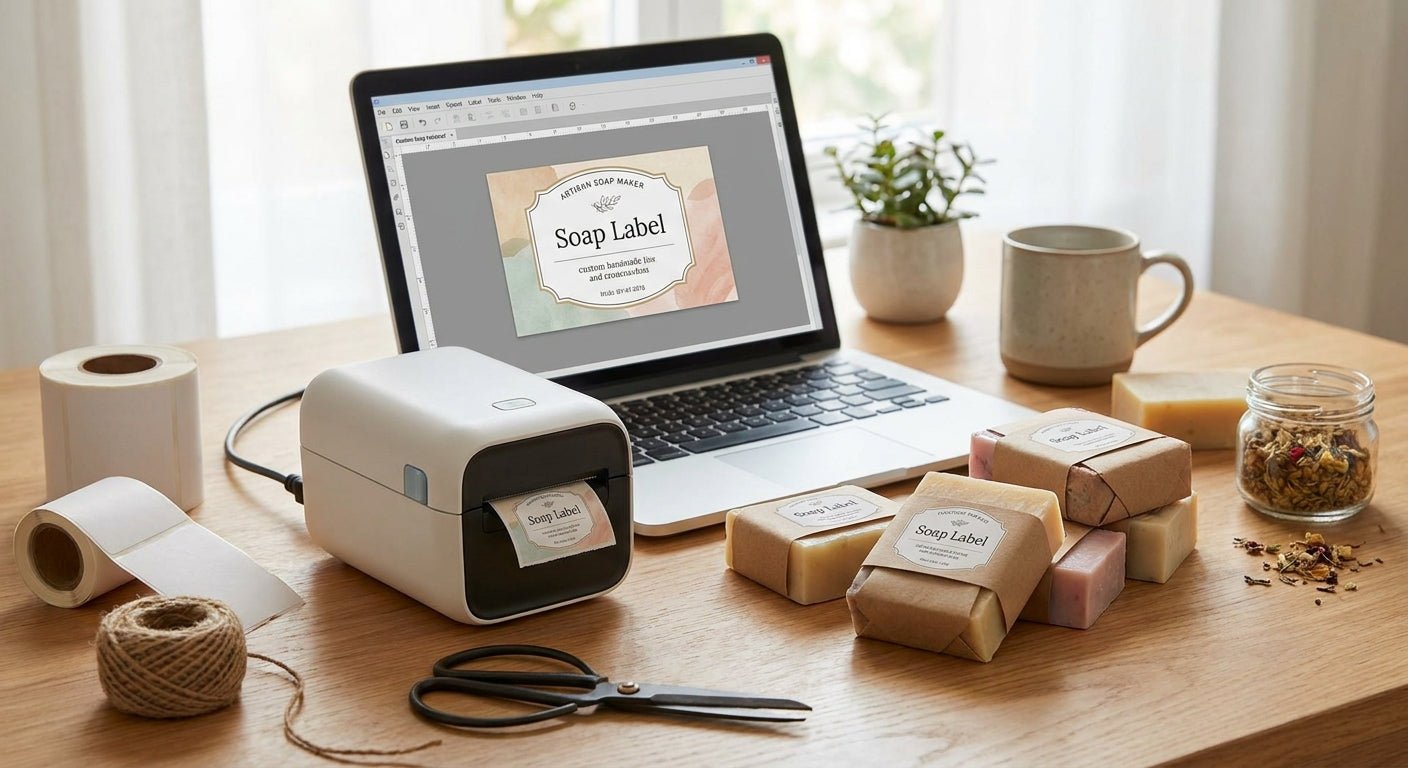
Soap bars sweat glycerin, sit in humid bathrooms, and get handled with wet fingers — a label printer built for shipping labels or office paperwork won't survive that environment, and this guide names the printers that will.
TL;DR
The best label printer for soap makers in 2026 is the GoDEX GE330, a 203 dpi thermal transfer printer that handles polyester and vinyl stock soap makers need for oil and moisture resistance — Buy. If your soap labels carry fine ingredient text or small logos, step up to the GoDEX RT230i at 300 dpi for sharper small-font rendering — Buy. Entry-level direct thermal printers work for short runs but the print fades against oils and steam over months, making them a Skip for anything beyond test batches. Thermal transfer with polyester label stock is the combination that actually survives a soap dish.
Why this matters
Soap labels sit closer to water, oil, and heat than almost any other product label category — a candle maker worries about wax residue, a soap maker worries about standing water in a soap dish plus hand oils rubbing the surface daily. Direct thermal prints (the kind on most cheap desktop label printers) are heat-activated ink baked directly into the paper, and that same heat sensitivity means the print darkens, fades, or smears when it hits warm, humid bathrooms. Thermal transfer printing melts a resin ribbon onto polyester or vinyl label stock instead, and that combination resists water, oil, and abrasion in ways direct thermal paper never will.
This matters more in 2026 than it did five years ago because more soap makers are selling wholesale into boutiques and subscription boxes, where labels need to survive shelf time, shipping, and repeated handling before a customer ever opens the bar. A label that looks fine on day one but smears by week three costs you reorders and refunds, not just a bad review.
How we ranked
Rankings below are based on aggregated printer specification data — resolution, print method, and label material compatibility — cross-referenced against known failure patterns for oil- and moisture-exposed labels. Direct thermal printers are penalized for longevity in wet-adjacent use; thermal transfer printers paired with polyester stock are rewarded. Price tier and print speed are noted where they change the buying decision, not invented as exact figures.
The ranked picks
1. GoDEX GE330 (203 dpi, thermal transfer) — the workhorse
The GoDEX GE330 prints at 203 dpi using a thermal transfer ribbon, which is the resolution most soap makers need for logo-plus-ingredient-list labels on 2×3 or 3×4 inch stock. It handles rolls up to 4 inches wide, covering most bar soap and bottle label sizes without a printer upgrade. For a soap maker printing labels weekly rather than daily, this is the printer that won't need replacing when volume grows in 2026. Buy.
2. GoDEX RT230i (300 dpi, thermal transfer) — the fine-print pick
Step up to the GoDEX RT230i when your soap label design carries small ingredient text, a QR code linking to a product page, or a detailed logo that blurs at 203 dpi. The extra resolution matters most on labels under 2 inches, where character edges get soft on lower-dpi printers. It's the same thermal transfer durability as the GE330 with sharper output for detail-heavy designs. Buy if your label copy is dense; otherwise the GE330 already covers you.
3. GoDEX RT863i (600 dpi, thermal transfer) — the overkill pick
At 600 dpi, the RT863i is built for barcode-dense industrial labels, not soap bars — most soap label artwork doesn't need resolution beyond 300 dpi, and you'll pay for capability you won't use. Skip unless you're also printing high-density barcodes for wholesale inventory alongside your soap line.
4. Entry-level direct thermal printers — the short-run pick
Direct thermal printers cost less upfront and work fine for test batches, craft fair one-offs, or labels that ship within a week or two of printing. Past that window, expect fading anywhere the label touches oil, steam, or direct sunlight through packaging. Consider only for short-term runs; Skip for anything going into long-term retail or subscription inventory.
5. Thermal transfer polyester label stock — the material that makes or breaks the setup
The printer only does half the job — thermal transfer printer labels in polyester white resist oil penetration and water exposure in ways paper stock cannot, which is the actual reason thermal transfer beats direct thermal for soap. Pairing a 203 or 300 dpi thermal transfer printer with paper labels instead of polyester defeats the purpose. Buy polyester stock alongside any thermal transfer printer purchase.
Comparison table
| Printer | Resolution | Print Method | Best For | Verdict |
|---|---|---|---|---|
| GoDEX GE330 | 203 dpi | Thermal transfer | Standard soap bar labels | Buy |
| GoDEX RT230i | 300 dpi | Thermal transfer | Fine text, QR codes, dense logos | Buy |
| GoDEX RT863i | 600 dpi | Thermal transfer | Barcode-dense industrial use | Skip for soap |
| Direct thermal (entry) | 203 dpi | Direct thermal | Short-run, craft fair batches | Consider (short-term only) |
Where to buy
- Buy the printer and the ribbon together — thermal transfer printers need resin ribbon matched to the label material, and mismatched ribbon is the most common cause of smearing complaints in 2026 support tickets.
- Order polyester or vinyl label stock, not paper, if the soap product will sit anywhere near water, oil, or direct sun for more than a few days.
- Buy from a supplier that stocks both the printer and compatible ribbon and label rolls in one place — sourcing three components from three vendors is where calibration and compatibility problems start.
FAQ
What's the best label printer for soap makers in 2026? The GoDEX GE330, a 203 dpi thermal transfer printer, is the best label printer for soap makers who need durable, oil- and water-resistant labels at standard soap bar sizes without paying for resolution they don't need.
Is direct thermal or thermal transfer better for soap labels? Thermal transfer is better for soap labels because it melts resin onto polyester or vinyl stock that resists oil and moisture, while direct thermal print fades when exposed to heat, steam, or repeated handling.
Do I need 300 dpi or is 203 dpi enough for soap labels? 203 dpi is enough for most soap label designs with standard text and logos; move to 300 dpi only if your label carries small ingredient lists, fine barcodes, or detailed artwork that looks soft at lower resolution.
Can I use paper labels with a thermal transfer printer for soap? You can, but it defeats the purpose — paper labels absorb oil and moisture the same way with either print method, so pairing a thermal transfer printer with polyester or vinyl stock is what actually improves durability.
How much does a label printer for soap makers cost? Cost varies by resolution and print method — check current pricing directly, since 203 dpi thermal transfer models are typically priced below 300 dpi and 600 dpi options.
Will soap oils make my labels peel off? Oils are more likely to cause print fading than adhesive failure, which is why label material and print method (thermal transfer plus polyester stock) matter more than adhesive strength alone for soap applications.
Can I print soap labels at home with a thermal transfer printer? Yes — desktop thermal transfer printers like the GoDEX GE330 are sized for home studios and small-batch production, not just warehouse floors.
What label size is standard for bar soap? Most bar soap labels run 2×3 inches to 3×4 inches depending on wrap style, and both the GoDEX GE330 and RT230i handle rolls up to 4 inches wide without upgrading.
One last thing
The detail most soap makers miss isn't the printer, it's the ribbon-to-label match — a wax-resin ribbon on polyester stock outlasts a straight resin ribbon on the same material in daily-handling tests, and that mismatch is the single most common reason a "durable" thermal transfer label still smears by month two in 2026.