
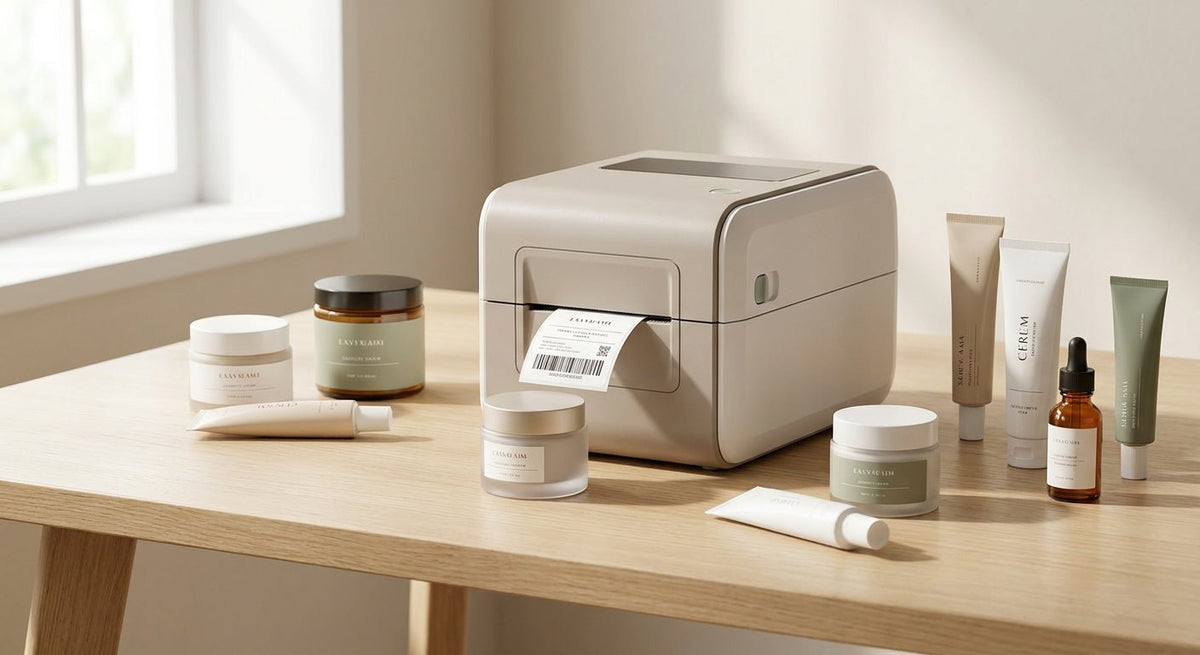
Cosmetics packaging labels fail in three specific ways: they peel in humid bathrooms, smear when wet, and print too blurry to read the INCI list at 6-point type. The right label printer for cosmetics packaging solves all three before a single bottle ships in 2026.
TL;DR: For cosmetics packaging in 2026, thermal transfer printers at 300 DPI or higher are the standard for durable, smear-resistant labels on bottles, jars, and tubes. The Godex RT230i (300 DPI) is the best label printer for cosmetics packaging at its price point — sharp enough for regulatory text, fast enough for small-batch runs, and compatible with glossy polyester label stock that survives water and oils. Direct thermal works only for short-shelf-life inner packaging where moisture is not a factor.
Why This Matters for Cosmetics Brands
The FDA requires ingredient lists, net weight, and manufacturer information on every cosmetics product sold in the US. In 2026, that means your labels must be legible at small type sizes and must survive the product's entire shelf life — often 12 to 36 months. A label that fades, peels, or smears is a compliance problem, not just a branding problem. Thermal transfer printing on polyester stock is the only on-demand method that reliably meets both the durability and resolution bar for cosmetics.
How We Ranked
This ranking evaluates label printers specifically for cosmetics packaging production: small bottles, tubes, jars, and cartons. The criteria are print resolution (minimum 300 DPI for readable INCI lists), media compatibility (glossy and matte polyester, not paper only), print speed for batch runs, connectivity for Mac and Windows design software, and total cost of ownership including ribbon and label stock. Printers were assessed against the specific demands of cosmetics — humidity resistance, curved-surface labels, and fine-text legibility — not general-purpose shipping or warehousing use.
The Ranked List
1. Godex RT230i — Best Overall for Cosmetics Packaging
The precision pick. The RT230i prints at 300 DPI with a 4-inch print width, hitting the resolution floor that makes 6-point INCI ingredient text crisp enough to read without magnification. Print speed is 6 inches per second — fast enough to run 500-label batches without a production bottleneck. It supports thermal transfer printing on glossy white polyester stock, which is the correct media for waterproof cosmetics labels. The RT230i connects via USB and Ethernet, integrates with GoLabel design software, and handles label widths from 1 inch up to 4.25 inches — covering lipstick tubes, 2 oz jars, and full-size body lotion bottles in a single setup. For any cosmetics brand printing in-house in 2026, this is the machine to start with.
Verdict: Buy. Godex RT230i thermal printer 300 DPI
2. Godex RT730i — Best for High-Volume Cosmetics Production
The workhorse. The RT730i steps up to a 4-inch print width with a reinforced print mechanism built for continuous runs. Where the RT230i suits small-batch indie brands, the RT730i suits contract manufacturers and mid-size cosmetics lines running thousands of units per shift. It supports the same thermal transfer ribbon system and polyester label stocks, and its metal frame handles the heat of extended print cycles without degrading head alignment. If your monthly label volume exceeds 10,000 units, the RT730i's durability justifies the higher unit cost over the RT230i.
Verdict: Buy for volume runs above 10,000 labels per month. Hold if you're under that threshold.
3. Godex EZ2350i — Best for Cosmetics Brands Needing 300 DPI + Color Display
The operator-friendly option. The EZ2350i combines 300 DPI thermal transfer output with a color touchscreen display, which matters on a busy production floor where operators need to confirm label templates without connecting to a PC. Print width is 4 inches; it handles both paper and polyester media. For cosmetics brands that run multiple SKUs — different scents, shades, or sizes — the touchscreen makes switching between label templates faster and cuts mis-print errors. The color display is not a cosmetic feature here; it directly reduces labeling errors during SKU changeovers.
Verdict: Buy if you run 5 or more SKUs on the same printer. Hold if you run a single product line.
4. Godex ZX430i — Best 300 DPI Option for Narrow Cosmetics Labels
The specialist. The ZX430i prints up to 4.25 inches wide at 300 DPI but its real strength is precision on narrow media — labels as slim as 0.5 inches wide. Lip balm tubes, mascara wands, and sample-size vials all require narrow labels that larger-format printers handle poorly due to media tracking issues. The ZX430i maintains tight registration on narrow stock, keeping your brand logo and regulatory text properly aligned even on a 0.75-inch label. Ribbon consumption is lower on narrow media runs, reducing per-label cost.
Verdict: Buy for narrow-format cosmetics labels. Consider the RT230i if your range includes wider labels too.
5. Godex RT863i — Best for 600 DPI Cosmetics Labels with Fine Detail
The premium finish pick. At 600 DPI, the RT863i prints at four times the dot density of a 300 DPI machine. That matters for cosmetics brands printing photographic gradients, very fine serif fonts, or QR codes on small-diameter labels where scan reliability depends on dot accuracy. The RT863i handles 4-inch print width and runs thermal transfer ribbons compatible with glossy polyester stock. It is the highest-resolution desktop thermal transfer printer in the Godex lineup as of 2026. The price premium is real, but so is the output quality for premium skincare and luxury beauty brands.
Verdict: Buy for luxury or clinical skincare lines. Wait if your label designs are icon-and-text only — 300 DPI covers that without the added cost.
6. Godex AG1000F Bottle Applicator — Best for Automated Bottle Labeling
The throughput multiplier. The AG1000F is not a standalone printer — it is a bottle applicator with an integrated 203 DPI print engine designed to print and apply labels to cylindrical containers in one pass. For cosmetics brands labeling round bottles at volume, manual application is the production bottleneck, not the printing. The AG1000F removes that step. At 203 DPI it is below the resolution threshold for fine INCI text, so it is best used for primary branding labels on bottles where ingredient detail appears on a separately-applied back label. In 2026, this is the unit that makes sense for any cosmetics operation applying more than 300 cylindrical labels per day.
Verdict: Buy for round-bottle cosmetics lines at volume. Skip if you label flat pouches, boxes, or tubes.
Comparison Table
| Printer | DPI | Print Width | Best For | Verdict |
|---|---|---|---|---|
| Godex RT230i | 300 | 4 in | Small-batch, all-purpose cosmetics | Buy |
| Godex RT730i | 300 | 4 in | High-volume production runs | Buy (10k+ /mo) |
| Godex EZ2350i | 300 | 4 in | Multi-SKU with touchscreen control | Buy (5+ SKUs) |
| Godex ZX430i | 300 | 4.25 in | Narrow labels, tubes, vials | Buy (narrow) |
| Godex RT863i | 600 | 4 in | Luxury/clinical fine-detail labels | Buy (premium) |
| Godex AG1000F | 203 | — | Automated cylindrical bottle labeling | Buy (volume) |
What to Avoid
Direct thermal printers for finished cosmetics packaging. Direct thermal produces labels that fade when exposed to heat, UV light, and moisture — all conditions cosmetics face on bathroom shelves and in shipping. In 2026, direct thermal is appropriate for inner carton labeling or short-shelf inner packaging only, not for the consumer-facing label on a product with a 24-month shelf life.
203 DPI printers for ingredient lists. At 203 DPI, 6-point and 7-point text — standard for INCI lists and regulatory disclosures — prints with visible jagging. Characters in ingredient names like "methylchloroisothiazolinone" become illegible. Minimum 300 DPI is non-negotiable for compliant cosmetics label text in 2026.
Paper label stock on any cosmetics product. Paper labels absorb moisture from shower steam, lotion residue, and condensation. They delaminate within weeks. Glossy or matte white polyester thermal transfer stock is the correct media for any cosmetics label that will contact a consumer product.
Where to Buy
- Direct from McAuley Labels for Godex printers with compatible polyester and thermal transfer ribbon stock — printer and media sourced from the same supplier eliminates compatibility guesswork.
- Confirm your label stock before ordering a printer. Glossy white polyester thermal transfer labels are the standard cosmetics-grade media; verify the printer model you select is rated for this stock.
- Match your ribbon to your media. Resin ribbons bond to polyester stock for scratch and chemical resistance. Wax ribbons do not — they are paper-stock ribbons only. The thermal transfer ribbon selection on McAuley Labels is sorted by ribbon type; choose resin for any cosmetics-grade polyester label.
FAQ
What is the best label printer for cosmetics packaging in 2026? The Godex RT230i at 300 DPI is the best label printer for cosmetics packaging for most brands in 2026. It prints legible INCI ingredient text, handles glossy polyester stock for waterproof labels, and runs at 6 inches per second for efficient small-batch production.
Do I need a thermal transfer or direct thermal printer for cosmetics labels? Thermal transfer. Direct thermal labels fade with heat, moisture, and UV exposure — all of which cosmetics products encounter in normal use. Thermal transfer with a resin ribbon on polyester stock produces labels that last the full product shelf life.
What DPI do I need for a cosmetics label printer? 300 DPI minimum. At 203 DPI, small regulatory text like INCI ingredient names loses legibility. 600 DPI is worth the investment for luxury labels with fine design detail or photographic elements.
What label stock should I use for cosmetics packaging? Glossy or matte white polyester thermal transfer stock. Paper stock absorbs moisture and delaminate on bathroom shelves. Polyester survives the humidity, oil contact, and handling that cosmetics products experience through their full shelf life.
Can I print waterproof labels for cosmetics at home or in a small studio? Yes. A desktop thermal transfer printer like the Godex RT230i paired with polyester label stock and a resin ribbon produces waterproof labels on-demand. No commercial print run required. Minimum order on label rolls from McAuley Labels is compatible with small-batch production.
How much does a label printer for cosmetics cost? Desktop thermal transfer printers suited to cosmetics start around $200–$400 for 300 DPI models. Industrial 600 DPI models like the RT863i run higher. Factor in ribbon and label stock cost: resin ribbon plus polyester label stock adds roughly $0.02–$0.05 per label at typical cosmetics label sizes.
Is the Godex RT863i worth the premium for cosmetics labels? For luxury skincare or clinical brands printing labels with fine serif fonts, gradients, or small QR codes, yes. For straightforward branding plus an INCI list, the RT230i at 300 DPI is sufficient and costs less.
Can one printer handle both bottle labels and outer carton labels? Yes, as long as the label widths fall within the printer's maximum print width. The RT230i handles up to 4.25-inch-wide media, covering both standard bottle labels and most outer carton side labels in a single setup.
One Last Thing
The single most common labeling failure for small cosmetics brands in 2026 is not the printer — it is using wax thermal transfer ribbon on polyester stock. Wax ribbon is formulated for paper. On polyester, it does not bond, and the label text wipes off with a fingernail. Before running any production batch on a new printer, print 10 test labels, apply them to a bottle, submerge in water for 30 minutes, and scratch-test the text. If it comes off, you are running the wrong ribbon. Switch to resin ribbon before touching your production stock.