
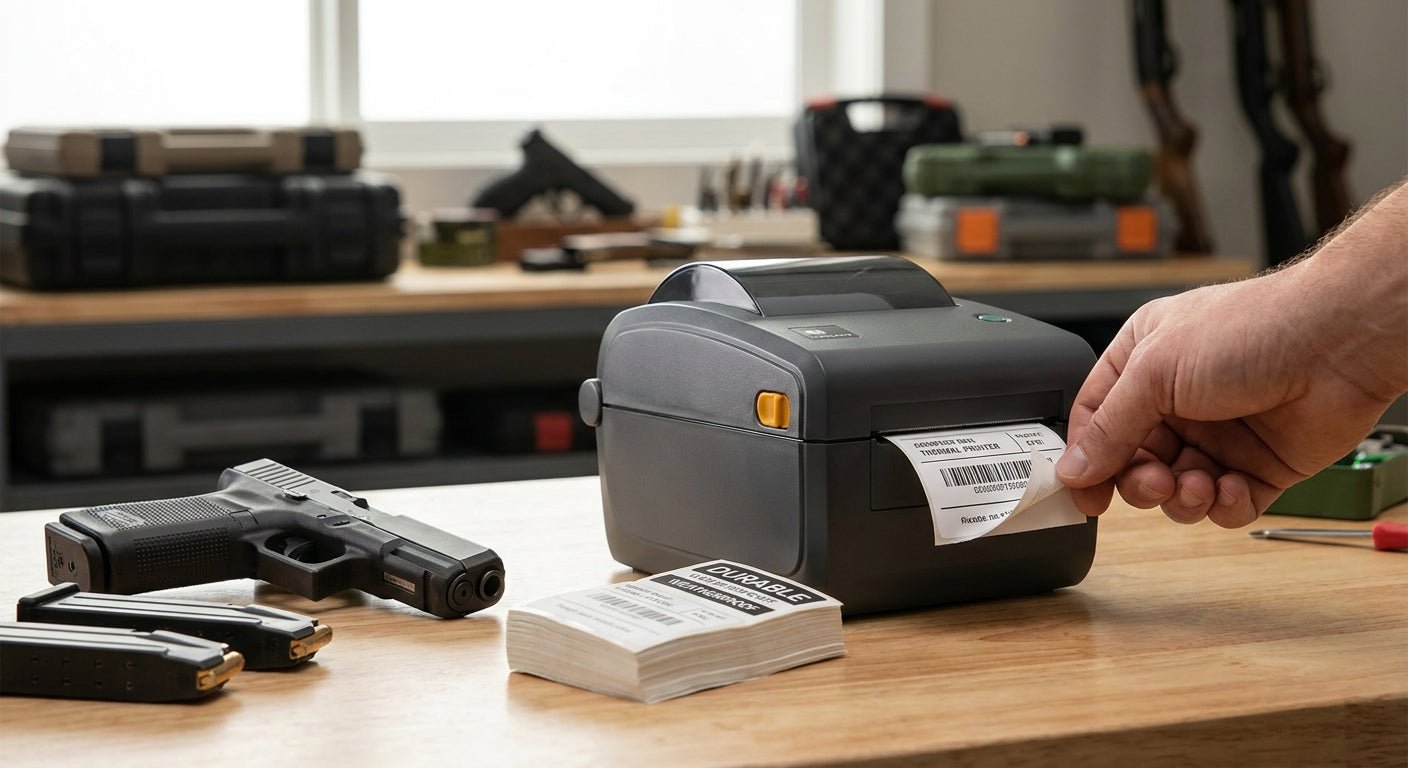
Gun ranges and FFL dealers need a label printer that can put a scannable barcode on a rifle rack tag, a pistol case, and an ammo bin without the print smearing after six months of handling — the best label printer for firearms inventory in 2026 is the GoDEX RT700i+ paired with 3M heavy-duty barcode asset tags, and this guide ranks the printers and label stocks that actually hold up under range conditions.
- GoDEX RT700i+ at $581 is the best label printer for firearms inventory tracking for most ranges and FFL counters in 2026 — Buy.
- 3M Heavy-Duty Silver Barcode Asset Tags at $115 survive gun oil, solvent, and daily handling that peel-off retail labels can't.
- GoDEX ZX430i+ at $945 with 300 dpi is the upgrade pick when serial numbers run past 12 digits on a small tag.
- Skip standard paper labels on firearm inventory — they smear under Hoppe's No. 9 and fail an ATF audit within a year.
Why this matters
FFL dealers and ranges log serialized firearms, consignment guns, rental inventory, and range rifles that move between racks dozens of times a day. A dropped scan or a faded barcode turns a five-second inventory check into a manual serial-number hunt through a logbook.
Most ranges start with whatever printer came with the POS system, then discover the labels can't take gun oil, solvent wipes, or repeated handling. McAuley Labels builds its catalog around exactly this gap — durable barcode stock and thermal printers rated for daily industrial use, not retail shelf tags.
The difference between a $581 printer setup and a $150 desktop model isn't the sticker price — it's whether the barcode still scans in 2026 after 300 handling cycles.
How this list was built
Each pick below is scored on four factors that matter specifically for firearms and range inventory: print resolution for small serial-number barcodes, label material durability against oil and solvent, throughput for daily rack-and-return volume, and total cost including ribbon and label stock. Specs and prices reflect current 2026 catalog listings. Every printer on this list runs on standard thermal transfer ribbon so you're not locked into a proprietary cartridge.
The ranked list
1. GoDEX RT700i+ Thermal Printer — the range counter workhorse
The GoDEX RT700i+ prints at 203 dpi on a 4-inch head with a color display for switching label templates on the fly — rifle rack tags one run, ammo bin labels the next. At $581, it's priced for a single-counter operation that needs one printer running all day, not a fleet.
203 dpi is enough resolution for most serial-number and SKU barcodes used in range inventory, and the printer handles both direct thermal and thermal transfer ribbon, so it works with the heavy-duty label stock below. Buy — this is the default pick for any range or small FFL dealer setting up serialized inventory in 2026.
2. Custom Asset Tags for Equipment — 3M Heavy-Duty Silver Barcode Label
The 3M Heavy-Duty Silver Barcode Asset Tags run $115 for the set and use a metalized silver polyester face built to survive oil, solvent wipe-down, and repeated handling on a rifle rack or gun locker. This is the label stock that actually separates a working inventory system from a peeling one.
Paper labels lift within weeks under gun oil exposure; this heavy-duty stock is the one to run through the RT700i+ for anything tagged directly on a firearm case or rack slot. Buy — non-negotiable if the tag touches oiled metal or gets handled daily.
3. Custom Barcode Inventory Labels — 3M Heavy-Duty
For bin-level tracking — ammo lots, magazine trays, cleaning kit stock — the 3M Heavy-Duty Barcode Inventory Labels at $115 give you a serialized barcode format built for shelf and bin surfaces rather than curved firearm cases. Metalized silver stock resists fading under range fluorescent lighting over a multi-year cycle.
This is the label to run for anything that sits on a warehouse shelf or storage rack rather than moving with an individual firearm. Buy — pair it with the RT700i+ for a single-printer, two-label-stock setup that covers both firearms and storage inventory.
4. GoDEX ZX430i+ Thermal Printer — the fine-print upgrade
The GoDEX ZX430i+ steps up to 300 dpi on a 4-inch print head at $945, which matters once serial numbers or lot codes push past 12 characters on a small 1-inch tag. At 203 dpi those characters start to blur; 300 dpi keeps them scannable.
This is the upgrade path for FFL dealers running consignment inventory with long manufacturer serial strings, not the default for a single-counter range. Consider — only worth the jump if your barcodes are already failing first-pass scans at 203 dpi.
5. GoDEX GX4200i Thermal Printer — the high-volume FFL pick
At $2,246, the GoDEX GX4200i is priced for a wholesale FFL dealer or multi-location range group printing hundreds of tags a day, not a single counter. It runs 203 dpi at up to 16 inches per second with a 5-inch touchscreen and USB, serial, and Ethernet connectivity for networked printing across stations.
The throughput and networking justify the price only once you're printing enough volume that a desktop unit becomes the bottleneck. Consider — skip it for a single range location, buy it for a multi-store FFL operation.
6. Custom QR Code Asset Tags — Metalized Silver Polyester
For ranges moving toward digital audit trails, custom QR code asset tags on the same metalized silver polyester stock let staff scan a firearm's location and status with a phone camera instead of a dedicated barcode scanner. They cost the same as the barcode version and run on the same printers.
The tradeoff is readability distance — QR codes need a closer, more deliberate scan than a linear barcode swept past a handheld reader. Consider — good for compliance documentation, less ideal for fast rack-and-return counting.
7. Thermal Transfer Ribbon — the consumable nobody budgets for
A $9 roll of wax/resin thermal transfer ribbon is what actually makes the heavy-duty asset tags durable — direct thermal printing alone fades faster on metalized stock. Skipping the resin ribbon and running direct-thermal-only is the single most common reason a range's barcodes fade within a year.
Buy — budget for ribbon replacement alongside label stock, not as an afterthought.
“If the barcode doesn't scan on the first pass, you don't have an inventory system, you have a filing cabinet.”


Comparison table
| Pick | Best for | Resolution / Material | Price | Verdict |
|---|---|---|---|---|
| GoDEX RT700i+ | Single-counter ranges | 203 dpi thermal transfer | $581 | Buy |
| 3M Heavy-Duty Silver Barcode Tags | Firearm rack tags | Metalized silver polyester | $115 | Buy |
| 3M Heavy-Duty Barcode Inventory Labels | Ammo/accessory bins | Metalized silver polyester | $115 | Buy |
| GoDEX ZX430i+ | Long serial numbers | 300 dpi thermal transfer | $945 | Consider |
| GoDEX GX4200i | Multi-location FFL dealers | 203 dpi, 16 ips | $2,246 | Consider |
| Thermal Transfer Ribbon | All of the above | Wax/resin | $9 | Buy |
Where to buy
- Buy printer and ribbon as a matched set. Direct-thermal-only prints fade on metalized asset tags within months; wax/resin ribbon is what makes the barcode survive daily handling through 2026 and beyond.
- Match label pitch to printer resolution. A 1-inch serial tag with a 14-digit code needs 300 dpi; anything shorter runs fine at 203 dpi and saves you $364 on the printer.
- Order asset tags with sequential numbering. A pre-numbered batch removes a manual data-entry step when you're logging dozens of firearms into a spreadsheet or inventory system at once.
FAQ
What's the best label printer for firearms inventory tracking?
The GoDEX RT700i+ at $581 is the best label printer for firearms inventory for most ranges and FFL counters in 2026. It prints 203 dpi barcodes on a 4-inch head and runs standard thermal transfer ribbon compatible with heavy-duty asset tag stock.
Do firearm inventory labels need to be waterproof?
They need to resist gun oil and solvent more than water. Metalized silver polyester asset tags handle daily oil exposure and solvent wipe-down without lifting, unlike standard paper labels.
Is 203 dpi enough for firearm serial number barcodes?
Yes for most serial numbers under 12 characters on a standard tag size. Longer manufacturer serial strings on small labels need 300 dpi, like the GoDEX ZX430i+, to stay scannable.
How much does a firearms inventory label setup cost?
A single-counter setup runs about $581 for the GoDEX RT700i+ printer plus $115 per asset tag pack and $9 per ribbon roll in 2026. A multi-location FFL dealer printing higher volume runs closer to $2,246 for a GoDEX GX4200i.
Should ranges use barcodes or QR codes for firearm tracking?
Barcodes scan faster with a handheld reader for rack-and-return counting; QR codes work better when staff scan with a phone for compliance documentation. Both print on the same metalized silver label stock and the same printers.
Can I use direct thermal printing instead of thermal transfer for firearm tags?
You can, but direct thermal prints fade faster on heavy-duty stock than thermal transfer with wax/resin ribbon. For tags that stay on inventory for years, thermal transfer holds the barcode readable longer.
What label material holds up best against gun oil?
Metalized silver polyester, like McAuley's 3M Heavy-Duty Silver Barcode Asset Tags, resists oil and solvent better than paper or standard vinyl labels. It's built for the same handling conditions as warehouse and manufacturing asset tags.
Do I need a different printer for firearms versus ammo bin labels?
No, one printer like the GoDEX RT700i+ handles both label types. Switch label stock and template between a firearm rack tag run and an ammo bin barcode run on the same machine.
One last thing
The detail most ranges miss: running heavy-duty metalized labels on direct-thermal-only settings instead of thermal transfer with resin ribbon. The label material is built to survive oil and solvent, but the print itself fades within months without the ribbon doing its job — check your printer settings before you blame the label stock for a scan failure.