
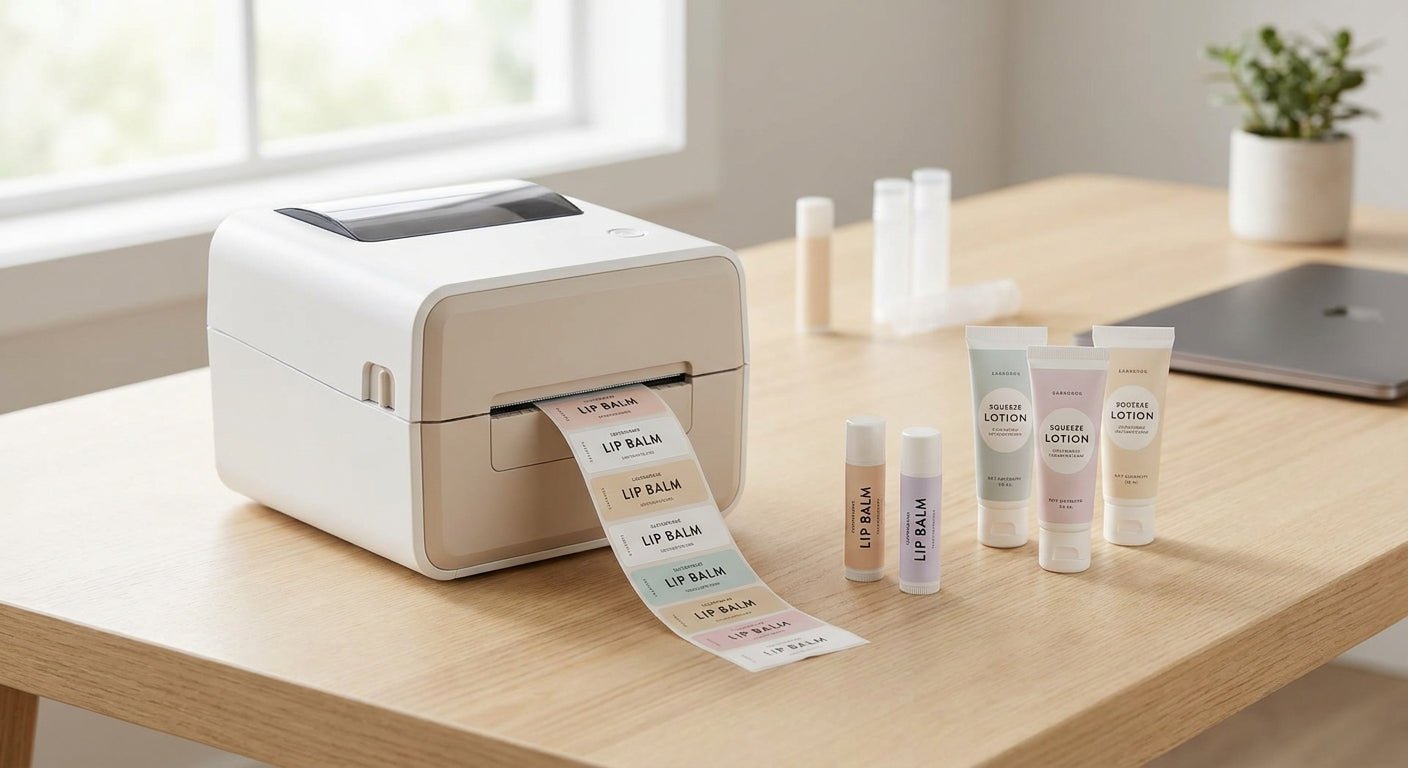
Picking a label printer for lip balm tubes and lotion bottles comes down to one number: resolution. Small text, thin barcodes, and curved surfaces expose a coarse printhead fast, and that's the difference between a label that reads clean at 1 inch wide and one that turns into a blur of ink.
Most D2C beauty brands shopping for a label printer for lip balm tubes in 2026 are printing runs of 100 to 5,000 units with ingredient lists, batch codes, and small logos crammed onto a half-inch to 2-inch label. That's a specific job, and it rules out a chunk of the general-purpose printers people default to. If you sell cosmetics at any real volume, the printer question and the label material question get decided together, not separately.
Why this matters
A 203 DPI printer prints roughly 8 dots per millimeter. On a shipping label that's fine. On a 5-point ingredient disclaimer wrapped around a 0.5-inch lip balm tube, it turns letters into mush by the third character. Lotion tubes have more real estate, but they're often glossy or slightly curved, which means adhesive and print durability matter as much as resolution.
Brands that get this wrong end up reprinting entire batches after a customer complains the label peeled in a bathroom or the barcode won't scan at a retail register. The fix isn't complicated: match DPI to label size, match label stock to the tube surface, and stop treating this like a generic shipping-label decision.
How this list was ranked
The ranking below weighs three things any lip balm or lotion brand actually cares about: print resolution relative to label size, ribbon requirement (direct thermal vs. thermal transfer), and whether the printer is built for continuous small-batch runs versus industrial daily volume. Specs are pulled from published printer data as of 2026 — no printer here gets credit for a feature it doesn't ship with.
Each entry gets a plain verdict: Buy, Consider, Hold, or Skip. No printer gets a pass just because it's popular.
The ranked list
1. GoDEX RT863i — the resolution king
The GoDEX RT863i prints at 600 DPI on a 4-inch head, which is nearly double the dot density of a standard 300 DPI unit. That density is what keeps a 6-point ingredient panel legible on a tube barely 3/4 inch wide.
If your lip balm SKUs carry FDA-style ingredient disclosures or fine-print batch/lot codes, this is the printer that won't force you to enlarge the label just to keep text readable. Buy if fine print and small-format legibility are non-negotiable for your line in 2026.
2. GoDEX RT230i — the workhorse
At 300 DPI, the GoDEX RT230i is the resolution most cosmetics brands actually need for lotion tube and jar labels in the 1.5 to 3-inch range. It handles thermal transfer ribbon, which means the print resists the humidity and handling that direct thermal labels can't survive in a bathroom cabinet.
This is the printer most lotion and lip balm operations should start with unless their label is smaller than an inch. Buy for standard-size tube and jar labels running daily production batches.
3. GoDEX DT230 — the budget play
The GoDEX DT230 direct thermal printer skips ribbon entirely, which lowers the per-label cost and simplifies changeovers for short runs. It's a reasonable pick if you're testing a new lip balm scent line and don't want ribbon inventory sitting around.
The tradeoff: direct thermal print fades with heat and UV exposure over months, which matters if your product sits in a car or a sunlit shelf. Consider for short test runs and prototypes, not for shelf-stable retail stock in 2026.
4. GoDEX GE300 — the entry point that falls short
The GE300 prints at 203 DPI, the same resolution common on basic shipping-label printers. On a standard 4x6 shipping label, that's plenty. On a lip balm tube label with an ingredient list packed into a half-inch strip, it isn't.
Brands that buy this one for tube labels almost always end up upgrading within a year. Skip for anything smaller than a 2-inch label; fine for warehouse and shipping use elsewhere in the operation.
5. GoDEX G500 — the wildcard
The G500 is built for wider label runs and higher daily throughput rather than the narrow, high-resolution labels lip balm packaging needs. It's a solid pick if your brand also ships pallets of finished goods and needs one machine to cover both jobs.
For tube labels alone, it's oversized for the task. Hold unless you're also running high-volume shipping labels alongside your cosmetics line.
6. GoDEX RT700i — the standalone convenience pick
The RT700i adds a color display and keyboard interface, letting a production line reprint a label without a connected PC. That's useful in a shared packaging station where three people are labeling different SKUs off one machine.
Resolution and use case otherwise mirror the RT230i. Consider if standalone operation without a workstation matters more than shaving cost.
Comparison table
| Printer | Resolution | Ribbon Required | Best Fit | Verdict |
|---|---|---|---|---|
| GoDEX RT863i | 600 DPI | Yes | Fine-print ingredient labels, small tubes | Buy |
| GoDEX RT230i | 300 DPI | Yes | Standard lotion/lip balm labels | Buy |
| GoDEX DT230 | 300 DPI | No | Short test runs | Consider |
| GoDEX GE300 | 203 DPI | Yes | Shipping labels, not tube labels | Skip |
| GoDEX G500 | 300 DPI | Yes | Mixed shipping + packaging use | Hold |
| GoDEX RT700i | 300 DPI | Yes | Standalone shared-station printing | Consider |
Where to source printers and label stock
- Buy the printer and the label material from the same source when possible — mismatched ribbon and printhead specs are the most common cause of skipped or smudged prints.
- For tube labels exposed to moisture (bathroom counters, gym bags), pair a thermal transfer printer with polyester label stock rather than paper — paper wicks moisture and lifts at the seams.
- Get a custom quote before committing to a printer if your label size, adhesive, or run volume is nonstandard; label stock and printhead compatibility vary more than most buyers expect.
FAQ
What's the best label printer for lip balm tubes in 2026? The GoDEX RT863i is the strongest pick for lip balm tubes because its 600 DPI resolution keeps small ingredient text and barcodes legible on labels under an inch wide, which lower-resolution printers can't reliably do.
Is 300 DPI enough for lotion bottle labels? Yes, for most lotion bottles and jars in the 1.5-inch-plus range, 300 DPI printers like the GoDEX RT230i produce clean, scannable results. Drop below 300 DPI and small text starts to blur.
Do I need thermal transfer or direct thermal for cosmetics labels? Thermal transfer holds up better against humidity, oils, and handling over the shelf life of a lip balm or lotion product. Direct thermal is cheaper per label but fades with heat and sun exposure within months.
How much does a label printer for lip balm tubes cost? Pricing varies by resolution and print width — check current listings for the specific GoDEX model, since 600 DPI units run higher than 203 or 300 DPI models.
Can one printer handle both lip balm tubes and lotion bottles? Yes, a 300 DPI printer like the GoDEX RT230i covers both if your smallest label stays above roughly 1 inch; drop to a 600 DPI unit if any SKU needs sub-1-inch fine print.
What label material works best on curved lip balm tubes? Polyester label stock conforms to curved surfaces better than paper and resists lifting at the seam, especially important on tubes that get handled daily.
Is a 203 DPI printer ever acceptable for cosmetics packaging? Only if your label is 2 inches or larger with minimal fine print — for standard lip balm tube sizes, 203 DPI is the wrong resolution.
Do these printers work with Shopify order and label workflows? GoDEX printers integrate with standard label design software for batch printing runs, which fits a Shopify-based cosmetics operation printing labels ahead of fulfillment.
One last thing
The detail most cosmetics brands miss isn't the printer — it's the ribbon-to-label match. A 600 DPI printhead paired with the wrong wax-resin ribbon for a glossy polyester label will still smear under a fingernail scratch test. Match resolution, ribbon chemistry, and label stock as one decision, not three separate purchases, and the reprint rate on lip balm and lotion runs drops close to zero.