
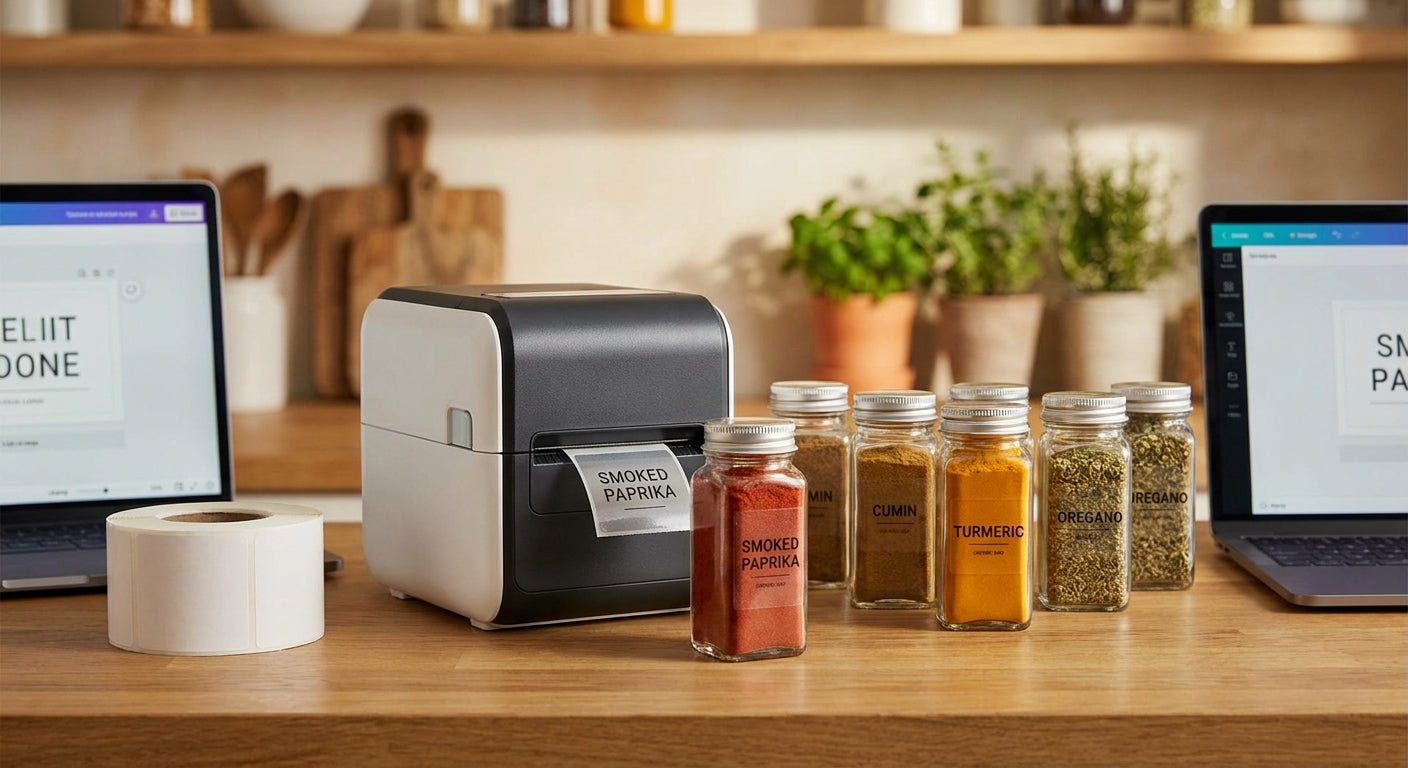
Spice jar labels are small, round or square, and printed by the hundreds or thousands per batch — that combination breaks a lot of general-purpose label printers before the first production run finishes. This guide ranks the machines that hold registration on tight label stock and survive daily use in a food packaging line.
TL;DR
For most spice brands printing under 5,000 labels a month, the GoDEX RT230i (300 DPI) is the verdict: sharp enough for 6-point ingredient text, fast enough for batch runs, and priced for small operations. If you're printing sub-1-inch labels with dense nutrition panels, step up to the GoDEX RT863i (600 DPI). Budget-first shops packaging basic single-spice jars can run the GoDEX GE300 (203 DPI) and get acceptable results through 2026 and beyond. A label printer for spice jars only earns its keep if it prints legible small text on curved surfaces without smearing under kitchen humidity — not every desktop printer clears that bar.
Why this matters
Spice jar labels carry more information per square inch than almost any other packaging label: product name, net weight, ingredient list, allergen warnings, and a barcode, all inside a label often smaller than 2 inches square. Push a low-resolution printer to render that much text at that size and you get blurred edges on 6- and 7-point fonts — the exact sizes FDA-style ingredient panels require.
DPI is the deciding spec here, not print speed. A label printer for food products built for cartons or pouches often runs at 203 DPI because larger labels forgive lower resolution — spice jars don't have that room. Get the resolution wrong and you'll reprint entire batches or accept labels a retail buyer flags on sight.
How we ranked
Each printer below is evaluated on four criteria that matter specifically for spice jar work: print resolution relative to typical label size (0.75" to 2.5"), rated print speed in inches per second (ips) for batch runs, direct thermal vs. thermal transfer capability for moisture and oil resistance in kitchen environments, and desktop footprint since most spice operations don't have dedicated warehouse floor space. Specs are pulled from published GoDEX printer documentation current as of 2026. No lab testing claims are made — this is a specification-based ranking, not a bench test.
The ranked list
1. GoDEX RT230i (300 DPI) — the resolution pick
The RT230i prints at 300 DPI and handles both direct thermal and thermal transfer ribbon, which matters if your spice jars sit near stovetop heat or get handled with oily fingers. Rated speed runs up to 5 ips, enough to clear a 500-label batch run in well under 15 minutes. At 300 DPI, 6-point ingredient text on a 1.5-inch label stays readable without a magnifying glass — 203 DPI printers routinely blur at that size.
This is the printer most spice brands should buy first in 2026: it covers small-batch label runs without the premium cost of 600 DPI hardware. Buy.
2. GoDEX GE300 (203 DPI) — the budget entry pick
The GoDEX GE300 is a 203 DPI direct thermal unit built for straightforward label jobs — brand name, weight, barcode, done. If your spice jar label design keeps ingredient text at 8-point or larger and skips a dense allergen block, 203 DPI is legible enough and the GE300 costs less upfront than the 300 or 600 DPI models.
Where it falls short: direct thermal-only means no ribbon option, so labels near heat sources or with heavy handling can fade faster than thermal transfer prints. Fine for indoor pantry shelf life, less fine for jars shipped in hot trucks. Consider if your design is simple and your budget is the priority.
3. GoDEX RT863i (600 DPI) — the premium pick for fine print
The GoDEX RT863i runs 600 DPI, roughly double the resolution of the standard 300 DPI models, and it's the printer to buy if your spice jar label design crams a full nutrition panel, allergen statement, and a small barcode onto a label under 1 inch tall. Barcodes at 600 DPI hold scan accuracy at sizes that would blur into an unreadable smear at 203 DPI.
Speed and resolution trade off here — 600 DPI printing runs slower per label than the 300 DPI RT230i, so high-volume batch runs take longer. For brands running dense compliance text on tiny jars, that tradeoff is worth it. Buy if label real estate is tight and legal text can't shrink further.
4. GoDEX RT200i (203 DPI) — the compact desktop pick
The RT200i is a smaller-footprint 203 DPI printer aimed at desks and countertop production spaces rather than dedicated packaging lines. It handles the same basic label jobs as the GE300 in a tighter physical package, which matters if your spice operation runs out of a shared kitchen or a converted garage rather than a warehouse.
Resolution ceiling is the same 203 DPI limitation — fine for large-format text, not for dense ingredient panels on small jars. Consider for desk-space-constrained operations with simple label designs.
5. GoDEX GX4200i (203 DPI) — the high-volume batch pick
The GX4200i is built for higher-throughput label runs than the desktop GoDEX models, with a sturdier chassis meant for daily multi-hour print cycles rather than occasional batches. If your spice brand is scaling past a few thousand jars a month and label printing has become a bottleneck, throughput matters more than desktop convenience.
At 203 DPI it carries the same small-text limitation as the GE300 and RT200i — pair it with a simplified label design or step up to 300 DPI hardware if ingredient panels are dense. Consider for volume, not for fine print.
Comparison table
| Printer | Resolution | Print method | Best for | Verdict |
|---|---|---|---|---|
| GoDEX RT230i | 300 DPI | Direct thermal + thermal transfer | Most spice jar labels | Buy |
| GoDEX GE300 | 203 DPI | Direct thermal | Simple label designs, tight budget | Consider |
| GoDEX RT863i | 600 DPI | Direct thermal + thermal transfer | Dense allergen/nutrition text on tiny jars | Buy |
| GoDEX RT200i | 203 DPI | Direct thermal | Small desk footprint | Consider |
| GoDEX GX4200i | 203 DPI | Direct thermal + thermal transfer | High-volume daily batch runs | Consider |
Where to buy
- Buy direct from a manufacturer or authorized reseller that stocks GoDEX printer parts and ribbon, not a marketplace listing with no support line — thermal printheads need calibration and occasional replacement.
- Confirm the label stock and ribbon combination is rated for food packaging use before ordering a bulk roll; not every direct thermal label survives grease or moisture contact on a spice jar.
- If you're unsure which resolution your label design needs, get a custom quote with your exact label dimensions and text density rather than guessing from a spec sheet alone.
FAQ
What's the best label printer for spice jars in 2026? The GoDEX RT230i at 300 DPI is the best all-around pick for most spice jar operations in 2026 — it balances legible small text with batch print speed most small brands need.
Do I need 300 DPI or 600 DPI for spice jar labels? 300 DPI covers most spice jar designs with 6-point or larger text. Move to 600 DPI only if your label crams a full nutrition panel and barcode onto a jar under 1 inch tall.
Is direct thermal or thermal transfer better for spice jars? Thermal transfer holds up better against oil, heat, and handling because the ribbon-based print resists fading; direct thermal is cheaper but fades faster near heat or moisture over time.
Can these printers handle small round labels? Yes — GoDEX desktop and industrial models handle small round and square label stock, but confirm your label roll width and gap-sensing settings match the printer's supported range before ordering rolls in bulk.
How much does a label printer for spice jars cost? Pricing varies by resolution and print method — check current pricing directly on the product page, since 203 DPI, 300 DPI, and 600 DPI models sit at different price points.
Will spice jar labels survive contact with oil or moisture? That depends more on label material and print method than on the printer alone — thermal transfer ribbon on the right stock resists oil and moisture better than basic direct thermal paper labels.
Is GoDEX better than Zebra for small-batch spice labeling? For small-batch food packaging runs, GoDEX printers offer comparable DPI options at a lower entry cost than most Zebra industrial models, though both brands cover the resolution range spice labeling needs.
Do I need a barcode on a spice jar label? Most retail spice jars need a scannable barcode for shelf sale, which is why resolution matters — a blurred barcode at 203 DPI on a label under 1 inch fails to scan at checkout.
One last thing
The resolution spec sheet doesn't tell the whole story: a 300 DPI printer running worn or uncalibrated can produce blurrier text than a properly calibrated 203 DPI unit. Before blaming the hardware for a smeared batch, check printhead calibration and ribbon tension first — it's the most common fix that gets skipped in 2026 troubleshooting calls.