
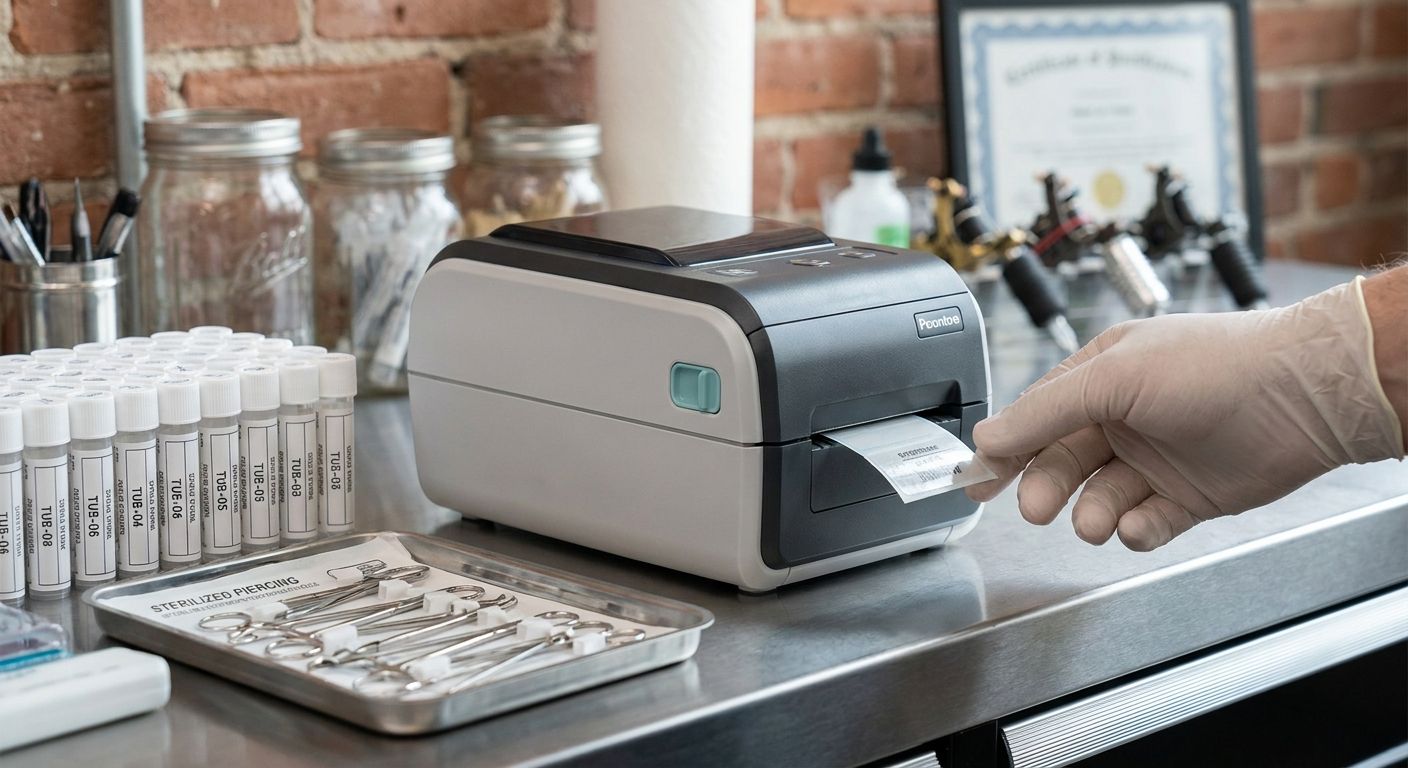
Tattoo and piercing studios print more labels than most people assume — aftercare cards, ink lot barcodes, consent form QR codes, sterilization pouch tags — and consumer inkjet printers choke on all of it. This guide ranks five GoDEX thermal printers sold through McAuley Labels that actually hold up on a studio counter in 2026.
- GoDEX RT700i+ is the best label printer for tattoo studios overall at $581 in 2026 — buy it.
- GoDEX ZX430i+ prints 300 DPI barcodes and QR consent codes for $945 — buy for detail-heavy shops.
- GoDEX DT200L is the compact $374 pick for single-chair studios and mobile piercers — consider it.
- Skip GE330's ribbon-only setup unless you already stock thermal transfer ribbon for synthetic stock.
Why this matters
A studio that skips barcode-tracked ink lots and legible aftercare labels is one health inspection away from a problem. McAuley Labels builds its printer lineup around exactly this kind of high-frequency, small-format printing — short runs, synthetic or paper stock, and labels that need to survive alcohol wipe-downs near a sterilization station.
Most studios need three label types on rotation: aftercare instruction cards handed to every client, barcode or QR-coded consent and intake records, and lot-numbered ink or cartridge tags for compliance. A cheap thermal printer built for shipping labels won't hold small text or barcode density well enough for any of the three. That's the gap this list fills.
How this list was ranked
Each printer here is scored on four things that matter specifically for a tattoo or piercing counter: print resolution for small QR and barcode work, desktop footprint since most stations are tight, direct thermal versus thermal transfer for supply simplicity, and price per unit in 2026. Printers that only make sense in a warehouse or a high-volume retail backroom were left off, even when they're solid machines for other jobs.
The ranked list
1. GoDEX RT700i+ Thermal Printer — the safe pick
The GoDEX RT700i+ is a 4-inch dual-mode printer running at 203 DPI with a color display, priced at $581 in 2026. It switches between direct thermal and thermal transfer without swapping hardware, which means one printer covers plain aftercare cards and ribbon-printed synthetic labels.
For a studio printing 50-150 labels a day across aftercare cards, price tags, and appointment slips, this is the printer that does the job without a learning curve. The color display makes it easy to check the label queue between clients without touching a computer.
Verdict: Buy. This is the GoDEX RT700i+ for any studio that wants one printer to cover 80% of daily label needs.
2. GoDEX ZX430i+ Thermal Printer — the detail specialist
The GoDEX ZX430i+ doubles resolution to 300 DPI on the same 4-inch dual-mode chassis, at $945 in 2026. That extra resolution is the difference between a QR code that scans on the first try and one a phone camera has to hunt for.
Studios that barcode ink lots for compliance tracking, or print QR-linked digital consent forms, need the sharper output. Sub-inch barcodes and dense text render clean at 300 DPI; they blur at 203.
Verdict: Buy for studios doing barcode inventory or QR consent tracking. The GoDEX ZX430i+ earns its higher price on detail work alone.
3. GoDEX DT200L Direct Thermal Printer — the compact one
The GoDEX DT200L is a 2-inch linerless direct thermal printer at 203 DPI, priced at $374 in 2026. Linerless means no backing paper to peel off and toss — a small detail that matters when counter space and trash volume are both tight.
This is the printer for a single-chair studio, a mobile piercer, or a pop-up booth that only needs aftercare cards and simple price tags, not barcode-dense inventory labels.
Verdict: Consider. Fine for small-footprint operations; underpowered for studios running barcode tracking on ink or jewelry stock.
4. GoDEX RT200i Thermal Printer — the budget entry point
The GoDEX RT200i is a 203 DPI desktop thermal printer, positioned below the RT700i+ in the lineup. It covers plain-text aftercare labels and basic price tags without the dual-mode flexibility or color display of the RT700i+.
A studio that only prints simple text labels — no barcodes, no QR codes — can run this without missing anything.
Verdict: Consider for text-only label needs; skip if barcode or QR printing is even a maybe for 2026.
5. GoDEX GE330 Thermal Transfer Printer — the ribbon specialist
The GoDEX GE330 is a 4-inch, 203 DPI thermal transfer printer — ribbon-only, no direct thermal mode. That makes it a fit for studios printing exclusively on synthetic or vinyl stock that needs to survive repeated alcohol wipe-downs near a sterilization bench.
For most tattoo and piercing studios, though, the dual-mode RT700i+ covers the same synthetic-label job without forcing a ribbon-only workflow for everything else.
Verdict: Hold. Only worth it if the studio already runs ribbon-based printing elsewhere and wants a dedicated unit for synthetic stock.


Comparison table
| Printer | Resolution | Width | Price (2026) | Best for | Verdict |
|---|---|---|---|---|---|
| GoDEX RT700i+ | 203 DPI | 4 in | $581 | All-around studio counter | Buy |
| GoDEX ZX430i+ | 300 DPI | 4 in | $945 | Barcode/QR-heavy labeling | Buy |
| GoDEX DT200L | 203 DPI | 2 in | $374 | Single-chair / mobile setups | Consider |
| GoDEX RT200i | 203 DPI | 4 in | Not listed | Text-only labels | Consider |
| GoDEX GE330 | 203 DPI | 4 in | Not listed | Ribbon-only synthetic stock | Hold |
Where to buy
- Buy direct-thermal-capable models (RT700i+, DT200L) if the studio wants to skip ribbon inventory entirely for basic labels.
- Confirm direct thermal versus thermal transfer before ordering label stock — the two use different label materials and one type won't run on the wrong printer mode.
- Match resolution to the smallest barcode or QR code the studio actually prints; buying 300 DPI for plain text labels is money spent on capability nobody uses.
FAQ
What is the best label printer for tattoo studios in 2026?
The GoDEX RT700i+ is the best label printer for tattoo studios in 2026 at $581, covering aftercare cards, price tags, and basic barcode labels in one dual-mode unit. Studios doing heavy QR or barcode work should step up to the GoDEX ZX430i+ instead.
Do tattoo studios need direct thermal or thermal transfer printers?
Most tattoo studios do fine with a direct thermal printer for aftercare cards and basic labels, since it skips ribbon costs entirely. Studios printing on synthetic stock near sterilization stations benefit from a thermal transfer or dual-mode printer like the RT700i+.
How much does a label printer for a tattoo studio cost?
Label printers for tattoo studios in this list range from $374 for the compact GoDEX DT200L to $945 for the 300 DPI GoDEX ZX430i+. Most single-location studios land in the $374-$581 range unless they need high-resolution barcode printing.
Is 300 DPI better than 203 DPI for tattoo studio labels?
300 DPI prints sharper small text and barcodes, which matters for QR-coded consent forms and dense ink lot barcodes. Studios only printing plain aftercare text won't notice a difference and can save money with a 203 DPI model.
Can a GoDEX printer print QR codes for consent forms?
Yes, GoDEX printers in the ZX430i+ and RT700i+ range print QR codes reliably, with the 300 DPI ZX430i+ handling smaller codes more cleanly. Low-resolution 203 DPI printers can blur dense QR codes below a certain size.
Do piercing studios need a different printer than tattoo studios?
No, piercing and tattoo studios have nearly identical labeling needs: aftercare cards, jewelry or cartridge lot tracking, and consent records. The same GoDEX models on this list cover both without modification.
What labels does a tattoo studio print most often?
Aftercare instruction cards handed to every client are the highest-volume label, followed by ink lot barcodes and appointment or price tags. Consent form QR codes are lower volume but higher stakes for compliance recordkeeping.
Does a linerless printer save money for a small studio?
Yes, a linerless printer like the GoDEX DT200L eliminates backing paper waste, which reduces both material cost and counter clutter in tight single-chair setups. It trades that convenience for a smaller 2-inch print width.
One last thing
The real dividing line between the RT700i+ and the ZX430i+ isn't the $364 price gap — it's whether the studio ever prints a QR code under roughly half an inch square. Below that size, 203 DPI starts producing codes that phone scanners hesitate on or reject outright, and that's a consent-form problem nobody wants during an audit.