
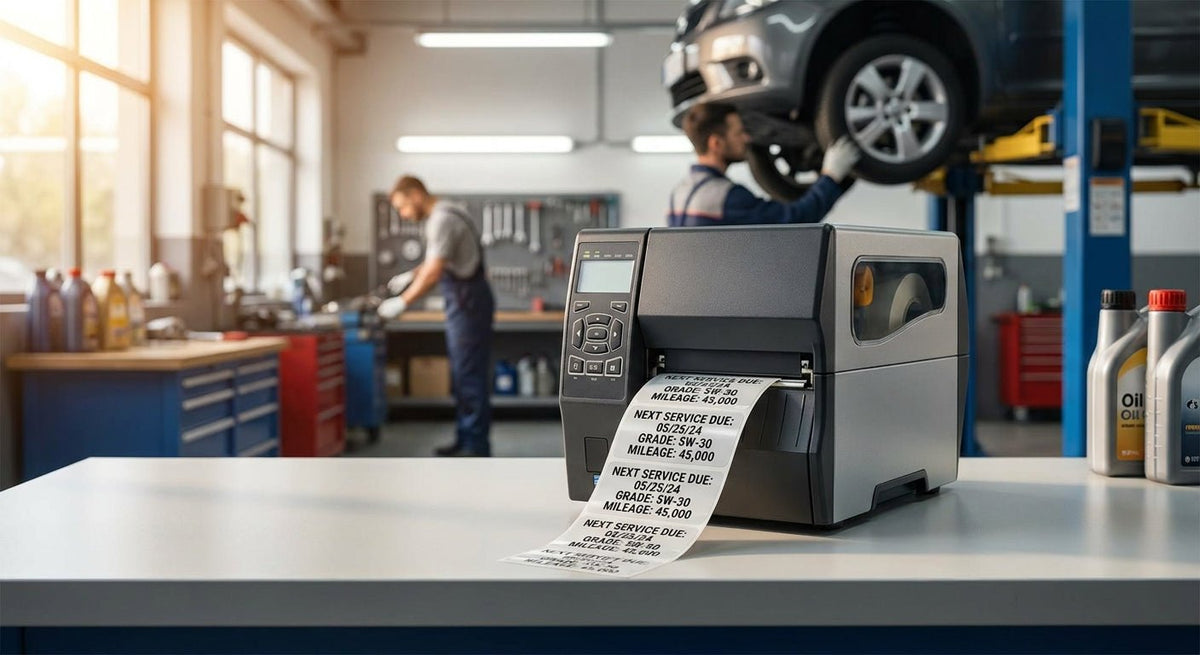
Express lube chains run on throughput — 15 to 25 cars per bay per day — and a slow or unreliable oil change sticker printer for express lube chains kills that pace fast. This guide ranks the best printer options for 2026, built around the specs that actually matter in a high-volume drive-through lube environment.
TL;DR: For express lube chains in 2026, the best oil change sticker printer for express lube chains is a 300 DPI direct thermal or thermal transfer unit — fast enough to print a sticker in under 3 seconds, durable enough to handle a greasy service bay, and simple enough that any tech can operate it without training. The McAuley Labels oil change sticker printer system is the purpose-built option. Godex models at 203 DPI work for lower-volume bays; 300 DPI is the floor for chains printing logos and QR codes at readable size.
Why This Matters for Express Lube Chains
A typical express lube location completes 80 to 120 oil changes per day across multiple bays. Every sticker gets applied to a windshield at drive-off — it carries your brand, the next service date, and mileage. If the printer jams, fades, or requires a PC reboot to run, you lose time on every single ticket. In 2026, most chains are also adding QR codes that link to digital service records, which demands a minimum of 300 DPI to scan reliably from a windshield. The printer choice is not a small decision.
How We Ranked
Rankings are based on four criteria weighted for express lube chain operations: print speed (stickers per minute at full label size), resolution (minimum readable QR code output), durability (operating temperature range and duty cycle), and deployment simplicity (standalone keyboard vs. PC-dependent setup). Printers that require a dedicated Windows PC at every bay score lower. Printers with standalone operation or USB host ports score higher. All models listed are available through McAuley Labels as of 2026.
The Ranked List
1. McAuley Labels Oil Change Sticker Printer System
The purpose-built pick for multi-bay chains.
This is the oil change sticker printer system built specifically for automotive service use. It ships pre-configured for windshield sticker stock, which eliminates the calibration step that trips up generic thermal printers in a service bay environment. The system is designed to run without a connected PC — a standalone keyboard handles label editing on the counter. For a chain opening a new location in 2026, this removes the IT dependency entirely.
Print speed is fast enough to keep pace with a 4-bay express lube at full throughput. The sticker output is sharp enough for logos and QR codes at standard windshield-sticker dimensions.
Verdict: Buy — the right tool for chains that want zero setup friction and consistent output across locations.
2. Godex RT230i — 300 DPI Thermal Transfer
The sharpest output in the Godex line for sticker detail.
The Godex RT230i at 300 DPI prints at 6 inches per second and handles label widths up to 4.4 inches — wide enough for a full windshield sticker with a logo, mileage field, and QR code on one label. At 300 DPI, QR codes at 0.8 inch square scan cleanly from 12 inches, which is the practical read distance through a windshield. The RT230i runs thermal transfer, meaning it uses ribbon — output is smear-resistant and survives temperature swings inside a parked car in summer.
For chains printing custom-logo stickers, 300 DPI at this print speed is the minimum spec that keeps the line moving without sacrificing legibility. The RT230i connects via USB, serial, or Ethernet — the Ethernet port matters for chains that want to push jobs from a shop management system.
Verdict: Buy — best resolution-to-speed ratio for branded sticker output in 2026.
3. Godex RT200i — 203 DPI Direct Thermal
The volume workhorse for plain-text sticker ops.
The Godex RT200i at 203 DPI is a no-ribbon direct thermal unit that prints date, mileage, and next-service fields cleanly at high speed. At 203 DPI, plain text is sharp; small logos are acceptable; QR codes below 1 inch square get marginal. If your chain uses pre-printed logo sticker stock and only needs a printer to fill in the variable data fields, the RT200i is faster to maintain — no ribbon changes mid-shift.
Direct thermal stock is slightly more sensitive to heat and UV over time compared to thermal transfer output, so chains in hot climates or with long service intervals should factor in fade risk on stickers sitting on a dashboard.
Verdict: Buy for plain-text ops; Hold if logo or QR code output is a requirement.
4. Godex GE300 — 203 DPI, 4-inch
The entry point for a new location on a tight equipment budget.
The Godex GE300 at 203 DPI prints at 5 inches per second on 4-inch media. It handles the basic oil change sticker format — date, mileage, shop name in text — without issue. The GE300 lacks the Ethernet port of the RT series, which limits centralized job management. For a single-bay location or a franchise pilot adding sticker printing for the first time in 2026, it covers the functional requirement at the lowest entry cost.
The duty cycle is rated for moderate volume. High-throughput bays running 100-plus tickets daily should step up to the RT series.
Verdict: Consider for low-volume locations; Skip for established multi-bay express lube chains.
5. Godex RT863i — 600 DPI Thermal Transfer
Overkill for most sticker ops, right tool for premium branding.
The Godex RT863i at 600 DPI prints at a resolution that makes photographic-quality logos legible on a 2-inch sticker. For most express lube chains, 600 DPI is more than the application needs. Where it earns its place is franchise groups that use full-color-adjacent high-contrast logos — think multi-color brand marks that look blurry at 203 DPI and acceptable at 300 DPI. At 600 DPI, they look intentional. The RT863i also handles compliance labels and equipment tags, making it a dual-purpose unit if the shop already needs high-resolution output for other labeling tasks.
Verdict: Hold unless premium logo resolution or dual-purpose use (oil change + asset tags) justifies the step up.
Comparison Table
| Model | DPI | Print Method | Print Speed | Ethernet | Standalone KB | Best For |
|---|---|---|---|---|---|---|
| McAuley Sticker Printer System | Configured | Thermal | Fast | Check site | Yes | Multi-bay chains, no IT setup |
| Godex RT230i | 300 | Thermal Transfer | 6 in/sec | Yes | No | Logo + QR stickers, Ethernet-connected bays |
| Godex RT200i | 203 | Direct Thermal | High | Yes | No | High-volume plain-text sticker ops |
| Godex GE300 | 203 | Direct Thermal | 5 in/sec | No | No | Single-bay or pilot locations |
| Godex RT863i | 600 | Thermal Transfer | Moderate | Yes | No | Premium logo detail, dual-use |
What to Avoid
Inkjet printers repurposed for sticker printing. Ink smears on greasy hands, fades under UV in weeks, and refill costs per sticker exceed thermal media costs by a wide margin at express lube volume.
203 DPI printers if your chain uses QR codes. A QR code below 1 inch at 203 DPI fails to scan reliably — especially through a tinted windshield in direct sunlight. Scannable QR output requires 300 DPI minimum on standard sticker stock.
PC-dependent setups without a shop management integration plan. A printer that requires an always-on Windows PC at each bay adds a failure point. If the PC crashes or updates mid-shift, the bay stops. Standalone or Ethernet-networked printers with server-side job push are the 2026 standard for chains with 3 or more bays.
Where to Buy
- McAuley Labels (mcauleylabels.com) carries the purpose-built oil change sticker printer system plus the full Godex line. Sticker stock — including windshield static-cling and adhesive formats — is available as matched media.
- Order custom-logo sticker stock alongside the printer so both arrive together and the system is ready to run on day one. The oil change stickers with custom logo page covers stock options.
- For chains needing a volume quote across multiple locations, the custom quote page handles multi-unit pricing.
FAQ
What's the best oil change sticker printer for express lube chains in 2026? The McAuley Labels oil change sticker printer system is the purpose-built choice — pre-configured for windshield sticker stock, standalone operation, and no PC required. For chains that want a Godex unit, the RT230i at 300 DPI is the correct spec for logo and QR code output.
Is 203 DPI good enough for oil change stickers? 203 DPI prints date, mileage, and text fields cleanly. It is not adequate for QR codes under 1 inch or small logos. Chains printing variable-data-only on pre-printed logo stock can use 203 DPI. Chains printing full stickers from blank stock need 300 DPI minimum.
How fast does a thermal printer need to be for a busy express lube? A bay completing 25 cars per day needs a printer that outputs one sticker in under 5 seconds. Godex RT-series printers at 6 inches per second cover that comfortably. Throughput is rarely the bottleneck — media jams and ribbon-out stops are the real pace-killers, so duty cycle and ease of ribbon reload matter more than raw speed.
Do I need a PC to run an oil change sticker printer? Not with the McAuley Labels system or Godex models that support standalone keyboard operation. For Ethernet-connected Godex units, a networked print server or shop management system handles job dispatch without a dedicated PC at each bay.
What sticker material works best for windshield oil change stickers? Static-cling stock removes without adhesive residue — preferred by customers. Adhesive stock stays put in extreme heat. McAuley Labels stocks both formats matched to their printers. See the comparison between static cling and adhesive options at the static cling vs adhesive oil change stickers guide.
Can I print QR codes on oil change stickers with a Godex printer? Yes, at 300 DPI or 600 DPI. The RT230i at 300 DPI produces scannable QR codes at 0.8 inch square. At 203 DPI, QR codes need to be at least 1.2 inches square to scan reliably — which may not fit standard sticker stock dimensions.
How do I set up a Godex printer for oil change sticker printing? Godex printers use GoLabel software for label design. Load the sticker template, set the media type (continuous or gap-detect), calibrate, and run a test print. Full setup steps are covered in the how to set up an oil change sticker printer system guide.
What's the difference between direct thermal and thermal transfer for oil change stickers? Direct thermal needs no ribbon — simpler to maintain mid-shift. Thermal transfer uses ribbon and produces output that resists heat, UV, and smearing better over a 6-month service interval. Chains in hot climates or with longer service intervals between customer visits should use thermal transfer stock.
One Last Thing
In 2026, the chains adding QR codes to their stickers are building a trackable service history without any additional software investment — the QR code links directly to the vehicle's record. That data becomes a retention tool at the customer's next visit. A 300 DPI printer pays for the upgrade in customer retention before the first ribbon roll runs out.