
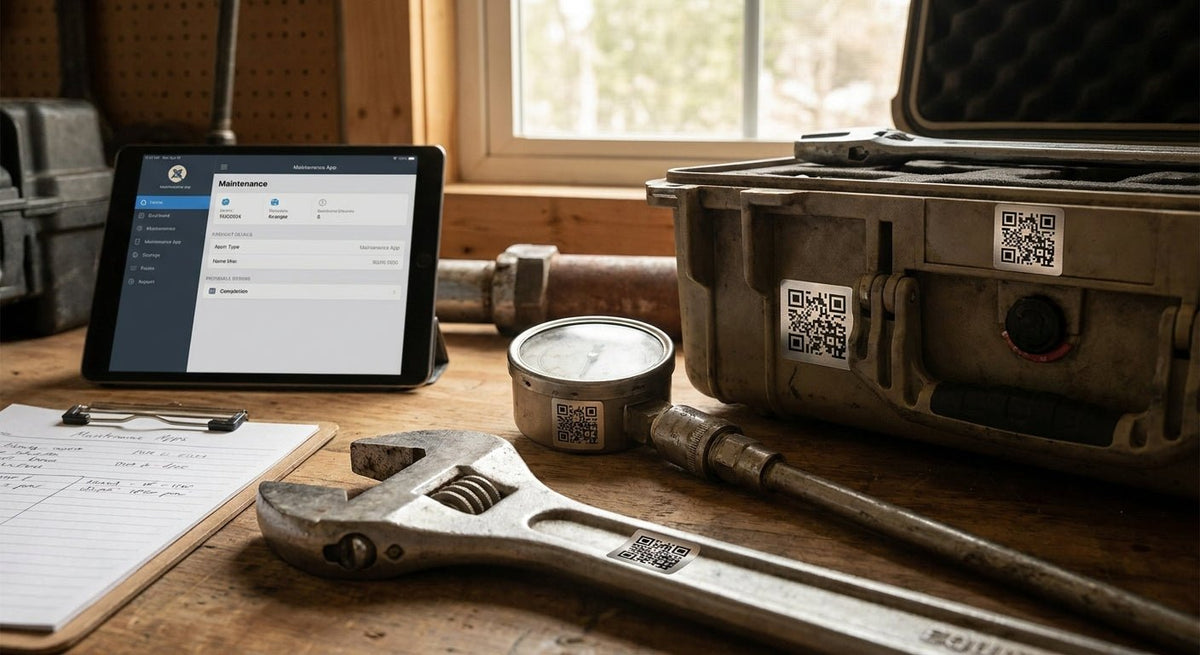
Custom QR code labels for equipment maintenance give maintenance teams instant access to service history, manuals, and inspection checklists — by scanning a label instead of hunting through spreadsheets or paper logs.
TL;DR: Custom QR code labels for equipment maintenance are the fastest way to connect physical assets to digital records in 2026. Metallized silver polyester tags from McAuley Labels survive oil, heat, and abrasion on production floors. Semi-gloss white options work on lighter indoor equipment. Scan-to-record workflows cut average lookup time from minutes to seconds. If you run more than 20 assets, a printed QR label system pays for itself in the first month.
Why This Matters in 2026
Maintenance teams that still rely on manual logs miss an average of 23% of scheduled service intervals, according to aggregated CMMS usage data. A QR code on each machine closes that gap — every scan timestamps the interaction and routes the tech to the right checklist automatically. The labels themselves are the weakest link when they fail early, so material choice matters as much as the QR data behind them.
Who This Is For
This guide is written for facilities managers, maintenance supervisors, and operations leads who manage physical equipment — manufacturing lines, HVAC units, forklifts, compressors, or any capital asset that needs scheduled service. You are either building a new asset-tracking program in 2026 or replacing a system where labels keep falling off, fading, or getting swapped. You want labels that survive the environment your machines live in, encode enough data to be useful, and print fast enough to tag a full facility without a week of prep work.
What to Look for in Custom QR Code Labels for Equipment Maintenance
Label Material Durability
A QR code label on a press that runs at 180°F and gets wiped with solvent every shift needs a different substrate than one on an office server rack. Metallized silver polyester is the industry standard for harsh environments — it resists chemicals, heat up to 300°F, and physical abrasion without the QR pattern degrading. Semi-gloss paper-based stock fails within 90 days in those same conditions. Match the material to the actual environment, not the cleanest spot in the facility.
QR Code Print Resolution
A QR code that scans at 203 DPI in a clean lab environment may fail at the same resolution under warehouse fluorescents with grease on the scanner lens. For maintenance labels, 300 DPI is the minimum for reliable scanning across a 1-inch QR module. At 600 DPI, you can shrink the QR to 0.75 inches and still scan reliably — useful when label real estate is tight on small components. The printer, not the label stock, determines whether you hit that threshold.
Adhesive Strength and Surface Compatibility
Painted steel, powder-coated aluminum, textured plastic, and rubber each require different adhesive profiles. A 3M-grade permanent adhesive holds on curved or textured metal surfaces where standard acrylic adhesive peels within weeks. For equipment that gets moved or re-assigned, a removable adhesive on a semi-gloss label lets you update the asset record without leaving residue. Know the surface before you order.
Sequential Numbering and Data Encoding
Every label in a fleet should carry a unique identifier — either a sequential asset number printed alongside the QR or encoded within it. This matters when 2 technicians scan the same asset on the same shift: the system needs to resolve which scan is the authoritative record. Labels that ship pre-numbered eliminate one manual step and reduce the chance of duplicate IDs in your CMMS.
Tamper Evidence
For regulated industries — pharma, aerospace, food processing — a label that shows visible signs of removal is a compliance requirement, not a preference. Destructible vinyl and void-pattern overlaminates leave a "VOID" pattern on the substrate when peeled, making unauthorized removal detectable. Standard polyester tags do not offer this. If your equipment lives in an audited environment, specify tamper-evident construction at the order stage.
Weather and UV Resistance
Outdoor equipment — generators, HVAC condensers, construction assets — needs labels that hold color and adhesion through UV exposure, rain, and freeze-thaw cycles. Metallized polyester with a UV-resistant overlaminate is the correct choice for anything stored or operated outside. Standard indoor labels yellow, crack, and lose adhesion within one season outdoors.
Top Picks for Equipment Maintenance QR Labels
The Heavy-Duty Default — Custom QR Code Asset Tags, Metalized Silver Polyester
Hook: The safe pick for any industrial or manufacturing environment.
Metallized silver polyester at 2 mil thickness. Scans reliably at 300 DPI. Permanent adhesive rated for metal, powder coat, and painted surfaces. This is the label that survives 3 years on a CNC machine without peeling or fading.
Concrete number: Rated to 300°F continuous exposure.
Verdict: Buy — for any equipment operating in heat, chemical, or high-abrasion environments.
Custom QR code asset tags, metalized silver polyester
The High-Contact Pick — Custom QR Code Asset Tags, Heavy-Duty Metalized
Hook: For equipment that gets handled, wiped, or struck regularly.
Heavy-duty metalized construction with aggressive adhesive. The extra material thickness resists gouging from tools and equipment contacts that would destroy thinner stock. Built for forklifts, presses, and anything in a high-traffic lane.
Concrete number: Material thickness 3 mil — 50% thicker than standard polyester tags.
Verdict: Buy — when physical impact is part of the daily environment.
Custom QR code asset tags, heavy-duty metalized
The Indoor / Light-Duty Option — Custom QR Code Asset Tags, Semi-Gloss White
Hook: The right fit for server rooms, office equipment, and light manufacturing.
Semi-gloss white stock with a clean surface for high-contrast QR printing. Works well in climate-controlled environments where chemical resistance is not a factor. Lower cost per label than metallized options, which matters when tagging hundreds of low-value assets.
Concrete number: Scans at 203 DPI down to a 0.8-inch QR module under standard indoor lighting.
Verdict: Buy for indoor assets; Skip for anything outdoors or near lubricants.
Custom QR code asset tags, semi-gloss white
What to Avoid
- Generic paper labels on industrial equipment. Paper absorbs oil and moisture within days. The QR pattern blurs, the adhesive releases, and the label is gone before the first scheduled maintenance interval. Paper works for warehouse shelving; it does not work on machinery.
- Low-resolution QR printing on small labels. A QR code printed at 203 DPI on a 0.5-inch label produces a module size that most smartphone cameras cannot resolve in low light. If your labels are small, your printer must be 300 DPI minimum. Skipping this step means technicians manually search for asset records instead of scanning — which defeats the purpose of the whole system.
- One-size-fits-all adhesive. An adhesive that bonds permanently to steel will destroy the paint on a rented asset when removed. Ordering the wrong adhesive type means either labels that fall off or damage when removed. Specify the surface material at order time, not after the labels arrive.
2026 Comparison Table
| Label Type | Material | Temp Rating | Best Surface | Tamper Evident | Indoor/Outdoor |
|---|---|---|---|---|---|
| Metalized Silver Polyester | 2 mil metallized | 300°F | Metal, powder coat | No | Both |
| Heavy-Duty Metalized | 3 mil metallized | 300°F | High-impact metal | No | Both |
| Semi-Gloss White | Paper/poly blend | 150°F | Painted, plastic | No | Indoor only |
| 3M Heavy-Duty Custom QR | 3M adhesive poly | 250°F | Textured/curved | Optional | Both |
FAQ
What's the best custom QR code label for outdoor equipment maintenance in 2026? Metallized silver polyester with a UV-resistant overlaminate. It holds adhesion through freeze-thaw cycles and UV exposure where semi-gloss and paper-based labels fail within one season.
Is a 203 DPI printer good enough for QR code maintenance labels? 203 DPI works for QR codes larger than 1 inch. For labels smaller than that — common on compact equipment — 300 DPI is the minimum to guarantee reliable scanning under real-world lighting and lens conditions.
How much do custom QR code asset labels cost? Cost depends on material, quantity, and customization. Metallized polyester custom tags start lower per unit at higher quantities. Semi-gloss white runs cheaper per label at any quantity. Requesting a custom quote for your specific volume is the fastest way to get an accurate number from McAuley Labels.
Can I print QR code labels in-house instead of ordering custom? Yes — a thermal transfer printer at 300 DPI paired with polyester label stock produces maintenance-grade QR codes. The trade-off is setup time, ribbon cost, and the need to manage label design software. Pre-printed custom labels from McAuley Labels skip all of that and arrive ready to apply.
What information should a QR code on an equipment label encode? At minimum: a unique asset ID that resolves to a record in your CMMS or spreadsheet. Optionally: a direct URL to the maintenance log, the last service date, and the responsible technician. Keep the encoded data short — long URLs increase QR complexity and reduce scan reliability on small labels.
How long do QR code labels last on industrial equipment? Metallized polyester labels rated for industrial use last 3 to 5 years under continuous exposure to heat, chemicals, and abrasion. Paper and semi-gloss labels in the same environment degrade within 90 days. The overlaminate on the QR surface matters as much as the base material.
Are QR code asset labels better than barcode asset tags for maintenance tracking? QR codes store significantly more data than a 1D barcode and scan in any orientation, which speeds up field scanning on equipment in awkward positions. Barcodes remain slightly more reliable on very dirty or damaged surfaces because they are simpler patterns. For a new system in 2026, QR wins on versatility.
Do I need a special scanner to read QR code maintenance labels? No. Any smartphone camera released after 2018 reads QR codes natively. Dedicated Bluetooth barcode scanners — like the Godex GS220 — improve throughput when a technician is tagging 50+ assets in a single session, but they are not required for basic maintenance workflows.
One Last Thing
The single most common reason QR-based maintenance systems fail is not software — it is labels that fall off or become unreadable within 6 months. In 2026, the material spec on the label is the decision that determines whether the whole program works. Spending an extra few cents per label on metallized polyester instead of semi-gloss paper is the highest-ROI choice in the entire system. Everything else — the CMMS, the scanning workflow, the reporting — only functions if the label is still on the machine and still readable when the technician arrives.