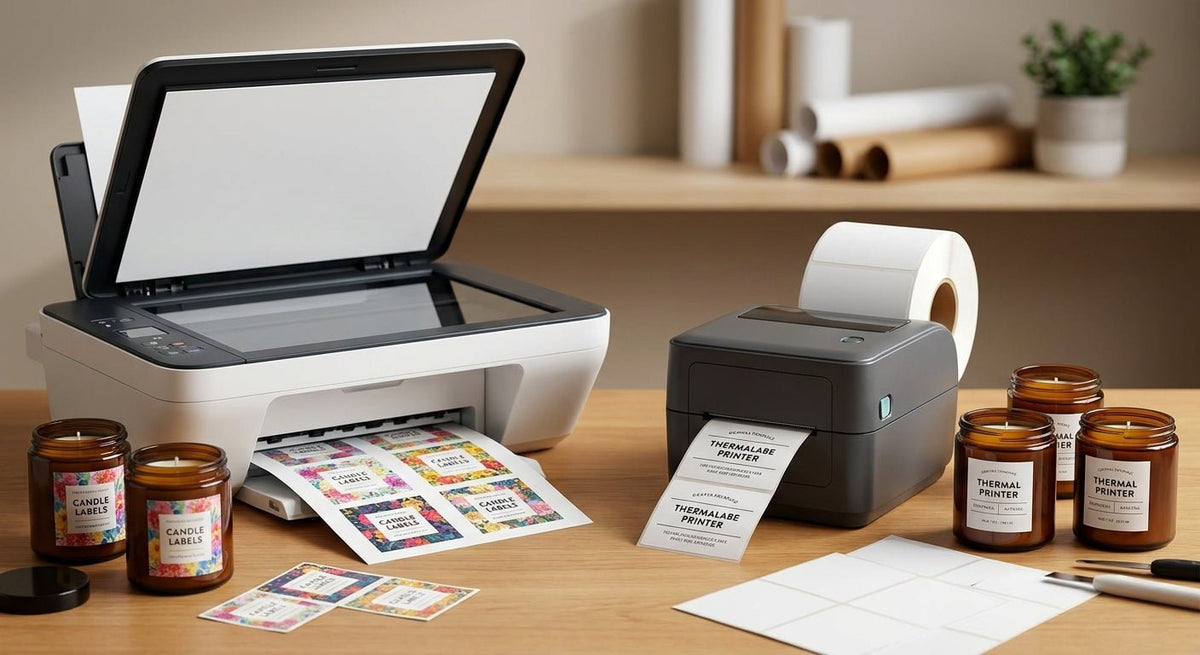
For small-batch candle makers choosing between inkjet vs thermal printer for candle labels, the wrong pick costs you smeared ink, peeling stock, and reprints that eat into margin. This guide ranks both technologies against the specific demands of candle label production in 2026 — heat, wax exposure, oil contamination, and curved glass surfaces.
TL;DR: Thermal transfer wins for candle labels in 2026. Direct thermal is too heat-sensitive for candles sitting near flame and warm wax. Inkjet produces rich color but requires waterproof coated stock, a separate cutter, and ink that smears on oily or waxy surfaces unless you laminate. For volume above 50 labels per week, a thermal transfer printer on glossy white polyester or synthetic stock delivers the durability and per-label cost that candle businesses actually need.
Why This Matters for Candle Labels
Candle labels face three stressors that most product labels don't: radiant heat from the flame, condensation on glass jars, and oily or waxy residue from handling. A label that looks perfect off the printer can be illegible or peeling after 30 days on a shelf. Choosing the wrong print technology in 2026 means either reprinting constantly or hand-applying professionally printed labels you ordered in bulk and can't change.
The inkjet vs thermal printer for candle labels question is also a workflow question. Inkjet printers sit on a desk and need ink cartridges, coated label stock, and often a laminator. Thermal printers — direct thermal or thermal transfer — use heat instead of ink, which changes the cost structure and the material requirements entirely.
How We Ranked
This ranking evaluates inkjet and thermal technologies across five criteria that matter specifically for candle label production: heat resistance, moisture and oil resistance, print quality on curved stock, per-label cost at 100–500 labels per week, and setup complexity for a small operation. Each technology is scored against those criteria, not against general office printing needs.
Ranked: Inkjet vs Thermal for Candle Labels in 2026
1. Thermal Transfer — The Production Pick
Hook: The production-grade choice for any candle maker printing more than 100 labels per week.
Thermal transfer printers use a heated printhead to melt wax-based or resin-based ink from a ribbon onto label stock. The printed image is physically bonded to the surface — it does not smear when exposed to heat up to approximately 150°F, oils, or water. On glossy white polyester stock (the standard material for candle jar labels), thermal transfer output resists scratching, condensation, and oily fingerprints without lamination.
Print resolution runs from 203 DPI on entry-level units to 300 DPI on mid-range models and 600 DPI on industrial units. For a candle label with a logo, ingredient list in 6pt type, and a barcode or QR code, 300 DPI is the practical minimum. At 203 DPI, fine serif fonts below 8pt become muddy.
Per-label cost at 300-label runs: approximately $0.04–$0.08 including ribbon and stock, depending on label size and ribbon type. That is lower than inkjet at any comparable volume.
The Godex RT230i (300 DPI) and the Godex GX4300i thermal printer are purpose-built for exactly this output. Both handle 4-inch wide label stock, which covers most standard candle jar formats including 2" x 3" wraparound labels and 3" x 3" flat-front labels.
Verdict: Buy. Thermal transfer is the right call for any candle operation printing consistently in 2026.
2. Direct Thermal — The Disqualified Option
Hook: Cheap upfront, unusable for candles.
Direct thermal printers use heat-sensitive paper that darkens when the printhead passes over it. No ribbon, no ink. That sounds attractive for a low-volume operation. The problem is that candle labels are stored near heat sources, shipped in warm vehicles, and sit on surfaces that get warm during pours. Heat above roughly 140°F — easily reached on a label stuck to a jar sitting near a candle — will darken or blank direct thermal output. Labels stored in a warm car or warehouse in summer show the same degradation.
Direct thermal is also sensitive to UV light, so labels fade in a few months in a retail display window. There is no fix for this with stock selection because the heat-sensitivity is built into the paper chemistry.
For shipping labels, kitchen date labels, or any application where the label has a short lifespan, direct thermal is fast and cost-effective. For candle labels, it is not functional.
Verdict: Skip for any candle label application.
3. Inkjet — The Color-Rich Compromise
Hook: The right answer only if full-color photo-quality labels are non-negotiable and volume stays low.
Inkjet printers deposit liquid ink onto label stock. On the right coated, waterproof stock, inkjet output can be vivid — CMYK or six-color systems reproduce gradients and photography that thermal transfer (which is typically monochrome or limited color) cannot match. For a candle brand built around premium visual identity with full-bleed color artwork, an inkjet printer on glossy inkjet-compatible label stock is a viable path.
The catch is the word "compatible." Standard inkjet ink is water-soluble. On an uncoated label, a single drop of water — or the condensation that forms on a cold glass jar brought into a warm room — smears the print immediately. You need inkjet-specific waterproof label stock, and even then oily residue from wax handling can lift ink from the surface over time. Many candle makers using inkjet add a laminate layer or overlaminate tape to seal the print, which adds $0.05–$0.15 per label and a manual step.
Inkjet ink cartridges are also consumable. A standard CMYK cartridge set for a desktop inkjet costs $30–$60 and yields enough ink for roughly 200–500 full-coverage 2"x3" labels. Per-label ink cost at that volume runs $0.10–$0.25, before stock. At 500+ labels per week, inkjet economics deteriorate fast.
Inkjet printers also require a separate cutter or manual trimming unless you buy a purpose-built inkjet label printer (such as the Primera LX series or the Epson ColorWorks line), which start at $300–$500 for entry-level units.
Verdict: Hold — appropriate only for makers producing under 50 labels per week who need photographic color and are willing to laminate.
4. Laser — Worth Mentioning, Not Recommended
Hook: Dry toner holds up better than inkjet on heat, but the format is wrong.
Laser printers use fused toner rather than liquid ink, so output is more heat-resistant than inkjet and does not smear when wet. For candle labels specifically, the limitation is format: most laser printers produce 8.5"x11" sheets, requiring you to print on full sheets of label stock and then hand-cut or die-cut individual labels. Sheet-fed laser label sheets cost $0.20–$0.50 per sheet for waterproof polyester stock, and cutting 8–12 labels per sheet by hand introduces sizing inconsistency. Color laser output is also more expensive per label than thermal transfer for volume above 100 labels per run.
Verdict: Skip unless you already own a color laser and need a one-time short run.
Comparison Table
| Criteria | Thermal Transfer | Direct Thermal | Inkjet | Laser |
|---|---|---|---|---|
| Heat resistance | High (150°F+) | Fails at ~140°F | Moderate (with laminate) | Moderate |
| Moisture resistance | High (polyester stock) | Low | Low–Moderate | Moderate |
| Oil/wax resistance | High | Low | Low (without laminate) | Moderate |
| Print resolution | 203–600 DPI | 203–300 DPI | 1200–4800 DPI | 600–1200 DPI |
| Color capability | Mono or limited color | Mono | Full CMYK | Full CMYK |
| Per-label cost (300/week) | $0.04–$0.08 | $0.03–$0.06 | $0.15–$0.40 | $0.20–$0.50 |
| Setup complexity | Medium | Low | Medium–High | High |
| 2026 verdict | Buy | Skip | Hold | Skip |
What to Avoid
- Direct thermal on any candle label, full stop. The heat sensitivity is not a minor drawback — it is a disqualifying defect for this application. Labels that blank out in a warm shipping box make your product look defective.
- Inkjet without lamination on glass jar labels. Condensation is not a rare event; it happens every time a cold jar enters a warm room. Unlaminated inkjet labels on glass will show water marks or smear within the first few handling cycles.
- Thermal transfer at 203 DPI on labels with fine text or small barcodes. If your label includes an ingredient list in any type size below 8pt, or a QR code smaller than 0.75" square, 203 DPI produces edges that are visibly jagged and QR codes that fail to scan. Specify 300 DPI minimum for candle labels.
Where to Buy
- Thermal transfer printer: Source a dedicated label printer sized for your label width (2"–4" covers nearly all candle formats). McAuley Labels carries the full Godex line, including 203 DPI, 300 DPI, and 600 DPI options, with US-based support.
- Stock: Match stock to printer. Thermal transfer requires thermal transfer label stock — paper or polyester. Glossy white polyester is the standard for candle jars because it conforms to curved surfaces and resists moisture. McAuley Labels stocks glossy white polyester TT labels compatible with thermal transfer output.
- Inkjet (if you go that route): Buy from a dedicated label printer manufacturer (Primera, Epson ColorWorks) rather than adapting an office inkjet. Office inkjets are not designed for roll label stock and will feed inconsistently.
FAQ
What's the best printer type for candle jar labels in 2026? Thermal transfer is the best printer type for candle jar labels. It produces heat-resistant, moisture-resistant output on polyester stock without lamination, and per-label cost stays below $0.10 at production volumes.
Is inkjet better than thermal for small-batch candle labels? Only if you need full photographic color and print fewer than 50 labels per week. Inkjet requires waterproof stock and lamination to hold up against the heat and moisture a candle label faces. Above 50 labels per week, thermal transfer is cheaper and more durable.
Can you use a direct thermal printer for candle labels? No. Direct thermal labels degrade when exposed to heat above approximately 140°F, which candle labels routinely encounter during storage, shipping, and normal use near a burning candle.
What DPI do I need for candle label printing? Minimum 300 DPI for candle labels with ingredient text, logos, and barcodes or QR codes. At 203 DPI, fine text becomes muddy and small QR codes can fail to scan reliably.
What label stock should I use for candle jars? Glossy white polyester thermal transfer stock. It conforms to curved glass, resists condensation, and holds thermal transfer ink without lamination. Paper stock works for flat tin candle containers in dry storage but fails on glass jars.
How much does it cost to print candle labels in-house in 2026? Thermal transfer runs approximately $0.04–$0.08 per label including ribbon and polyester stock at 300-label runs. Inkjet with laminate runs $0.20–$0.45 per label at the same volume. The printer itself is a one-time cost; factor in $300–$600 for an entry-level thermal transfer unit.
Can I print color candle labels with a thermal transfer printer? Standard thermal transfer is monochrome (black on white or colored stock). Some thermal transfer units support color ribbons for 2- or 3-color spot-color output, which covers most candle brand designs — logo color plus black text. Full-process CMYK thermal transfer exists but the hardware costs $2,000+. For full-color photo artwork, inkjet with lamination is the practical alternative.
Does label size affect which printer type I should choose? Yes on format width. Most thermal transfer desktop units handle up to 4" wide stock, which covers standard candle formats including wraparound labels for 8 oz and 16 oz jars. Labels wider than 4" require a wide-format thermal transfer unit or sheet-fed laser/inkjet.
One Last Thing
The failure mode almost no one talks about: thermal transfer labels printed on paper stock (not polyester) will still delaminate from glass jar surfaces when condensation forms between the label and the glass. The print survives; the adhesive fails. If your candles are displayed in a refrigerated case, a high-humidity retail environment, or shipped in temperature-variable packaging, specify polyester stock with a permanent pressure-sensitive adhesive rated for glass — not the default paper stock that comes with most label sample packs.