
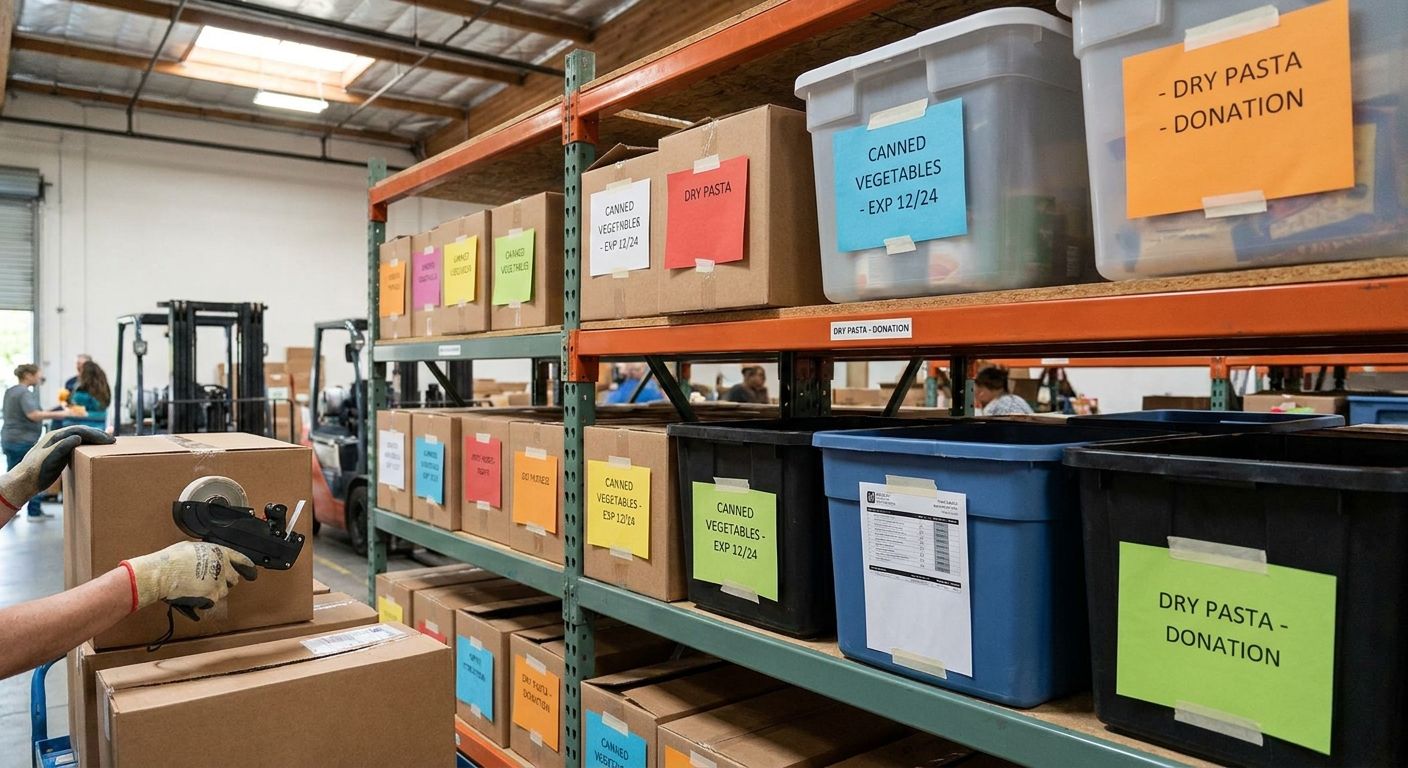
Food pantries and nonprofit warehouses run inventory with volunteer labor, thin budgets, and storage rooms that swing from dry shelving to a walk-in cooler in the same aisle — this guide names the specific inventory labels that hold up under those conditions in 2026 and the ones that fail by week three.
- McAuley Labels' Custom QR Code Inventory Labels ($67) are the safe pick for inventory labels for food pantry warehouses in 2026 — Buy.
- 3M Heavy-Duty Barcode Inventory Labels ($115) hold on pallet racking and coolers; Skip them for one-time donation bins.
- Semi-gloss numbered QR labels ($67) suit dry-storage shelving but curl in humid loading docks — Consider for climate-controlled rooms.
- Laser-printed address labels and static cling stickers peel within weeks in a cooler — Skip both for nonprofit warehouse inventory.
Why this matters
A pantry that re-labels the same shelf three times a year isn't dealing with bad shelving — it's dealing with the wrong label stock. Standard inkjet stickers smear the moment a volunteer wipes a shelf with a damp rag, and a barcode scanner can't read faded ink under warehouse fluorescents. Metalized silver polyester inventory labels avoid that failure because the image isn't ink absorbed into paper — it's printed direct thermal or thermal transfer onto a synthetic face that doesn't soak up moisture.
Custom QR Code Inventory Labels run $67 a roll and hold a scan through a season in a walk-in cooler, where a laser-printed sticker turns illegible inside a few weeks. That's the difference between a volunteer re-counting a pallet by hand in 2026 and one who scans a code and moves to the next rack.
Who this is for
This guide is for the person running inventory at a food bank distribution center, a church pantry with donated pallet racking, or a nonprofit warehouse where the labeling crew turns over every few months. You're not choosing labels for a retail backroom with trained staff — you're choosing labels a new volunteer can apply correctly on day one, that a $30 smartphone scanner can read, and that survive a facility with no climate control budget for the storage room.
What to look for in inventory labels for food pantry warehouses
Adhesive that holds on cold, condensing surfaces
A walk-in cooler or a loading dock in January puts condensation on every metal surface a label touches. Cheap adhesive lifts at the corner within days, and once one corner lifts, the whole label goes in the trash with the pallet wrap. McAuley Labels builds its inventory label adhesives to stay put through that cycle instead of needing a laminate pouch as a workaround.
Print method that survives handling, not just printing
A label that looks fine coming off the printer isn't the same as one that survives six months of forklifts, box cutters, and shrink wrap. Direct thermal print fades under UV and heat over time; thermal transfer with a resin ribbon locks the image into the label face and resists rub-off from repeated handling — the difference matters more in a warehouse than a retail counter.
Barcode or QR density a cheap scanner can read
Most nonprofit warehouses don't own a $1,200 industrial scanner — they scan with a phone or a $30-$60 handheld unit. Label density has to match that hardware: oversized barcodes and clean-edged QR codes scan reliably on entry-level gear, while tightly packed codes printed at low resolution just produce error beeps and manual entry.
A numbering system that survives volunteer turnover
If your labeling scheme lives in one coordinator's head, it dies the day that person moves on. Sequential numbered labels tied to a simple spreadsheet or free inventory app let any volunteer scan and log an item without training, which matters more in a warehouse where the labeling crew changes every quarter.
Cost per label that scales with donation volume, not against it
Donation volume spikes around holidays and disaster response, and label spend needs to flex with it, not become the bottleneck. A $67 roll of a few hundred labels beats ordering small batches of pre-printed numbered stickers every time volume jumps, because the roll gets printed in-house as inventory changes.
Top picks for food pantry and nonprofit warehouse inventory labels
The safe pick — Custom QR Code Inventory Labels (metalized silver polyester), $67. These print on a synthetic face that shrugs off cooler condensation and cardboard dust, and the QR format scans clean on a basic smartphone camera. Any warehouse mixing dry shelving with cold storage should default here. Verdict: Buy.
The heavy lifter — Custom Barcode Inventory Labels, 3M Heavy-Duty, $115. The 3M adhesive is built for painted metal pallet racking and high-touch zones where labels get bumped, scraped, and re-scanned daily. It costs $48 more than the standard roll, which only pays off if your racking sees heavy daily traffic. Verdict: Buy for pallet racking, Skip for one-time donation crates.
The budget pick — Custom QR Code Inventory Labels Numbered, Semi-Gloss White, $67. Same price as the metalized silver option but built for dry-storage shelving rather than damp environments. It's the right call for a canned-goods storage room that never sees condensation. Verdict: Consider, for climate-controlled rooms only.
The wildcard — Asset Tags for Equipment, Semi-Gloss White Barcode, $67. These are built for tagging fixed equipment and shelving units, not rotating product inventory, so they're the wrong tool if you need to track what's on the shelf rather than the shelf itself. Use them on racking, pallet jacks, and refrigeration units, not on food bins. Verdict: Consider for fixed-asset tracking, Skip for product-level inventory.


What to avoid
- Laminated paper labels sold as "waterproof." The laminate pouch peels at the seam the first time it hits a walk-in cooler, and once moisture gets under the edge the barcode underneath is gone.
- Generic inkjet or laser address labels. They have no guaranteed scan resolution and the ink runs the moment a damp cloth touches the shelf — fine for a mailing list, wrong for a scanned inventory system.
- Static cling stickers built for windshields. They're designed to grip glass, not painted metal racking, and they slide off shelving edges within a shift. For shelf and bin labeling specifically, see inventory stickers for shelves and storage bins before ordering the wrong stock.
“If a label needs a laminate pouch to survive the walk-in cooler, it's the wrong label for a food pantry warehouse.”
Verdict comparison table
| Label | Material | Best Use | Price | Verdict |
|---|---|---|---|---|
| Custom QR Code Inventory Labels | Metalized silver polyester | Cooler and freezer shelving | $67 | Buy |
| Custom Barcode Inventory Labels, 3M Heavy-Duty | 3M heavy-duty polyester | Pallet racking, high-traffic zones | $115 | Buy |
| Custom QR Code Inventory Labels Numbered | Semi-gloss white | Dry-storage shelving | $67 | Consider |
| Asset Tags for Equipment | Semi-gloss white | Fixed racking, not product bins | $67 | Consider |
FAQ
What are the best inventory labels for food pantry warehouses in 2026?
Metalized silver polyester QR code labels are the best all-around choice for food pantry warehouses in 2026 because they hold up in coolers and dry storage alike. A 3M heavy-duty version is worth the upgrade for pallet racking that sees daily forklift traffic.
Do QR code labels work better than barcodes for a food pantry?
QR codes generally read easier on a basic smartphone camera than 1D barcodes, which matters when a nonprofit is scanning with donated phones instead of dedicated scanners. Barcodes still work fine with a handheld scanner if the warehouse already owns one.
How much do custom inventory labels cost for a nonprofit warehouse?
Standard metalized silver or semi-gloss white inventory labels run about $67 a roll, while 3M heavy-duty versions built for rough pallet racking run around $115. Cost per label drops as roll count goes up, which matters for a warehouse printing labels in-house.
Will inventory labels survive a walk-in cooler or freezer?
Metalized silver polyester and 3M heavy-duty labels are built for condensation and cold surfaces, unlike paper-based or laser-printed stickers. Laminated paper labels are the most common failure point in cold storage because the laminate seam lets moisture in.
Can volunteers apply inventory labels without training?
Yes, if the labels are pre-sized and numbered sequentially, a new volunteer can apply them correctly without a walkthrough. The bigger risk is inconsistent numbering when the labeling system isn't documented anywhere outside one person's memory.
Is 3M heavy-duty adhesive necessary for a food pantry warehouse?
Only for surfaces that get heavy daily handling, like pallet racking or forklift-adjacent shelving. For dry-storage shelving that sees light traffic, a standard semi-gloss white or metalized silver label at $67 is enough and skips the $48 premium.
What's the difference between asset tags and inventory labels?
Asset tags are meant for fixed equipment like shelving units, refrigeration, and pallet jacks, while inventory labels track rotating product on that equipment. Using asset tags to label food bins mixes up the two systems and makes stock counts harder to audit.
Do I need a special printer to print these labels in-house?
A direct thermal or thermal transfer label printer running 203 to 300 DPI covers most barcode and QR needs for a warehouse. Higher 600 DPI resolution only matters if you're printing very small QR codes under half an inch.
One last thing
The detail most pantries miss isn't the label material — it's the math on batch size. A $67 roll of a few hundred labels beats reordering small batches of pre-printed numbered stickers every quarter, because the roll format lets a warehouse print labels in-house the moment inventory changes, instead of waiting on a reorder while a new pallet of donated goods sits unlabeled on the dock in 2026.