
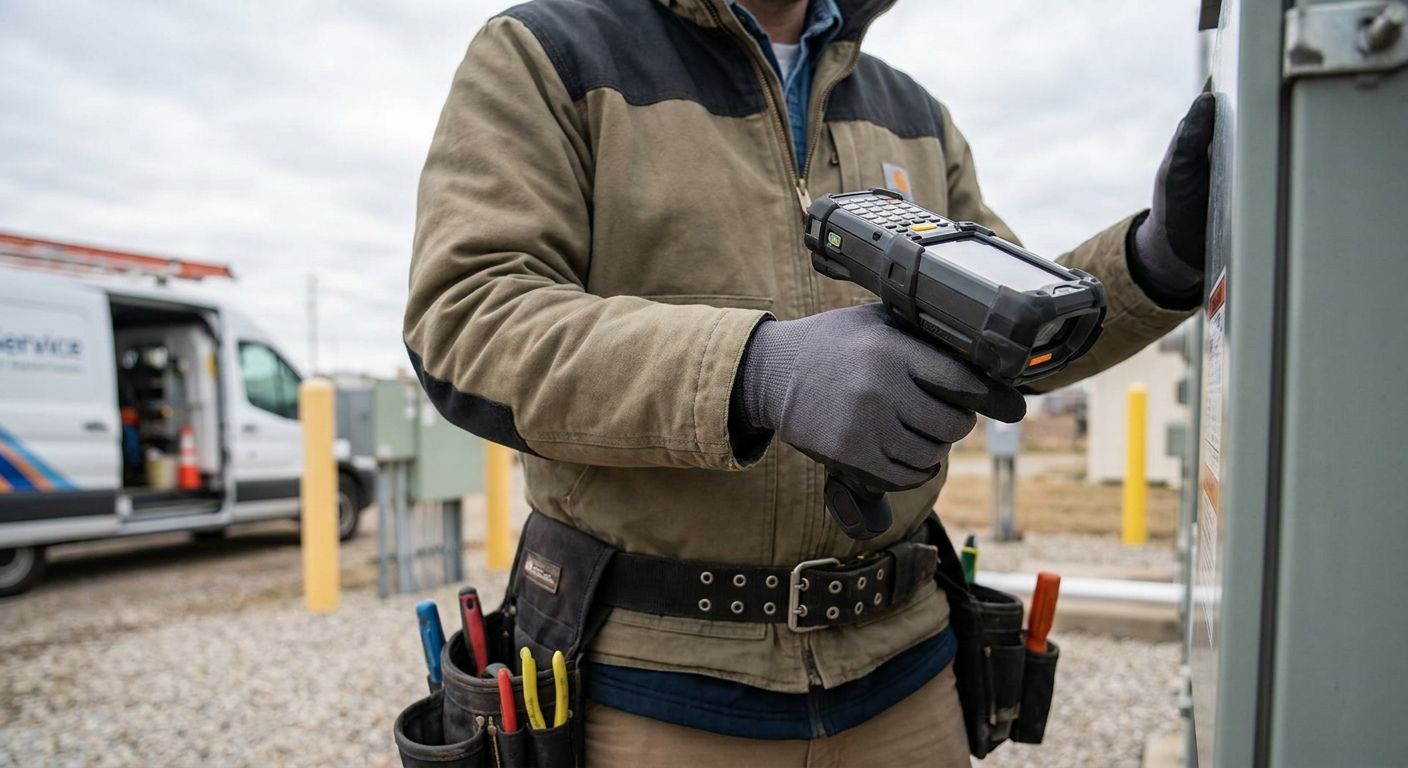
Field service technicians scan barcodes on trucks, in driveways, and inside mechanical rooms with bad lighting — the wrong scanner slows down every stop on the route. This guide breaks down which scanner type actually holds up in that environment and which one is overkill for 2026 budgets.
- GoDEX GS220 USB 1D scanner is the buy at $86 for techs scanning simple linear barcodes on asset tags.
- 2D imager scanners are the right call the moment QR codes show up on oil change stickers or equipment tags.
- Cordless/Bluetooth scanners earn their keep on multi-bay shops and large sites, not single-van routes.
- Rugged industrial scanners are a Consider, not a default buy, unless drops and dust are a daily reality.
- Mobile computer combo units are a Wait for most crews — the scanner-plus-PDA premium rarely pays off in 2026.
Why this matters
A field technician's barcode scanner is only as good as the labels it's reading. Most service fleets already run 3M heavy-duty asset tags on equipment, and those tags carry either a straight linear barcode or a QR code depending on when they were ordered. Buy a scanner that can't read the tag format already on your equipment and every stop turns into a manual data entry job.
The mistake most service managers make in 2026 is buying the scanner that worked at the retail counter and expecting it to hold up in a truck bed. Retail scanners sit on a stand under fluorescent light. Field scanners get dropped, rained on, and read barcodes at odd angles on curved metal housings. That's a different spec sheet.
How this list is ranked
Each scanner type below is evaluated against three things a field technician actually deals with: what barcode formats it reads (linear-only vs QR-capable), how it connects (corded vs wireless), and whether it survives outdoor conditions. Pricing reflects the McAuley Labels catalog where a matching product exists; category types without a direct product are described by what the category typically requires, not a specific SKU price.
The ranked list
1. USB 1D scanner — the straightforward pick
Hook: the one that costs less than a tank of gas.
The GoDEX GS220 is a plug-and-play USB scanner built for 1D linear barcodes — the format printed on most standard asset tags and inventory labels. It costs $86, needs no pairing, no charging, and no software install beyond a USB port.
This is the right scanner if every barcode your technicians touch is a straight linear code. It is the wrong scanner the moment QR codes enter the workflow, because 1D scanners physically cannot decode a 2D symbol. For a deeper breakdown of when a 1D unit is enough, see how to choose a 1D barcode scanner.
Verdict: Buy for crews running linear-barcode asset tags and a tight 2026 hardware budget.
2. 2D imager scanner — the QR-code requirement
Hook: the one you need if a phone camera could scan your tag but your scanner can't.
2D imagers read linear barcodes and QR/PDF417 codes in the same pass, which matters because a growing share of oil change stickers and equipment tags in 2026 carry QR codes linking to service history or maintenance forms. A 1D-only scanner reads none of that.
Imagers also tolerate a damaged or partially torn label better than laser-based 1D scanners, because they capture the whole symbol as an image rather than sweeping a beam across it. That matters on tags that have lived on a compressor for three years. Full buying criteria live in best 2D barcode scanner for scanning QR codes.
Verdict: Consider — mandatory if any QR-coded tags or stickers are in the field, unnecessary if they're not.
3. Cordless/Bluetooth scanner — the mobility upgrade
Hook: the one that untethers you from the van.
A cordless scanner pairs to a phone, tablet, or a base unit and lets a technician walk a large site — a warehouse floor, a multi-bay service shop, a rooftop mechanical room — without dragging a USB cable back to a laptop. The tradeoff is battery management: someone has to remember to charge it.
For a single-van route where every stop is one piece of equipment, cordless is a solution to a problem you don't have. For techs covering distribution centers or campus facilities, it removes real friction.
Verdict: Buy for multi-site or large-footprint work; Skip for single-stop residential routes.
4. Rugged/industrial scanner — the drop insurance
Hook: the one built for the truck bed, not the counter.
Rugged scanners are built to enclosure ratings (commonly IP54 or higher in this category) that resist dust ingress and light rain, and they're housed to survive drops onto concrete from a few feet up. That construction adds bulk and cost compared to a standard imager.
If your technicians work outdoors in all weather — utility, telecom, HVAC service calls — the extra durability earns its keep over a standard scanner's lifespan. If most work happens indoors in a shop bay, a standard imager does the same job for less.
Verdict: Consider for outdoor and utility field crews; Skip for shop-based technicians.
5. Mobile computer / scanner-PDA combo — the all-in-one
Hook: the one that also files the work order.
These units combine a barcode scanner with a handheld computer running a full mobile OS, letting a technician scan a tag and update a work order on the same device. It's the most capable option on this list and the most expensive to buy and provision.
For most field service crews in 2026, a phone or tablet already handles work orders, and the scanner's only job is reading the barcode — which a standalone imager does for a fraction of the cost and none of the device management overhead.
Verdict: Wait unless your dispatch software specifically requires an integrated scanning computer.
Comparison table
| Scanner Type | Reads | Connection | Best For | Verdict |
|---|---|---|---|---|
| USB 1D (GoDEX GS220) | Linear barcodes only | Corded USB | Simple linear-barcode asset tags | Buy |
| 2D Imager | Linear + QR/PDF417 | Corded or cordless | QR-coded tags, oil change stickers | Consider |
| Bluetooth/Cordless | Linear + QR | Wireless | Large sites, multi-bay shops | Buy |
| Rugged/Industrial | Linear + QR | Corded or cordless | Outdoor, drop-prone environments | Consider |
| Mobile Computer Combo | Linear + QR | Wireless, standalone | Techs who log work orders on-device | Wait |
Where to buy
- Match the scanner to the barcode format already printed on your asset tags before you buy anything — check a sample tag under the scanner's spec sheet, not a marketing photo.
- Confirm warranty terms before ordering; GoDEX printers and scanners carry a 3-year warranty as of 2026, which is worth factoring into a cost comparison against cheaper unbranded scanners.
- Buy from a supplier that also stocks the label stock your scanner needs to read — mismatched label material and scanner optics cause more field failures than the scanner hardware itself.
FAQ
What's the best barcode scanner for field service technicians in 2026?
A 2D imager scanner is the best default for field service technicians in 2026 because it reads both linear barcodes and QR codes. For crews using only simple linear-barcode asset tags, the GoDEX GS220 USB 1D scanner at $86 covers the job for less.
Is a 2D scanner better than a 1D scanner for field service work?
Yes, if any tags or stickers in the field use QR codes, because a 1D scanner physically cannot decode a 2D symbol. If every barcode is a linear code, a 1D scanner does the same job for a lower cost.
How much does a barcode scanner cost for a field service crew?
A basic USB 1D scanner like the GoDEX GS220 costs $86. Cordless, 2D imager, and rugged units cost more depending on connectivity and durability rating, but exact pricing varies by supplier and configuration.
Do field technicians need a Bluetooth or corded scanner?
Corded USB scanners work fine for single-stop, single-device scans at a van or workstation. Bluetooth scanners make more sense for techs walking large sites like warehouses or multi-bay shops where cable length becomes a limitation.
Can a barcode scanner read QR codes on oil change stickers?
Only a 2D imager scanner reads QR codes on oil change stickers — a 1D laser scanner cannot decode a QR symbol regardless of print quality. If your fleet uses QR-coded windshield stickers, a 2D imager is required, not optional.
What barcode format do asset tags use?
Asset tags most commonly use linear (1D) barcodes like Code 128, though QR codes are increasingly common on tags that link to a maintenance record or service history. Check the tag format before choosing a scanner.
Is a rugged scanner worth the extra cost for field service?
A rugged scanner is worth it for technicians working outdoors in all weather or handling equipment that risks drops, since standard scanners aren't built for dust and impact resistance. Shop-based or indoor technicians rarely need the upgrade.
How long is the warranty on a GoDEX barcode scanner?
GoDEX devices, including scanners and printers, carry a 3-year warranty as of 2026. Confirm current warranty terms with the seller before purchase since coverage details can change.
One last thing
The scanner is only half the equation — a 2D imager reading a faded, three-year-old linear barcode still fails, and that's a label problem, not a hardware problem. Before upgrading the scanner fleet, check whether the asset tags themselves need replacing; a $67 batch of fresh metalized silver barcode labels often fixes more scan failures than a $200 hardware upgrade does.