
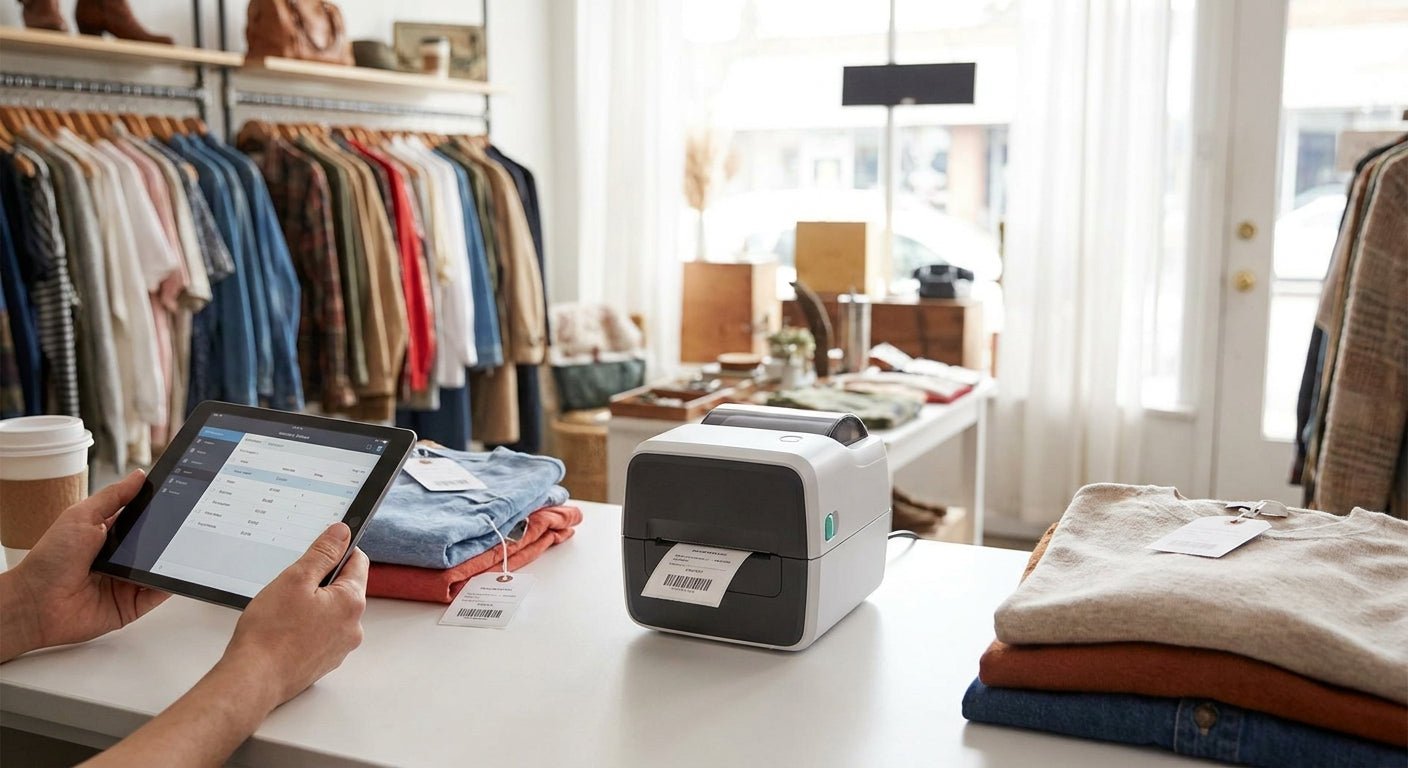
Consignment and resale shops turn over inventory fast — 200 to 500 new items a week isn't unusual for a busy store — and a label printer that can't keep pace with intake becomes the bottleneck, not the POS system.
- The GoDEX RT700i+ is the safe label printer for consignment shops needing barcode tags fast at $581 — buy it.
- GoDEX DT230's 300 DPI prints small text clean on jewelry and antique tags in 2026 — buy for detail work.
- Semi-gloss white barcode asset tags outlast handwritten price tags under daily handling — buy for durability.
- Skip desktop shipping-label printers that lack barcode symbology support for consignment inventory tracking.
Why this matters
A thrift store printer and a consignment shop printer are not the same tool. Retail chains reprint the same SKU thousands of times a day. Consignment shops print one label per unique item, often with a consignor number, condition note, and price that changes every 30 to 60 days as items get marked down.
That one-off nature is why generic shipping-label printers stumble here. McAuley Labels builds thermal printers around barcode symbology and small-batch runs, which matches how resale inventory actually moves through a store in 2026 — one tag, one item, one scan at the register.
Get the printer wrong and staff either hand-write tags (slow, error-prone) or batch-print labels a day ahead (items sit untagged, get misplaced, or leave with the wrong consignor split). Get it right and intake-to-floor time drops to minutes per item.
Who this is for
This guide is for owners and intake staff at consignment stores, resale boutiques, thrift operations, and multi-location resale chains who tag unique items daily — clothing, furniture, electronics, jewelry, and collectibles — and need a barcode on each piece before it hits the sales floor.
What to look for in a label printer for consignment shops
Print resolution matched to tag size
A 4-inch clothing tag at 203 DPI reads fine from three feet away. A jewelry tag with an 8-point consignor number needs 300 DPI or the text blurs into a smudge. Match resolution to your smallest tag, not your average one.
Barcode and QR support your POS actually reads
Your label printer is only as useful as the scanner and POS behind it. Confirm the printer outputs the barcode symbology (Code 128, UPC, or QR) your inventory software expects before you buy — not after the first batch of unreadable tags hits the floor.
Direct thermal vs. thermal transfer for handling life
Direct thermal tags fade under sunlight and friction within weeks — fine for fast-turn clothing racks, risky for furniture that sits in a display window for months. Thermal transfer with ribbon holds up through repeated handling and re-tagging when an item gets marked down.
Standalone operation for walk-in intake
Consignment intake happens at the counter while a customer waits. A printer with a keyboard or standalone controller lets staff key in a price and print a tag without opening a laptop for every single item — a real speed difference during a Saturday morning drop-off rush.
Cost per label at your actual volume
A shop tagging 50 items a week and one tagging 500 have very different math. Ribbon and label cost per tag matters more at higher volume; printer price matters more at lower volume. Run the numbers on your weekly intake before picking a tier.
Top picks for consignment and resale shops
The safe pick — GoDEX RT700i+. This 4-inch dual-thermal printer runs 203 DPI with a color display, priced at $581 in 2026, and comes with the standard 3-year warranty GoDEX puts on its printer line. It handles clothing tags, general merchandise labels, and barcode price tags without asking staff to learn a complicated interface. Verdict: Buy for shops tagging general resale inventory daily. GoDEX RT700i+
The detail pick — GoDEX DT230. At 300 DPI, this direct thermal model resolves small text and fine barcodes cleanly, which matters for jewelry tags, collectible cards, and antique labels where a consignor number and item ID both need to fit on a half-inch tag. Verdict: Buy if your inventory skews toward small, high-detail items. GoDEX DT230
The durability pick — semi-gloss white barcode tags. Rather than a printer swap, some shops solve the handling-life problem with tougher label stock. Semi-gloss white barcode asset tags hold a scan-clean barcode through months of rack handling and repricing better than standard direct thermal paper. Verdict: Buy as a stock upgrade if tags are wearing out before items sell. Semi-gloss white barcode asset tags
The budget pick — GoDEX RT200i. An entry 203 DPI model for shops just getting off handwritten tags. It covers the basics — barcode printing, standard label sizes — without the display or ribbon-handling features of the RT700i+. Verdict: Consider for single-register shops under 100 items a week; Skip if you're running two or more locations.


What to avoid
- Consumer shipping-label printers marketed for online sellers. They handle 4x6 shipping labels well but often lack the barcode symbology or small-label sizing consignment tagging needs.
- Direct thermal-only setups for display window furniture. Direct thermal fades under UV light within weeks. If tags sit in a sunlit window for a season, thermal transfer with ribbon holds up far longer.
- The cheapest 203 DPI printer with no standalone keyboard. It looks like a bargain until intake staff have to tether it to a laptop for every single tag during a Saturday rush.
Verdict comparison
| Pick | Resolution | Best for | Verdict |
|---|---|---|---|
| GoDEX RT700i+ | 203 DPI | General resale tagging | Buy |
| GoDEX DT230 | 300 DPI | Jewelry, small collectibles | Buy |
| Semi-gloss white barcode tags | N/A (label stock) | Durability upgrade | Buy |
| GoDEX RT200i | 203 DPI | Single-register, low volume | Consider |
FAQ
What is the best label printer for consignment shops in 2026?
The GoDEX RT700i+ is the best label printer for consignment shops handling general resale inventory in 2026, running 203 DPI with a color display at $581. Shops tagging fine-detail items like jewelry should step up to 300 DPI instead.
Do I need thermal transfer or direct thermal for resale tags?
Direct thermal works for fast-turn clothing that sells within weeks. Thermal transfer with ribbon holds up better for furniture or display items that sit tagged for months.
Is 203 DPI enough for consignment barcode tags?
203 DPI is enough for standard clothing and merchandise tags at typical viewing distance. Jewelry, small collectibles, and antiques with dense text need 300 DPI to keep the barcode and item ID scannable.
How much does a consignment shop label printer cost?
Entry-level 203 DPI printers for consignment tagging run in the $300 to $600 range in 2026, with the GoDEX RT700i+ priced at $581. Industrial models built for multi-location chains cost considerably more.
Can I use a shipping label printer for consignment tags?
Most consumer shipping label printers aren't built for the barcode symbology or small tag sizes consignment inventory needs. Confirm barcode format support before buying one for tagging instead of shipping.
How often do consignment shops need to reprint tags?
Reprints happen whenever an item gets marked down, typically every 30 to 60 days on unsold stock. A printer with fast standalone reprinting saves the most staff time on this cycle.
What barcode format works best for resale inventory?
Code 128 and standard UPC formats cover most consignment POS systems in 2026. Confirm your specific inventory software's supported format before ordering a printer or label stock.
One last thing
Most consignment shops replace their printer before they ever replace their label stock — but the RT200i comparison above shows the cheaper printer is often fine. What actually fails first is the tag material under handling, not the print head. Upgrading to semi-gloss white barcode tags solves more re-tagging headaches than a printer upgrade does, at a fraction of the cost.