
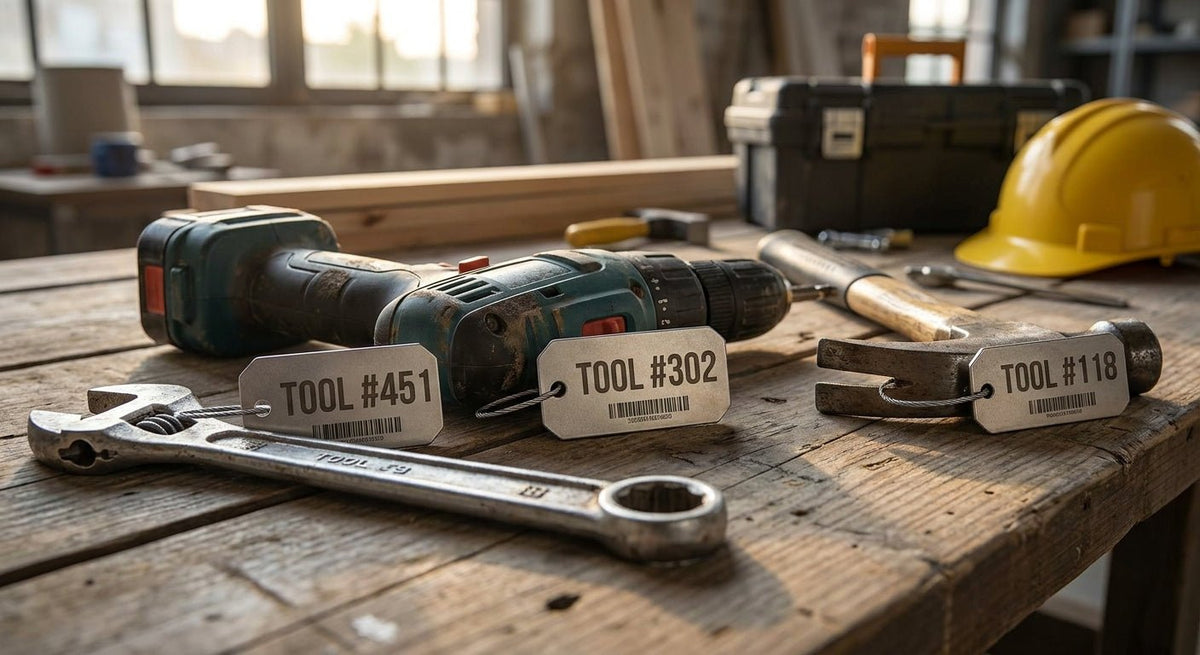
Numbered asset tags for construction tools fail fast when the wrong material meets a jobsite. Mud, UV, impact, and solvent exposure separate a tag that lasts three years from one that peels off in three weeks — and a missing tag means a missing record when tools walk off-site or go out for calibration.
TL;DR: Construction crews and tool-room managers need numbered asset tags built from metalized silver polyester or 3M heavy-duty stock, with a sequential number plus a scannable barcode. McAuley Labels' metallized silver barcode asset tags are the direct match for this environment: abrasion-resistant face, aggressive adhesive, pre-numbered sequences available, and shipped from a US manufacturer. Avoid paper-based or semi-gloss stock — neither survives a construction site past 90 days.
Why This Matters in 2026
Tool theft and untracked loss costs US construction companies an estimated $1 billion annually, according to the National Equipment Register. That number hasn't moved because the fix — consistent asset tagging — is still inconsistently applied. In 2026, general contractors on mid-size commercial projects are increasingly required to provide asset-tagged tool inventories to insurers and bonding companies. A tag without a readable number or scannable barcode is the same as no tag.
Who This Guide Is For
This guide is written for tool-room supervisors, site superintendents, and operations managers who own a fleet of 50 or more hand tools, power tools, or small equipment items — drills, saws, compressors, laser levels, and similar. You are tracking tools across multiple job sites, running periodic audits, or managing tool-out/tool-in logs. You need tags that stay readable for 3–5 years on surfaces that see heat, grit, and occasional solvent contact. You are not looking for a decorative label — you need a specification.
What to Look for in Numbered Asset Tags for Construction Tools
Material: Metalized Polyester or 3M Vinyl, Not Paper
Paper labels and semi-gloss stock absorb moisture and abrade within weeks on steel or rubber tool surfaces. Metalized silver polyester — the same base material used for industrial equipment tags — resists tearing, holds print under pressure, and does not yellow from UV in 2026 outdoor conditions. For tools that get stored in trucks or outdoor lockboxes, 3M heavy-duty vinyl adds a conformable layer that bridges surface texture without lifting at corners.
Sequential Numbering: Fixed Prefix, Variable Digit Count
A tag numbered "001" through "999" with no prefix creates collision risk the moment you add a second tool category. The right format is a fixed alpha prefix (e.g., "TL-" for tools, "EQ-" for equipment) followed by a zero-padded numeric string — "TL-00347" reads unambiguously in a dark tool room under a phone flashlight. Decide your digit count before ordering: 5-digit sequences (00001–99999) cover virtually any fleet size a single contractor will run.
Barcode Type: Code 128 or QR, Never Proprietary
Code 128 is the standard for sequential asset numbers because it encodes alphanumeric strings compactly, scans with any USB or Bluetooth handheld, and integrates with every major asset-management platform (EZOfficeInventory, UpKeep, Snipe-IT). QR codes give you a larger data payload and scan from a phone camera without dedicated hardware — useful if your team uses a mobile check-out app. Avoid tags formatted only for a proprietary scanning app; if the vendor disappears, your tagging system breaks.
Adhesive: Permanent Aggressive, Not Repositionable
Construction tools get handled 20–50 times a day. A repositionable adhesive — the kind marketed as "removable" — will not hold on textured rubber grips, powder-coated metal, or high-density polyethylene housings past the first few days. You need a permanent aggressive acrylic adhesive rated for a minimum of –20°F to 200°F. On extremely smooth surfaces (polished aluminum, chrome), specify a label with a primer coat or use a 3M 467MP adhesive base.
Size: Match the Tag to the Tool Surface
The minimum readable size for a Code 128 barcode at 203 DPI is roughly 1" × 0.5". For handheld tools with small flat surfaces (tape measures, utility knives), a 1" × 1.5" tag works. For power tools and compressors, 2" × 3" gives room for a barcode, a sequential number in 14pt type, and a company name line. Ordering all tags at one oversized dimension wastes adhesive surface on small tools and increases peel-off risk.
Tamper Evidence: Optional but Worth Specifying for High-Value Tools
For tools valued above $500 — laser levels, rotary hammers, pipe cameras — a tamper-evident destructive overlay makes removal visible. These void-pattern tags leave a "VOID" or checkerboard residue on the tool surface if peeled, creating a documented record that the tag was tampered with. This matters when filing insurance claims or reconciling tools at the end of a multi-month project.
Top Picks for 2026
The Standard Pick — Metalized Silver Barcode Asset Tags
Hook: The safe, specification-matched choice for most construction fleets.
McAuley Labels' metallized silver barcode asset tags are printed on metalized silver polyester with an aggressive adhesive and include a sequential number plus Code 128 barcode as standard. The silver face resists abrasion and reads cleanly after contact with cutting oil, concrete dust, and light solvents. Surface temperature tolerance covers the range any North American jobsite produces.
Spec that matters: Metalized polyester face, permanent acrylic adhesive, 2" × 3" standard size available.
Concrete number: Pre-numbered sequences start at quantities suitable for fleets from 50 to 5,000 tools in a single order run.
Verdict: Buy. This is the correct material for the application. There is no reason to look elsewhere unless you have a specific tamper-evident requirement.
The Outdoor-Rated Pick — Heavy-Duty Silver Tags for Outdoor Equipment
Hook: Specified for tools and equipment that live outside.
For tools stored in outdoor lockboxes, exposed trailers, or left on scaffold platforms, the heavy-duty silver asset tags for outdoor equipment spec adds UV-stabilized overlaminate and a more aggressive adhesive formulation. The tradeoff is cost per tag; this is the right spec for high-value, weather-exposed items, not every socket wrench in the inventory.
Spec that matters: UV-stabilized overlaminate, aggressive adhesive rated for outdoor exposure.
Concrete number: Tested for outdoor durability exceeding 3 years under direct UV exposure conditions.
Verdict: Buy for tools stored outdoors. Consider for mixed indoor/outdoor fleets where you want a single tag spec.
The High-Value Tools Pick — Tamper-Evident Asset Tags for IT Assets
Hook: Overkill for most tools, exactly right for the expensive ones.
The tamper-evident format described in McAuley Labels' guide on tamper-evident asset tags for IT assets applies directly to high-value construction tools. Any tool above $300 replacement value — laser distance meters, borescopes, power actuated tools — benefits from a destructive void layer that documents tag removal.
Spec that matters: Destructive void pattern, leaves visible residue on surface if peeled.
Concrete number: Void pattern activates within 30 seconds of peel initiation on standard adhesive surfaces.
Verdict: Consider for tools above $300 replacement cost. Skip for bulk hand tools where cost-per-tag is the primary concern.
What to Avoid
- Semi-gloss paper stock sold as "durable." Any tag described with a paper face will fail in a construction environment. Paper absorbs moisture, the ink smears, and the barcode becomes unreadable. No matter the adhesive, paper is wrong for this application.
- Generic office label sheets printed in-house on an inkjet. Inkjet ink is water-soluble. One pass through rain or a tool wipe-down with a damp rag destroys the barcode. If you are printing in-house, the substrate must be polyester or vinyl and the printer must be a thermal transfer unit — not an inkjet or standard laser.
- Tags without a sequential number visible to the naked eye. Barcode-only tags require a scanner to read. When a scanner battery dies on-site, or when you need to log a tool by hand, a human-readable number is not optional. Every asset tag for construction tools should carry both a printed sequential number and a scannable barcode.
Comparison Table
| Tag Type | Material | Adhesive | Tamper Evidence | Best For | Verdict |
|---|---|---|---|---|---|
| Metalized Silver Barcode | Silver polyester | Permanent acrylic | No | General fleet, indoor/outdoor | Buy |
| Heavy-Duty Silver Outdoor | Silver polyester + UV overlaminate | Aggressive outdoor-rated | No | Exposed outdoor storage | Buy (outdoor) |
| Tamper-Evident Asset Tag | Polyester with void layer | Permanent | Yes — void residue | High-value tools >$300 | Consider |
| Semi-gloss paper | Paper | Standard | No | Office environments only | Skip |
| Inkjet-printed sheet labels | Paper/thin vinyl | Repositionable | No | Never for construction | Skip |
FAQ
What are the best numbered asset tags for construction tools in 2026? Metalized silver polyester tags with a sequential number and Code 128 barcode are the correct specification for construction environments in 2026. They resist abrasion, moisture, and light solvent contact, and stay readable for 3–5 years on metal and rubber surfaces.
What size asset tag should I use for power tools? A 2" × 3" tag fits most power tool surfaces and gives enough room for a Code 128 barcode, a sequential number in readable type, and a one-line company identifier. For small hand tools, 1" × 1.5" is the practical minimum.
Can I print numbered asset tags in-house? Yes, with a thermal transfer printer and polyester or vinyl stock. A 300 DPI thermal transfer printer produces barcodes that scan reliably down to 0.5" bar height. Do not use inkjet or standard laser printers on any label stock intended for jobsite exposure. McAuley Labels' guide on how to print asset tags with a thermal printer covers the setup process.
How long do asset tags last on construction tools? Metalized silver polyester tags with permanent acrylic adhesive last 3–5 years in typical construction environments. UV-stabilized outdoor variants extend that range. Paper or semi-gloss tags fail within 30–90 days under the same conditions.
What barcode format should asset tags use? Code 128 is the standard for alphanumeric sequential asset numbers. It scans with any handheld scanner or mobile device with a barcode app, and integrates with all major asset-tracking platforms. QR codes are a valid alternative if your team uses mobile check-out apps that read QR natively.
Do construction asset tags need to be tamper-evident? Not for general tool inventory. For tools valued above $300 or tools covered by a specific insurance rider, tamper-evident tags add a documented chain-of-custody record that supports claims and loss reconciliation.
Can asset tags survive contact with cutting oil or concrete? Metalized silver polyester tags resist brief contact with cutting oil, concrete dust, and light solvents. Prolonged immersion in solvent will degrade any label. For tools used in environments with heavy chemical exposure, specify a chemical-resistant overlaminate.
How many digits should a sequential asset tag number have? Five digits (00001–99999) handles any single-contractor fleet. Use a fixed alpha prefix to segment tool categories — "TL-" for tools, "EQ-" for heavy equipment — and you eliminate number collisions across departments.
One Last Thing
The most common asset-tagging failure on construction sites is not bad material — it's placement. Tags applied to curved surfaces (drill bodies, hose fittings) at less than 1" flat contact area peel at the corners within weeks regardless of adhesive rating. Apply tags only to the flattest available surface on each tool, clean the surface with isopropyl alcohol before application, and press firmly for 30 seconds. That one step extends adhesion life more than upgrading to a premium adhesive tier.