
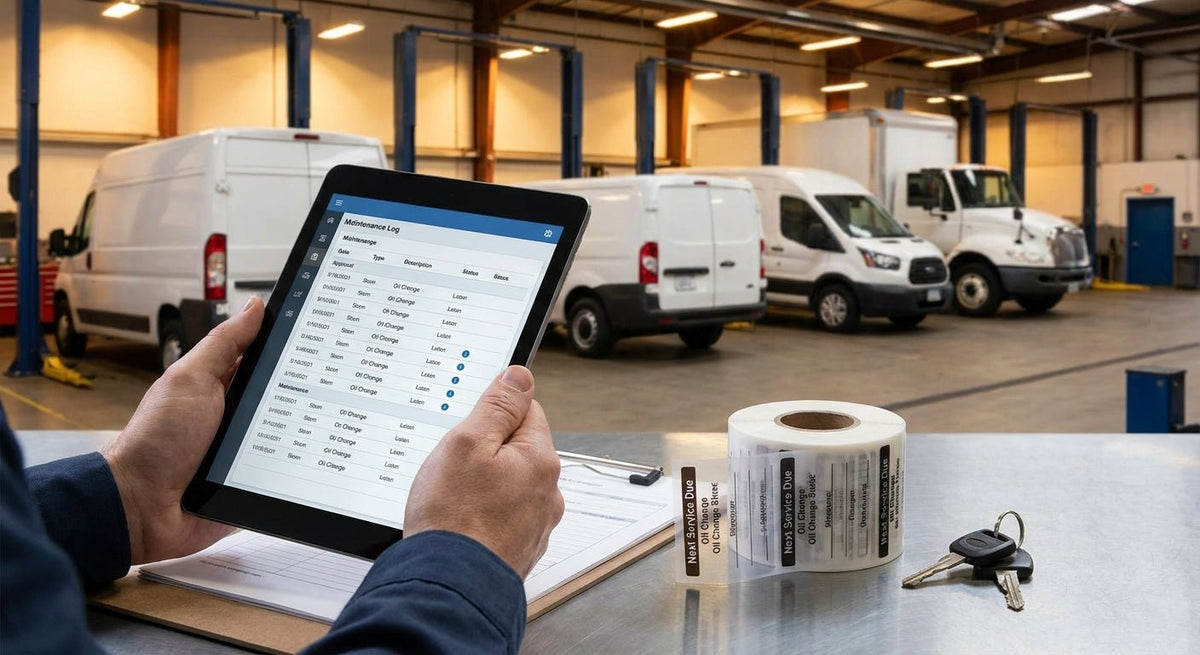
Fleet maintenance managers juggle dozens of vehicles, rotating service intervals, and drivers who ignore dash lights — oil change stickers for fleet maintenance are the lowest-cost, highest-visibility tool for keeping every unit on schedule in 2026.
TL;DR
For fleet maintenance managers running 10 or more vehicles, custom oil change stickers with your fleet's logo and mileage intervals outperform generic pre-printed stickers on every metric that matters: driver compliance, service documentation, and auditor-ready records. McAuley Labels manufactures windshield-grade stickers printed to your specs, shipped direct from the US. The right pick depends on whether you need static cling (no residue, driver-removable) or permanent adhesive (tamper-resistant, stays put). Both formats support QR codes that link to full service records. Buy the oil change stickers with custom logo if you run a branded fleet; consider QR-coded stickers if your shop management software supports URL-based vehicle history.
Why This Matters in 2026
The average commercial fleet vehicle burns through 4–6 oil changes per year. Multiply that by 20 vehicles and you have 80–120 service events annually where a missed interval means warranty exposure, engine wear documentation gaps, or a failed DOT inspection. A sticker on the windshield, visible from the driver seat at every startup, is the only service reminder that requires zero driver action to see. Text messages, fleet app push notifications, and shop management alerts all get ignored. The sticker does not.
Who This Is For
This guide is written for fleet maintenance managers at trucking companies, municipalities, utility contractors, delivery operations, and large dealership groups — anyone responsible for scheduling and documenting oil changes across 10 or more vehicles. If you manage a single-bay shop servicing retail walk-ins, see the custom oil change stickers for independent shops guide instead. This page focuses on volume, documentation rigor, and the sticker specifications that hold up across mixed fleets: vans, box trucks, pickups, and heavy-duty units.
What to Look for in Oil Change Stickers for Fleet Maintenance
Adhesive Type Matched to Your Fleet Vehicles
Commercial vehicles often cycle through multiple drivers and may be sold or remarketed after 3–5 years. Permanent adhesive stickers bond hard to glass and leave a clean paper trail — the sticker either stays until removal or shows visible tampering. Static cling stickers are residue-free, which matters when vehicles return to lessors or rotate to other departments. Choose permanent adhesive for owned long-term fleet assets; choose static cling for leased or rotating units.
Custom Mileage and Date Fields Sized for Glove-Box Distance
A driver glancing up from the seat needs to read the next-service mileage in under 2 seconds. That means the mileage and date fields must be the dominant visual element — minimum 18-point font on a standard 2.5" x 1.5" sticker. Crowded designs with too many secondary fields (oil type, technician initials, shop address) push the critical numbers into smaller type. Fleet stickers should prioritize next-service date and next-service mileage above everything else.
QR Codes Linked to Vehicle Service Records
In 2026, any fleet running software like Fleetio, Samsara Maintenance, or a dealer DMS can encode a vehicle-specific URL into a QR code printed directly on the sticker. A shop foreman or auditor scans the windshield sticker and pulls the full service history in 5 seconds — no VIN lookup, no paper log retrieval. McAuley Labels' windshield oil change stickers with QR code support custom QR codes per order, making this viable for fleets of any size.
Durability Rated for Windshield Heat and UV Exposure
Dash and windshield temperatures in parked commercial vehicles routinely reach 160°F–180°F in summer. A sticker that fades, curls, or loses adhesion before the next service interval defeats its purpose. Specify a UV-resistant face stock — semi-gloss white or clear polyester — and confirm that the printing method is thermal transfer (resin ribbon), not direct thermal, which fades under heat and UV within 60–90 days.
Fleet Logo and Branding for Driver Accountability
A generic pre-printed sticker looks like it came from a gas station. A sticker with your fleet's logo, department name, or dispatch phone number signals that this vehicle is managed, tracked, and maintained to a standard. Drivers treat branded equipment differently. Custom logo stickers cost less per unit than generic pre-prints when ordered in the volumes a fleet actually uses — typically 500 to 2,000 units per order run.
Bulk Pricing With Consistent Spec Across the Order
Fleet procurement requires repeatable spec: same size, same adhesive, same print resolution, every run. Variable quality between batches creates compliance headaches when stickers from different suppliers peel at different rates or print at different legibility levels. Source from a single US manufacturer that holds spec across reorders. McAuley Labels ships from the US and holds print resolution at 300 DPI minimum for logo clarity on windshield stickers.
Top Picks for Fleet Maintenance Managers
The Standard Fleet Pick — Custom Logo Oil Change Stickers
Hook: The safe, auditor-ready choice for any managed fleet.
McAuley Labels' custom logo oil change stickers print your fleet branding, next-service mileage field, and date field on a windshield-grade face stock. Minimum order quantities are designed for fleet volumes. The print resolution is sharp enough for logo legibility at arm's length, and the adhesive holds through a full 3,000–10,000 mile service interval without edge lift.
Verdict: Buy — for any fleet running branded vehicles where documentation and driver-facing accountability matter.
Order oil change stickers with custom logo
The Tracking Upgrade — QR Code Windshield Stickers
Hook: The right call if your fleet uses digital maintenance software.
QR-coded windshield stickers add a scannable vehicle history link to every service event. For fleets integrated with a DMS or fleet management platform, each sticker becomes a physical access point to the vehicle's full record — no manual lookup required. These stickers carry the same windshield-grade adhesive and UV-resistant face stock as standard options, with the QR field printed at a density that scans cleanly from a phone held 6–12 inches from the glass.
Verdict: Buy if your fleet software supports URL-based vehicle records. Consider if you are planning a fleet management platform migration in 2026 — lock in the sticker format now so it works on day one of go-live.
The In-House Print Option — Thermal Printer + Blank Stock
Hook: Highest per-unit flexibility, steeper upfront cost.
Fleets with a dedicated shop office can print stickers on-demand using a thermal transfer printer and pre-formatted label stock. This eliminates reorder lead times and lets you encode vehicle-specific QR codes at the time of service, not at order time. The tradeoff is equipment cost (a 300 DPI thermal transfer printer runs $200–$400) and the time investment of setting up label templates. For fleets servicing 50+ vehicles in-house, the math usually favors in-house printing within 12–18 months. Smaller fleets are better served by ordering pre-printed custom stickers in bulk.
Verdict: Consider for large in-house fleets. Skip if you outsource oil changes to a quick lube or dealership.
What to Avoid
- Generic pre-printed pads with blank write-in fields. Handwritten mileage and dates are illegible from the driver seat, fade quickly, and provide no audit trail. They also carry no fleet branding, which eliminates the driver accountability effect.
- Direct thermal stickers for windshield use. Direct thermal face stock turns black and loses print clarity within 60–90 days of UV and heat exposure. Windshield stickers must use thermal transfer printing or pre-printed UV-laminated stock. Any sticker that is not explicitly rated for windshield heat is wrong for this application.
- Single-source QR codes not tied to vehicle-specific records. Some vendors print a single static QR code on all stickers that links to a generic shop homepage. This provides zero documentation value for fleet audits. QR codes on fleet stickers must be vehicle-specific to be worth the field they occupy.
Verdict Comparison Table
| Option | Logo/Branding | QR Code | Windshield-Grade | Bulk Pricing | In-House Flexibility |
|---|---|---|---|---|---|
| Custom Logo Stickers | Yes | Optional | Yes | Yes | No |
| QR Code Windshield Stickers | Yes | Yes | Yes | Yes | No |
| In-House Thermal Print | Custom | Vehicle-specific | Depends on stock | N/A | Yes |
| Generic Pre-Print Pads | No | No | Varies | Yes | Write-in only |
FAQ
What are the best oil change stickers for fleet maintenance? Custom-printed windshield stickers with your fleet logo, a clear next-service mileage field, and UV-resistant face stock are the best choice for managed fleets in 2026. QR codes add service record access for fleets using maintenance software.
How many oil change stickers should a fleet order at once? For a fleet of 20 vehicles averaging 5 oil changes per year, that is 100 stickers minimum annually. Order 500 at a time to reduce per-unit cost and avoid reorder gaps — most fleet operators find a 500-unit run lasts 12–18 months.
Are static cling or adhesive oil change stickers better for fleets? Permanent adhesive is better for owned fleet assets — it stays secure through the full service interval and is harder to remove without visible evidence. Static cling is better for leased vehicles or units that rotate to other departments, since it removes cleanly without residue.
Can oil change stickers include a QR code for vehicle history? Yes. McAuley Labels prints QR codes on windshield oil change stickers. The QR code must encode a vehicle-specific URL you provide — typically a link into your fleet management software or DMS. A generic QR code that links to a shop homepage has no documentation value for fleet audits.
What print resolution do oil change stickers need for logo clarity? 300 DPI is the minimum for a clean logo on a 2.5" x 1.5" sticker. 600 DPI is better if the logo includes fine lines or small text below 8-point. For plain text mileage fields, 203 DPI is readable, but it degrades logo quality. Fleet stickers with branding should be printed at 300 DPI minimum.
Do oil change stickers hold up to summer heat in commercial vehicles? Windshield and dash temperatures in parked commercial vehicles reach 160°F–180°F in summer months. Stickers rated for windshield use with thermal transfer printing and UV-resistant face stock handle that range without fading, curling, or adhesive failure. Direct thermal stickers do not — they degrade within 60–90 days under those conditions.
How do fleet managers handle oil change sticker compliance across multiple locations? Standardize on a single sticker spec — same size, adhesive type, and logo version — ordered from one manufacturer. Distribute pre-printed rolls or pads to each service location with documented instructions on field completion. For multi-location fleets using in-house printing, a shared label template file ensures every location produces identical output.
What size oil change sticker works best for commercial vehicle windshields? 2.5" x 1.5" is the most common fleet windshield sticker size — large enough to read from the driver seat, small enough to avoid obstructing the driver's line of sight. Some fleets use 3" x 2" for vehicles with larger windshields or where multiple fields (date, mileage, oil type, technician ID) need to be legible simultaneously.
One Last Thing
A 2026 fleet audit finding that is increasingly common: inspectors flagging vehicles where the windshield sticker mileage does not match the odometer reading in the maintenance log. A QR-coded sticker that links directly to the vehicle's timestamped service record eliminates that discrepancy — the sticker is the log entry, not a separate document. For fleets subject to DOT review or corporate compliance audits, that linkage is worth more than the cost difference between a plain sticker and a QR-coded one.