
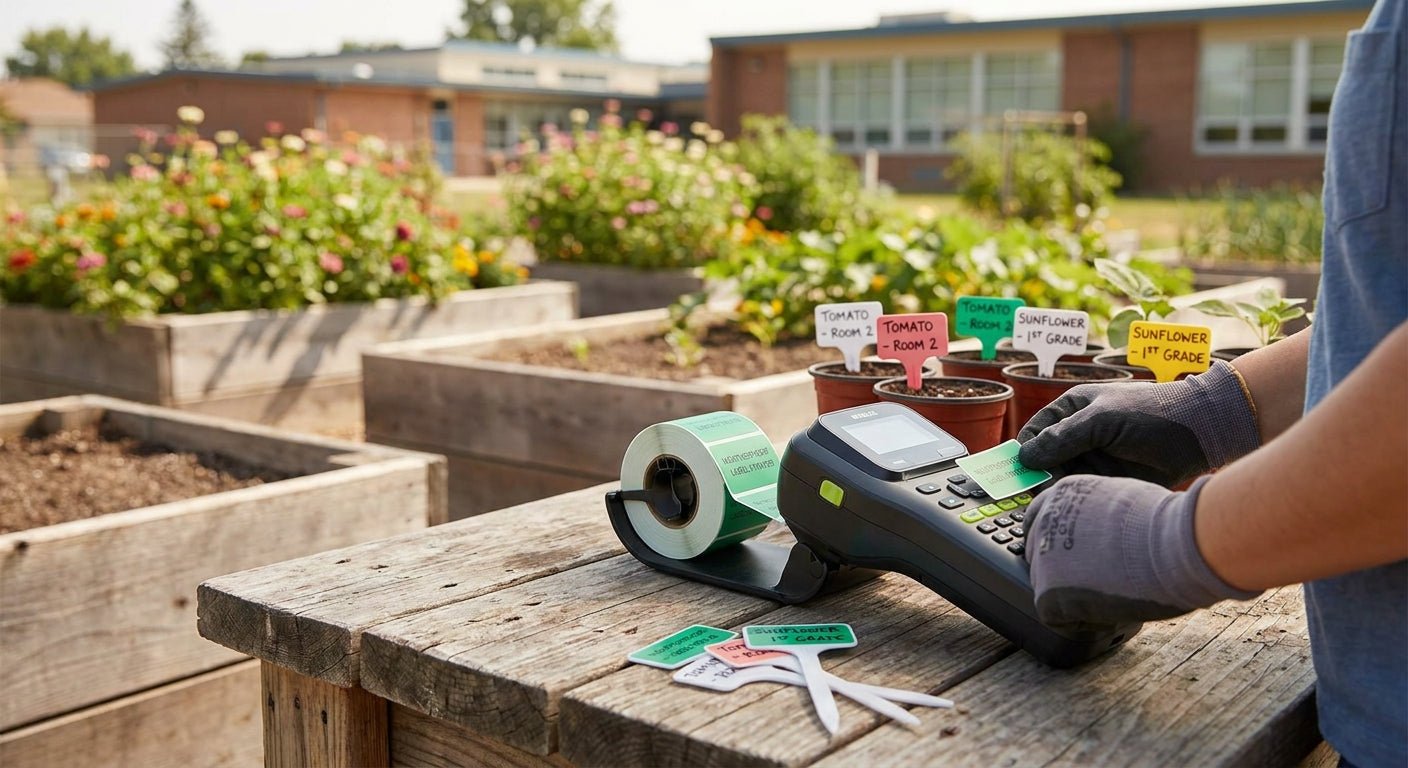
School and community garden programs need tags that survive sprinklers, July sun, and volunteers who yank them out at the wrong angle — and that rules out most home printers and laminated paper stakes before the first growing season ends.
- A plant tag printer for school gardens needs 203 DPI minimum and waterproof stock, or plant names blur within weeks.
- The GoDEX RT700i+ at $581 covers basic variety tags for most classroom and community plots. Buy.
- The GoDEX ZX430i+ at $945 adds 300 DPI resolution for QR codes linking to care instructions. Buy.
- Skip laminated paper stakes and inkjet prints — they fade or peel inside 60 days outdoors.
- A $554 GoDEX G530 works for indoor seed-tray tags but struggles with fine print outdoors.
Why this matters
A plant tag that fails mid-season isn't a cosmetic problem — it's a lost lesson for the kid who planted the bean and a wasted trip for the volunteer who has to reprint it. Inkjet ink and laser toner aren't rated for direct sun or irrigation contact, and both start degrading in 2026 the same way they did a decade ago. A dedicated plant tag printer for school gardens solves this once, at the printer and the label stock, instead of every few weeks at the garden bed.
Who this is for
This guide is for garden coordinators running raised-bed programs at elementary and middle schools, master gardener volunteers managing community plots through an extension office, and PTA garden clubs that need dozens of legible, weatherproof tags before every planting day. If your current process is a Sharpie on a popsicle stick or a laminated index card, a GoDEX RT700i+ label printer closes that gap without asking a volunteer to learn design software.
What to look for in a plant tag printer for school gardens
Print resolution for small variety names
Plant tags pack a lot into a small footprint — common name, botanical name, sometimes a planting date. Anything under 203 DPI turns small text into a smear once the label is six inches from a reader's eye. If tags carry more than a single word, 300 DPI is the safer floor.
UV-stable, waterproof label stock
Standard paper labels absorb moisture from soil contact and irrigation spray, and the adhesive lets go within a season. Thermal transfer labels rated for outdoor use hold ink and adhesive through freeze-thaw cycles and direct sun, which matters more in a garden bed than in almost any other labeling use case.
Standalone printing for volunteer crews
Most garden programs run on rotating volunteers, not a dedicated staffer at a laptop. A printer with a built-in keyboard or simple software queue means a parent volunteer can reprint a batch of tags in ten minutes without a training session.
Batch speed before planting day
School gardens print in bursts — 40 tags the weekend before a spring planting, not one tag at a time. A printer rated for a reasonable inches-per-second output clears a full bed's worth of tags before the volunteer shift ends.
Cost per tag over a full season
A $9 wax/resin ribbon roll runs 243 feet, which is enough for a full season of tags at most garden programs, so the real cost driver is the printer itself, not the consumables. Compare that against buying pre-printed laminated stakes every season, which adds up faster than a one-time printer purchase.


Top picks for school and community gardens
The safe pick: GoDEX RT700i+. 203 DPI, color display, $581. This handles the standard job — common name, botanical name, bed number — cleanly and fast enough for a Saturday morning batch print. Verdict: Buy.
The upgrade for QR codes: GoDEX ZX430i+. 300 DPI, $945. If your program links tags to care instructions or a class project page through a QR code, 203 DPI isn't sharp enough to keep small codes scannable after a season of handling. This printer clears that bar. Verdict: Buy.
The budget entry point: GoDEX G530. 300 DPI, $554. Cheaper than the ZX430i+ and still 300 DPI, but it's built for indoor, lower-volume runs — think seed-tray labels for a greenhouse unit rather than outdoor garden stakes exposed to weather daily. Verdict: Consider for indoor use, Skip if the tags live outside year-round.
What to avoid
- Laminated paper stakes from a home printer. They look fine on day one and peel or fade inside 60 days of sun and sprinkler contact.
- Labels marketed as "outdoor safe" without a UV rating. The adhesive is usually the failure point, not the ink — check the stock, not just the marketing copy. The waterproof plant label printer buying guide breaks down which stock actually holds up.
- Any printer under 203 DPI for tags carrying more than a plant name. Care instructions and QR codes need the extra resolution or they turn into guesswork by midsummer.
If a tag can't survive irrigation, it isn't a garden tag — it's a paper cup with a plant name on it.
“If a tag can't survive irrigation, it isn't a garden tag — it's a paper cup with a plant name on it.”
How the picks compare
| Printer | DPI | Price | Best for | Verdict |
|---|---|---|---|---|
| GoDEX RT700i+ | 203 | $581 | Standard variety tags, outdoor beds | Buy |
| GoDEX ZX430i+ | 300 | $945 | QR-coded care instructions, small text | Buy |
| GoDEX G530 | 300 | $554 | Indoor seed-tray labels, greenhouse use | Consider |
FAQ
What's the best plant tag printer for school gardens?
The GoDEX RT700i+ at $581 is the best fit for most school and community gardens in 2026. It prints at 203 DPI, which is sharp enough for plant names and bed numbers on tags that need to survive irrigation and sun.
Is a 203 DPI printer good enough for plant tags?
Yes, for plant names and basic care notes. If tags carry QR codes or dense text, move up to a 300 DPI printer like the GoDEX ZX430i+ so the small details stay scannable.
How much does a plant tag printer cost in 2026?
Printers built for this job run from $554 for a 300 DPI GoDEX G530 to $945 for a GoDEX ZX430i+ with a color display. Ribbon adds roughly $9 per 243-foot roll.
Can you print QR codes on plant tags with a thermal printer?
Yes, at 300 DPI or higher. Lower resolutions blur the fine grid of a QR code enough that phone cameras stop reading it after a few months of outdoor wear.
What label material lasts longest outdoors?
Thermal transfer labels on a UV-stable, waterproof stock outlast standard paper or laminated stock by a full growing season or more. Standard paper labels start failing at the adhesive within weeks of irrigation contact.
Direct thermal or thermal transfer for plant tags?
Thermal transfer for anything living outside longer than a few weeks. Direct thermal prints fade under UV exposure without a ribbon layer protecting the image.
Do school gardens need a dedicated printer, or can a home inkjet work?
A dedicated thermal printer is the right call. Inkjet ink isn't rated for moisture or sun exposure and typically fades or smears within a season of garden use.
How long do thermal transfer plant tags last outside?
A full growing season and often longer on UV-stable stock, compared to weeks for laminated paper. Ribbon and stock quality matter more than the printer once resolution is set correctly.
One last thing
A single $9 ribbon roll runs 243 feet — at roughly an inch of print per tag, that's enough for a full season of plant tags for most school or community garden programs without a reorder. The printer is the one-time cost; the ribbon is the part that barely shows up on a budget line.