
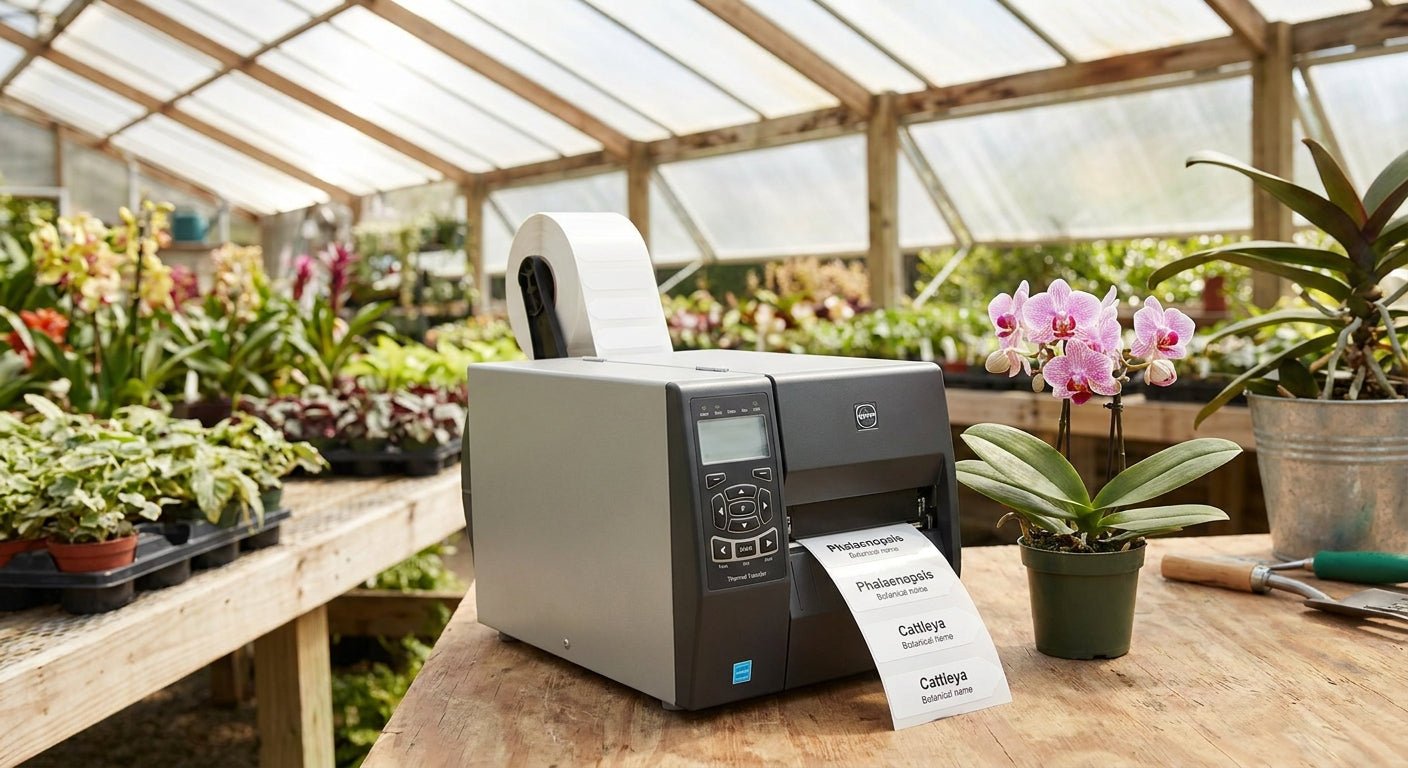
Orchid and specialty plant growers need tags that survive misting systems, direct sun, and months of handling — and text small enough to fit genus, species, hybrid, and cultivar names on a tag the size of a matchbook. This guide breaks down which plant tag printer setup handles that job in 2026, with specific models, resolution numbers, and buy or skip calls.
- GoDEX ZX430i+ at 300 DPI is the balanced plant tag printer for orchid growers in 2026 — buy it for most collections.
- GoDEX RT700i+ at 203 DPI works for larger nursery flat tags but blurs fine cultivar text under 8pt — consider it, don't lead with it.
- 600 DPI matters only above roughly 500 tags a month with long hybrid names; below that, 300 DPI wins on cost.
- Wax/resin ribbon, not direct thermal, is the call for tags that stay outdoors past 90 days.
Why this matters
A general-purpose label printer bought for shipping or retail tags will not hold up on a greenhouse bench. Orchid growers print short runs of highly specific text — Phalaenopsis amabilis 'Sogo Vivien' takes real character count — on stock that has to resist humidity, hose spray, and UV without fading by season two.
Get the resolution or the label stock wrong and you're reprinting tags every few months, which costs more in ribbon and labor than buying the right McAuley Labels setup once. The full breakdown of what makes a tag survive outdoor conditions lives in the waterproof plant label printer buying guide — this article focuses on which printer produces that result for specialty growers specifically.
Who this is for
This is written for orchid nurseries, specialty plant breeders, botanical collectors, and small-batch growers who label individual plants or pots rather than pallets. If you're tagging hundreds of identical bedding-plant flats with a single SKU, a simpler direct thermal setup covers you. If you're printing dozens of distinct hybrid names a week, on tags meant to stay legible outdoors for a full growing season or longer, keep reading.
What to look for in a plant tag printer for orchid growers
Print resolution fine enough for botanical names
Cultivar and hybrid names run long, and orchid tags are small — often under 1 inch wide. A 203 DPI printer renders roughly 8 dots per millimeter; a 600 DPI unit renders close to three times that density. Below 6pt text, that difference is the line between readable and smudged.
Thermal transfer, not direct thermal
Direct thermal labels fade under UV and heat within weeks outdoors — a real problem on a sunny bench. Thermal transfer printing, which uses a wax/resin ribbon fused onto synthetic label stock, holds ink for a full growing season and beyond. For anything living outside a climate-controlled room, this isn't optional.
Waterproof, UV-stable label stock
Misting systems and rain will lift paper labels within days. Polyester or vinyl label stock rated for outdoor use is the baseline for orchid and specialty plant tags — check that whatever printer you buy is compatible with synthetic media, not just paper.
Compact footprint for bench or backroom use
Orchid operations rarely need an industrial floor printer. A desktop unit with a 4-inch print width covers nearly every plant tag format, and takes up a fraction of the counter space a warehouse-grade printer demands.
Cost per label at your actual volume
A grower printing 200 tags a month has different math than one printing 3,000. Ribbon and label cost per unit matters more at scale than the sticker price of the printer itself — factor in ribbon length (a standard roll runs 243 feet) against your monthly tag count before you buy.
Top picks for orchid and specialty plant tag printing
The balanced pick: GoDEX ZX430i+
The GoDEX ZX430i+ 300 DPI thermal printer prints at $945 and hits the resolution sweet spot for most cultivar and hybrid names without the price jump of a 600 DPI unit. Its color display makes it easy for non-technical nursery staff to run batch jobs without a manual on hand.
For an orchid operation printing a rotating mix of species and hybrid tags each week, 300 DPI resolves 6-8pt botanical text cleanly. Verdict: Buy — this is the default recommendation for specialty growers in 2026.
The budget entry: GoDEX RT700i+
The GoDEX RT700i+ 4-inch color display printer runs $581 at 203 DPI. It's a real cost saver, and it's fine for larger nursery flat tags where the text is a genus name and a price, not a full cultivar string.
Where it falls short is dense botanical text under 8pt — expect some softening on the finest characters at that resolution. Verdict: Consider — good for mixed-use nurseries running both plant tags and general labels, not the first buy for a pure orchid specialist.
The compact bench option: GoDEX G530
The GoDEX G530 prints at 300 DPI for $554 and is one of the smallest footprints in the GoDEX lineup, which matters if bench space is tight in a working greenhouse. It matches the ZX430i+ on resolution at a lower price point, with a smaller touchscreen interface.
For low-volume specialty growers who don't need color display or high-speed batch runs, this is a reasonable entry point. Verdict: Buy for growers under roughly 200 tags a month.
The high-resolution option: GoDEX GX4600i
At $2,966, the GoDEX GX4600i pushes to 600 DPI with speeds up to 8 inches per second. That resolution is genuinely necessary once you're printing dense hybrid registration names or QR codes alongside text on a tag under an inch wide.
This is overbuilt for a hobbyist collection but right-sized for a commercial orchid operation running high tag volume with fine print requirements. Verdict: Consider — only if your monthly volume and text density justify the jump from $945 to $2,966.


What to avoid
- Direct thermal-only printers marketed as "eco" or "ribbon-free." They print fast and cheap, but fade in outdoor UV within weeks — wrong for orchid tags meant to last a season.
- Paper label stock for anything outside a climate-controlled space. It looks fine on day one and lifts or smears the first time a misting cycle hits it directly.
- Wide-format 6-inch industrial printers. They're built for shipping and case labels, not for a tag under an inch wide — you're paying for capacity you'll never use on a plant tag run.
Verdict comparison
| Printer | Resolution | Price | Best for | Verdict |
|---|---|---|---|---|
| GoDEX ZX430i+ | 300 DPI | $945 | Mixed cultivar/hybrid tag runs | Buy |
| GoDEX RT700i+ | 203 DPI | $581 | Larger flat tags, budget runs | Consider |
| GoDEX G530 | 300 DPI | $554 | Low-volume bench printing | Buy |
| GoDEX GX4600i | 600 DPI | $2,966 | High-volume, dense micro-text | Consider |
Whichever printer you land on, pair it with thermal transfer ribbon rated for wax/resin printing — a standard 2.25" x 243' roll runs $9 and is what actually keeps text on synthetic tags from wiping off in the rain, not the printer itself.
FAQ
What's the best plant tag printer for orchid growers in 2026?
The GoDEX ZX430i+ at 300 DPI is the best plant tag printer for orchid growers in 2026 for most operations, balancing resolution and price at $945. High-volume growers with dense hybrid text should consider the 600 DPI GoDEX GX4600i instead.
Do I need thermal transfer or direct thermal for plant tags?
Thermal transfer, using a wax/resin ribbon, is the right choice for plant tags that live outdoors. Direct thermal labels fade under UV and heat within weeks, which makes them a poor fit for greenhouse or outdoor bench tags.
What DPI do I need for small botanical text on orchid tags?
300 DPI handles most genus, species, and cultivar text down to about 6-8pt cleanly. Drop below that text size or add dense hybrid registration names and 600 DPI becomes worth the extra cost.
Is polyester or paper label stock better for greenhouse tags?
Polyester label stock is better for greenhouse and outdoor tags because it resists moisture and UV fading. Paper stock works only in climate-controlled indoor settings where humidity and direct sun aren't a factor.
How much does a plant tag printer cost in 2026?
Entry-level 300 DPI printers like the GoDEX G530 start around $554, while 300 DPI models with color displays like the ZX430i+ run $945. High-resolution 600 DPI units run closer to $2,966 for high-volume commercial use.
Can a plant tag printer also print barcode or QR tags for inventory?
Yes, the same thermal transfer printers used for botanical text tags can print barcodes and QR codes on the same label stock. This is common for nurseries tracking inventory alongside plant identification.
How long does a thermal transfer ribbon last for label printing?
A standard 2.25 inch by 243 foot ribbon roll prints hundreds to a few thousand small tags depending on label size and print density. Ribbon length, not the printer, is usually the recurring cost to budget for.
Is a 203 DPI printer good enough for nursery flat tags?
A 203 DPI printer like the GoDEX RT700i+ works fine for larger nursery flat tags with short text like genus name and price. It struggles with dense cultivar or hybrid text under 8pt, where 300 DPI or higher is the better call.
One last thing
The resolution debate matters less than the ribbon choice for most orchid growers — a 300 DPI printer running wax/resin ribbon on polyester stock will outlast a 600 DPI printer running the wrong ribbon type by an entire growing season. Get the ribbon and stock right first in 2026, then decide if you need to spend up for resolution.