
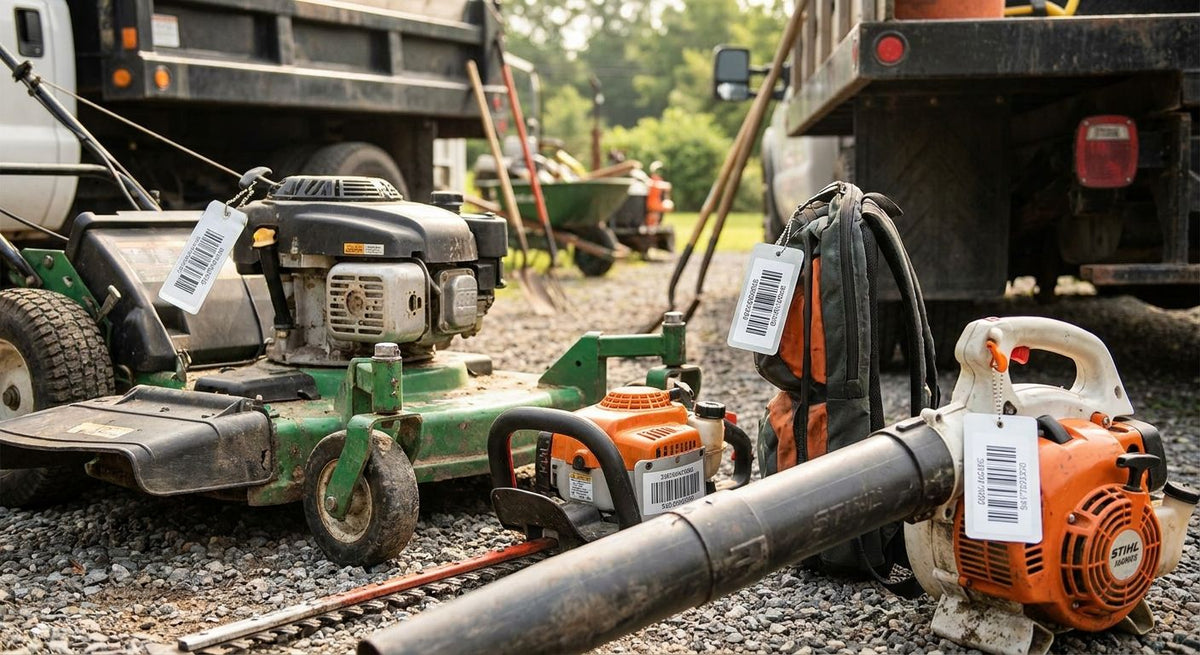
Landscaping and lawn care asset tags identify mowers, trimmers, blowers, edgers, and trailers with barcode or QR labels built to survive mud, fuel splashes, UV exposure, and pressure washing, cutting equipment loss and speeding up seasonal inventory counts. A three-truck residential crew tags differently than a commercial landscaping company running twenty machines across a dozen job sites in one day in 2026 — the stakes and the storage conditions aren't the same.
- Asset tags for landscaping equipment need 3M heavy-duty or metalized silver stock — standard paper labels fade within one mowing season.
- McAuley Labels' metalized silver barcode tags handle mud, fuel, and UV exposure on mowers, trimmers, and blowers stored in open trailers.
- A GoDEX RT700i thermal transfer printer lets crews print and number tags in-house instead of waiting on a pre-printed batch order.
- QR code asset tags only pay off when scans link to a maintenance log — a plain sticker alone tells a crew nothing.
Why asset tags matter for landscaping and lawn care crews
Landscaping equipment moves constantly. A zero-turn mower rides a trailer to three job sites in a morning, gets loaded onto a different truck by a different crew lead in the afternoon, and sits in an unlocked yard overnight. Hand tools — edgers, blowers, hedge trimmers — get passed between employees with no paper trail behind any of it.
Without a tag, there's no fast way to prove which truck a mower belongs to when two crews park side by side, and no way to flag a machine that's overdue for blade service. Metalized silver barcode asset tags mounted on the deck or handle settle the ownership question in under two seconds with a phone scanner.
That matters more for landscaping companies than most trades in 2026, because the equipment lives outdoors, gets pressure-washed weekly, and takes direct sun for months at a stretch — conditions that peel a standard adhesive label inside a single season. McAuley Labels' asset tags are built around that exposure problem specifically, not adapted from an office inventory label.
Audit your equipment fleet before you order tags
Before ordering a single label, walk the yard and count what you actually own. Skipping this step is the fastest way to end up short 40 tags or paying twice for a rush reorder in the middle of spring.
- Walk the lot and list every mower, trimmer, blower, edger, and trailer by make and model
- Record any serial numbers the manufacturer already stamped on the housing
- Flag equipment that's shared across crews or stored off-site at a foreman's house
- Separate daily-use tools that ride in a truck from stationary shop equipment
- Add a 10-15% buffer to your tag count for new purchases and mid-season replacements
Match the tag material to how the equipment gets stored
A push mower parked in a locked shop overnight doesn't need the same tag as a trimmer that rides an open trailer through rain and gravel roads all summer. Match the material to the exposure, not to the lowest price per tag.
- Metalized silver barcode asset tags for mowers, blowers, and trimmers stored outdoors or on open trailers
- 3M heavy-duty silver stock for equipment that gets pressure-washed weekly or handled with wet gloves
- Semi-gloss white ID labels for hand tools kept inside a locked shop or enclosed trailer
- Skip paper labels entirely on anything that contacts fuel, two-cycle oil, or a garden hose
McAuley Labels ships the 3M heavy-duty stock pre-cut and ready for outdoor mounting — no lamination step required on the crew's end.
Choose barcode, QR code, or sequential numbering
A sequential number printed on a tag is the cheapest system and works fine for a five-truck operation tracking equipment by eye. A barcode adds scan speed once you're past 30-40 pieces of equipment. A QR code goes further — scanning it can open a maintenance log, a service due date, or a photo of the last inspection, right from a foreman's phone.
- Sequential numbers only: cheapest, works for small fleets tracked on a clipboard
- 1D barcode: fast scan-in/scan-out for mid-size fleets with a handheld scanner
- QR code: links to a maintenance record, warranty date, or service history online
- Combine a printed number with a barcode so the tag still works if a scanner dies
Decide between pre-printed tags and an in-house printer
Ordering pre-numbered tags in a batch works fine if your fleet size is stable and you order once a year. Once you're tagging new mowers, trimmers, and rental replacements mid-season, printing in-house gets tags on equipment the same day it arrives.
A GoDEX RT700i thermal transfer printer prints barcode and QR asset tags on demand, so a shop manager can generate a new tag the moment a replacement trimmer shows up, no waiting on a supplier's turnaround. 300 DPI resolution in 2026 remains the standard for barcode clarity on a small tag.
- Order pre-printed batches once a year if your fleet count barely changes
- Print in-house if you add or replace equipment mid-season regularly
- Match the printer's resolution to your smallest barcode — 203 DPI blurs fine text, 300 DPI holds it
- Keep spare thermal transfer ribbon on hand so a torn ribbon doesn't stall tagging day
Apply tags correctly to curved and vibrating surfaces
A mower deck curves, vibrates, and gets scraped against curbs. A tag slapped on cold, dirty metal peels within weeks — the adhesive never got a real bond in the first place.
- Clean the mounting surface with isopropyl alcohol before applying any tag
- Apply tags to a flat section of the housing, not a curb-facing lip or edge
- Use a heat gun on cold days to help 3M heavy-duty adhesive bond to metal
- Avoid mounting directly over a vibration point like the deck belt cover
- Press firmly for 10-15 seconds after placement instead of a quick pat
Build a scan-in, scan-out system before the next season
A tag without a process behind it is just a sticker. The system doesn't need software on day one — a shared spreadsheet with tag number, equipment description, and assigned truck covers a small fleet fine.
- Start with a spreadsheet: tag number, equipment, assigned crew, last service date
- Move to a barcode scanner app once a clipboard system starts missing entries
- Require a scan or manual log entry when equipment moves between trucks
- Reconcile the list at the start and end of each season, not just once a year
Train every crew lead on the process, not just the shop manager
Asset tags fail in the field when only one person in the company understands why they're there. Crew leads load and unload equipment daily — they're the ones who actually use the system.
- Walk each crew lead through scanning a tag with their own phone
- Explain why a missing scan matters for insurance claims on stolen equipment
- Post a one-page instruction sheet in each truck cab
- Make tag checks part of the existing end-of-day equipment count


Asset tag options for landscaping equipment
| Option | Best for | Key limitation |
|---|---|---|
| Metalized silver barcode asset tags | Mowers, trimmers, blowers stored on open trailers | Needs line-of-sight for a barcode scanner |
| 3M heavy-duty silver barcode tags | Equipment pressure-washed weekly or exposed to fuel | Costs more per tag than standard stock |
| Semi-gloss white ID labels | Hand tools kept in a locked shop or enclosed trailer | Not rated for constant outdoor UV |
| Custom QR code asset tags | Crews wanting a phone scan to pull maintenance history | Useless without a linked digital log behind it |
For landscaping companies with equipment parked outdoors year-round in 2026, 3M heavy-duty silver barcode asset tags are the safest default — everything else is a trade-off on cost or exposure.
Common mistakes landscaping companies make with asset tags
- Using standard paper labels on mowers and trailers that live outside — most fade or peel before the season ends
- Mounting a tag on a curved deck lip that scrapes against curbs instead of a flat, protected panel
- Skipping the fleet audit and ending up with duplicate tag numbers across two crews
- Adding QR codes with nothing behind them — no maintenance log means the scan tells a foreman nothing useful
- Never training the crew leads who actually load and unload equipment, so tags exist but never get scanned
FAQ
What's the best asset tag for landscaping equipment stored outdoors?
3M heavy-duty silver or metalized silver barcode asset tags are the best option for outdoor landscaping equipment in 2026. Both resist mud, fuel splashes, and UV exposure better than paper or standard vinyl stock.
How do I put an asset tag on a curved mower deck?
Clean the surface with isopropyl alcohol, apply the tag to a flat section rather than a curb-facing lip, and use a heat gun on cold days to help the adhesive bond. Curved, high-scrape areas are the top cause of early tag failure.
Are QR code asset tags better than barcode tags for landscaping crews?
QR code asset tags are better when they're linked to a maintenance log or service record, since a scan can pull up history instantly on a phone. A barcode is simpler and cheaper if all you need is a fast ownership check.
How much does an asset tag system cost for a small lawn care company?
Cost depends on tag material, quantity, and whether you print in-house or order pre-printed batches. Check current pricing on individual product pages before budgeting a full fleet rollout.
Do asset tags survive pressure washing and fuel spills?
3M heavy-duty and metalized silver polyester tags are built to survive regular pressure washing and fuel splashes. Standard paper labels are not — they peel or fade within a season of that exposure.
Can I print my own asset tags instead of ordering pre-printed ones?
Yes, a thermal transfer printer like the GoDEX RT700i prints barcode and QR asset tags on demand, which is faster than waiting on a supplier batch when equipment changes mid-season. Pre-printed batches still make sense for stable fleets ordering once a year.
How do I track landscaping equipment across multiple crews?
Start with a shared spreadsheet logging tag number, equipment, assigned crew, and last service date, then require a scan or manual entry whenever equipment moves between trucks. Reconcile the list at the start and end of each season.
What's the difference between an asset tag and an inventory label?
An asset tag identifies and tracks a specific piece of equipment over its full working life, while an inventory label typically tracks stock quantity in a warehouse. Landscaping equipment needs asset tags, not inventory labels, because each mower or trimmer is tracked individually.
One last thing
The tag placement mistake that costs landscaping crews the most replacement tags isn't material — it's location. Mounting on the mower deck lip that scrapes curbs and driveways wears through a heavy-duty tag in one season. Move the tag to the underside of the handlebar mount or a flat panel on the fuel tank shield, and the same 3M heavy-duty stock lasts multiple seasons instead of one, which is the difference between re-tagging a fleet every spring and doing it once every few years.