
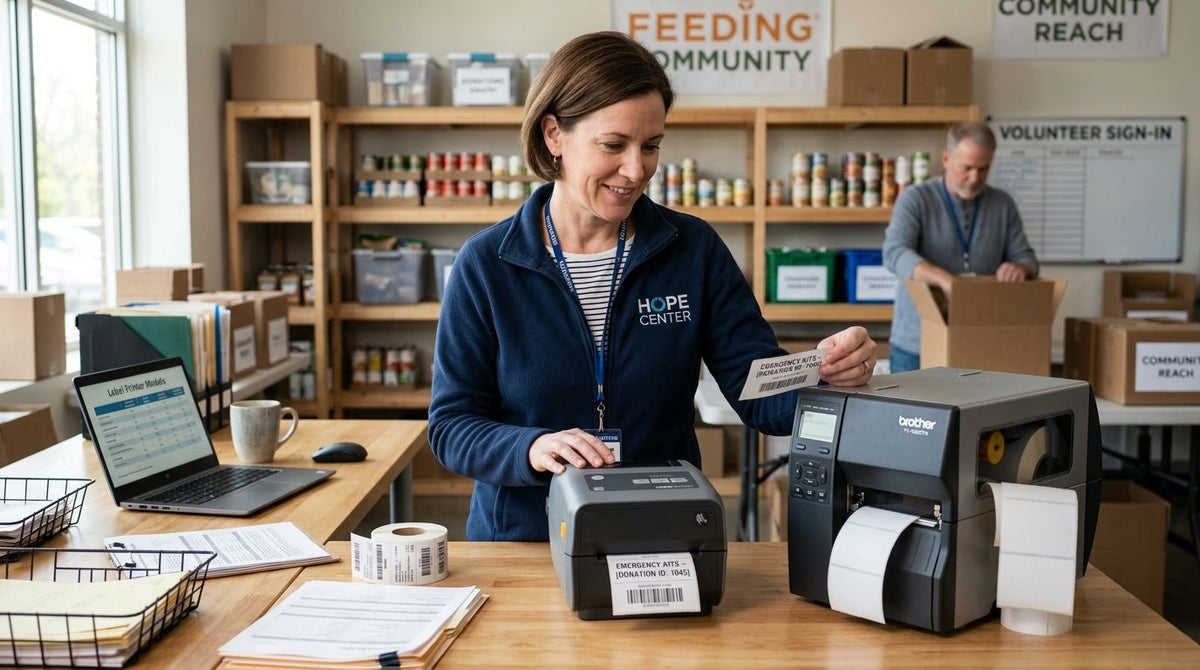
Nonprofits need a label printer that survives donation intake counters, equipment audits, and thrift-store backrooms — not a machine built for office memos. A 203 DPI direct thermal printer with no ribbon covers general labeling for most nonprofits in 2026, while equipment and outdoor property need heavier-duty asset tags rated for years of exposure, not printer paper.
- A 203 DPI direct thermal printer, like the GoDEX RT200i, handles donation labels and general office printing without ribbon costs.
- 3M heavy-duty and metalized silver asset tags survive outdoor donation bins, church grounds equipment, and food pantry racks.
- 300 DPI thermal transfer only pays off when a barcode needs to stay scannable for years on metal or outdoors.
- GoDEX printers include a 3-year warranty, which matters for a volunteer-run office with no repair budget.
Why this matters
Most nonprofit label decisions get made by whoever inherited the old printer, not by anyone who compared resolution or ribbon type. That works fine until a donation counter jams three times a day or a barcode on a landscaping tool fades after one summer outdoors.
A GoDEX RT200i 203 DPI printer is priced and built for exactly the volume most nonprofits actually run: donation receipts, shelf labels, and general inventory tags. The mistake isn't picking the wrong brand — it's matching consumer-grade office gear to a job that needs an industrial spec sheet, or overspending on 300 DPI resolution nobody in the building needs.
Getting this right in 2026 means separating two different jobs: printing labels fast at a counter, and tagging equipment that has to survive weather, forklifts, and years of handling.
How to choose a label printer for a nonprofit organization
Start with volume and environment, not brand. A thrift store printing hundreds of price tags a day has different needs than a food pantry tagging shelving once a quarter.
| Printer type | Resolution | Ribbon needed | Best for | Verdict |
|---|---|---|---|---|
| Direct thermal (GoDEX RT200i) | 203 DPI | No | Donation receipts, price tags, general labeling | Buy |
| Direct thermal linerless (GoDEX DT200L) | 203 DPI | No | High-volume intake counters, fast turnaround | Buy |
| Thermal transfer (GoDEX ZX430i+) | 300 DPI | Yes | Small barcodes on asset tags, outdoor gear | Buy for asset tracking |
The direct thermal row covers most nonprofit office and retail printing. The thermal transfer row exists for one reason: equipment and property tags that need to survive outside a climate-controlled room.
Direct thermal printers: 203 DPI covers most nonprofit labeling
A 203 DPI direct thermal printer prints without ribbon, which cuts consumable cost and simplifies training for volunteers who rotate through the front desk. It's the right call for donation receipts, retail price tags in a thrift shop, and general inventory labels that stay indoors.
The tradeoff: direct thermal labels fade faster under UV exposure or heavy handling than thermal transfer prints. For anything staying indoors and turning over within a year or two, 203 DPI direct thermal is the correct spec — buying more resolution than that job needs just adds cost.
Thermal transfer printers: 300 DPI for asset tags that must survive years outdoors
Once equipment leaves the building — landscaping tools, HVAC units, vehicles parked outside a church or shelter — the label has to survive sun, rain, and repeated handling for years, not months. A 300 DPI thermal transfer printer prints small barcodes cleanly enough to scan reliably even after the surface takes some wear.
Pair it with 3M heavy-duty or metalized silver tags rather than paper stock. Metalized silver barcode asset tags hold up on metal equipment and outdoor property in a way office-grade adhesive labels never will.
Why printer needs vary across nonprofits
- Donation volume: a busy thrift store needs fast, ribbon-free printing at the counter; a small pantry might print a handful of labels a week.
- Indoor vs. outdoor assets: office equipment and shelving need less durability than landscaping gear, vehicles, or HVAC units left outside.
- Barcode density: small asset tags with tight barcodes need 300 DPI resolution to stay scannable; large price tags don't.
- Volunteer turnover: printers with simple, standalone operation reduce training time for staff who change every few months.
- Consumable budget: ribbon-free direct thermal labels cost less to maintain over time than thermal transfer setups that require ribbon reorders.
- Reporting needs: donor and grant reporting sometimes requires tracked inventory, which pushes toward barcode-capable tags over blank labels.


Is a 203 DPI printer good enough for a nonprofit thrift store?
Yes, 203 DPI is good enough for a nonprofit thrift store printing price tags, donation receipts, and shelf labels — that resolution reads cleanly at normal barcode and text sizes. Move up to 300 DPI only if the store needs small, dense barcodes on tiny items.
Do nonprofits need thermal transfer labels for outdoor asset tags?
Yes, thermal transfer labels are the right call for outdoor asset tags because the ribbon-based print resists fading and abrasion far longer than direct thermal ink alone. Landscaping equipment, HVAC units, and vehicles parked outside all fall into this category.
Can one printer handle both donation labels and IT asset tracking?
One 203 DPI direct thermal printer can handle donation labels, but IT asset tracking works better on a dedicated setup using heavy-duty or metalized silver tags, since laptops and equipment move between rooms and need labels that survive years of handling. Running both jobs on one printer works for low-volume nonprofits; higher-volume operations tend to split the two.
McAuley Labels ships GoDEX printers and asset tags built around this split — a direct thermal printer for counters and receipts, and 3M heavy-duty or metalized silver tags for anything that leaves the building. That's the practical answer for most nonprofit budgets heading into 2026, without buying resolution or ribbon capability nobody in the office actually uses.
FAQ
What's the best label printer for a small nonprofit office?
A 203 DPI direct thermal printer, such as the GoDEX RT200i, is the best fit for a small nonprofit office because it skips ribbon costs and handles receipts, shelf labels, and general printing without extra maintenance.
Is a 203 DPI printer good enough for barcode asset tags?
203 DPI is good enough for most barcode asset tags at normal sizes, but small or densely packed barcodes on equipment tags print more reliably at 300 DPI.
Do nonprofits need thermal transfer or direct thermal labels?
Nonprofits need direct thermal labels for indoor, short-term use like receipts and price tags, and thermal transfer labels for outdoor or long-term asset tags that must resist fading and abrasion.
What material works best for outdoor donation bins and equipment?
3M heavy-duty or metalized silver tags work best for outdoor donation bins and equipment because they resist weather and repeated handling far better than paper or standard adhesive labels.
Can one printer handle both donation tags and equipment asset tags?
One direct thermal printer can handle both jobs for low-volume nonprofits, but higher-volume operations get better results running a dedicated setup with heavy-duty tags for equipment.
Do nonprofits need a barcode scanner along with a label printer?
A barcode scanner is only necessary if the nonprofit tracks inventory or equipment by scan rather than by sight, which becomes worthwhile once asset counts pass a few dozen items.
How long do label printers last for occasional nonprofit use?
GoDEX printers carry a 3-year warranty, and occasional office use — well under daily industrial volume — typically runs well past that warranty period before needing replacement.
One last thing
The detail most nonprofits miss isn't the printer — it's the ribbon. A direct thermal printer needs zero ribbon, which sounds minor until a volunteer-run office realizes it just removed one more consumable to track, reorder, and budget for in 2026. Skip thermal transfer unless equipment actually leaves the building; everything else runs cheaper and simpler on ribbon-free direct thermal labels.