
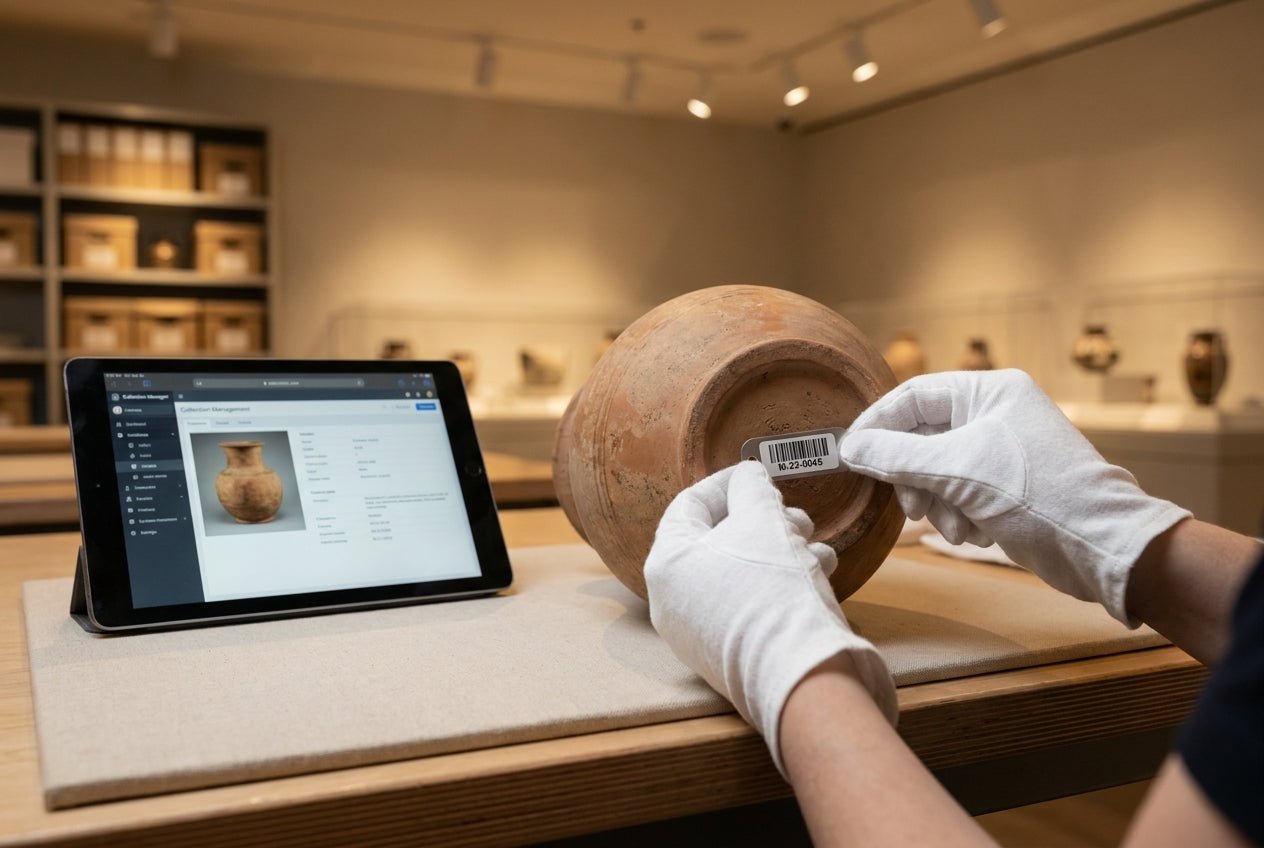
Museum registrars need asset tags that survive decades in storage, scan cleanly at tiny sizes, and never bleed adhesive onto a display case or shelf. This guide breaks down what to look for in asset tags for museum collections and which McAuley Labels options make sense for a permanent collections management program in 2026.
TL;DR
For asset tags for museum collections, metalized silver polyester tags win on longevity and legibility, and QR-code versions beat plain barcodes once a collection tops a few thousand objects. The Metalized Silver ID Label is the safe, general-purpose pick for most registrars in 2026. Skip standard paper labels and direct-thermal stock for anything going into long-term storage — they fade under UV and humidity swings inside a decade.
Why this matters
A museum collection isn't a warehouse. Objects move between storage, conservation, exhibit, and loan, sometimes for 20-plus years without a single physical inventory check. A tag that fades, peels, or scans inconsistently doesn't just cost time — it breaks the chain of custody a registrar needs for insurance, loan agreements, and accreditation reviews. Asset tags for museum collections have to work in 2026 and still work when someone pulls that object off a shelf in 2040.
Most small and mid-size museums don't tag the object itself — that's a conservation decision, not a labeling one. The tag usually goes on the storage box, mount, shelf location, or accession folder, which changes what "durable" actually means here: less about scratch resistance, more about adhesive stability on cardboard, wood, and painted metal shelving over long, undisturbed periods.
Who this is for
This guide is built for museum registrars, collections managers, and archivists running a permanent catalog of accessioned objects — whether that's a 400-piece local historical society or a university collection with 15,000-plus items. If you're tagging loaned traveling exhibits or a rotating retail gift shop inventory, the durability math is different and you can use a lighter-duty label.
What to look for in asset tags for museum collections
Adhesive that holds on storage materials, not just metal
Most asset tag adhesive is engineered and tested for painted metal and plastic — think warehouse racking or IT equipment. Museum storage surfaces are cardboard archival boxes, wood shelving, and folder stock, which absorb adhesive differently. Confirm the tag's adhesive is rated for extended dwell time on porous surfaces before ordering in bulk.
Barcode or QR readability at small sizes
Collection tags often need to sit in a corner of a folder or box lid, which means small format — sometimes under an inch. A barcode that reads fine at 2 inches can fail at 0.75 inches if the printer resolution isn't high enough. This is where print resolution stops being a spec sheet detail and starts being a daily workflow problem.
Print resolution matched to tag size
A 203 DPI printer is fine for larger barcode tags with generous white space. Anything with small text, a QR code, or a dense numeric sequence on a small tag benefits from 300 DPI. The GoDEX RT230i prints at 300 DPI, which keeps small accession numbers sharp instead of smudged.
Sequential and custom numbering
Most collections use an accession number system already in place — often decades old. Your tag supplier needs to print sequential or custom numbers that match that existing scheme exactly, not force you onto a new numbering convention. Ask before ordering a batch of 500 or more.
Longevity in low-light, climate-controlled storage
Most collection storage rooms are climate-controlled and dark, which is actually the easiest environment for a label to survive in — no UV, no temperature swings. That means you don't need outdoor-rated adhesive here, but you do want polyester or vinyl stock over paper, since paper degrades and yellows even in stable conditions over 10-plus years.
Order economics for large one-time batches
Collections management tagging is usually a single large project, not an ongoing weekly order. A registrar tagging 8,000 objects wants one bulk print run, consistent numbering across the whole batch, and a fixed unit cost — not per-order pricing that penalizes volume. Get a custom quote before committing to a full collection rollout.
Top picks for museum collection tagging
The safe pick: Metalized Silver ID Label Metalized silver polyester is the standard material for permanent asset identification, and it holds up on folder stock and box lids without curling at the edges. It ships as a plain ID label rather than a barcode format, which suits collections still using a manual ledger alongside digital records. Verdict: Buy — this is the default choice for most registrars starting a tagging project in 2026.
The modern pick: Custom QR Code Asset Tags, Metalized Silver Polyester A QR code tag on metalized silver polyester lets staff scan an object straight into a collections database from a phone, no dedicated barcode scanner required. This matters most for collections over 2,000 objects where staff turnover makes a fast, phone-based lookup worth more than a legacy barcode format. Verdict: Buy — the phone-scan workflow saves real time during annual inventory checks.
The heavy storage pick: Heavy Duty Silver Barcode Heavy-duty silver barcode tags add a tougher laminate layer over the standard metalized stock, which matters for tags on frequently handled storage bins rather than untouched archival boxes. If your collection gets pulled and reshelved often — a working research collection versus a sealed archive — the extra laminate resists edge lifting. Verdict: Consider — worth the upgrade only if handling frequency is genuinely high.
The in-house printing pick: GoDEX RT230i, 300 DPI If a museum wants to print its own tags on demand rather than ordering pre-printed batches, the GoDEX RT230i prints at 300 DPI, sharp enough for small accession numbers and dense QR codes. This only pays off if the collection keeps growing and new accessions need tags weekly or monthly rather than in one bulk run. Verdict: Consider — skip it for a one-time tagging project and just order pre-printed tags instead.
The bulk rollout pick: Custom Quote for full collection tagging A collection with thousands of objects and a fixed numbering scheme should get pricing and turnaround confirmed before the project starts, not after the first 500 tags arrive. The custom quote path lets a registrar lock in sequential numbering, material, and unit cost for the entire batch in one order. Verdict: Buy — this is the right move for any project over roughly 1,000 objects.
What to avoid
- Direct thermal paper labels — they look fine on day one but fade within a few years even in dark storage, and a faded accession tag defeats the whole point of tagging.
- Generic warehouse asset tags sized for equipment, not folders — a 2-inch by 3-inch tag built for a forklift doesn't fit inside most archival folders or box corners cleanly.
- Over-aggressive industrial adhesive — adhesive engineered to grip painted steel can pull cardboard fibers or bond too permanently to wood shelving that gets repainted or replaced.
Verdict comparison
| Option | Best for | Print resolution | Verdict |
|---|---|---|---|
| Metalized Silver ID Label | General collection tagging | Pre-printed | Buy |
| Custom QR Code Asset Tags (metalized silver) | Phone-scan inventory checks | Pre-printed | Buy |
| Heavy Duty Silver Barcode | High-handling working collections | Pre-printed | Consider |
| GoDEX RT230i printer | In-house, ongoing tagging | 300 DPI | Consider |
| Custom Quote (bulk order) | 1,000+ object rollouts | Pre-printed | Buy |
FAQ
What's the best material for asset tags for museum collections? Metalized silver polyester is the standard choice because it resists yellowing and edge-curling in long-term storage, unlike paper stock. It's the material behind McAuley Labels' ID label and QR code asset tags.
Should museum objects be tagged directly? Most registrars tag the storage box, folder, or shelf location rather than the object itself, since direct tagging is a conservation decision outside a standard labeling workflow. Check with a conservator before applying any adhesive tag to an artifact surface.
Are QR codes better than barcodes for museum inventory? QR codes let staff scan an object into a database using a phone camera, while barcodes usually need a dedicated scanner. For collections over roughly 2,000 objects, the QR code workflow saves meaningful staff time during annual inventory counts.
How small can an asset tag barcode be and still scan reliably? Barcode legibility depends on print resolution more than tag size alone — a 300 DPI printer like the GoDEX RT230i keeps small codes sharp where a 203 DPI printer might blur at the same size.
Do museum asset tags need to be weatherproof? Only if storage isn't climate-controlled. Most collection storage rooms are indoor and dark, so UV and moisture resistance matter far less than they do for outdoor equipment tags.
How much does it cost to tag a large museum collection? Cost scales with volume and material, so a bulk collection project should get a fixed quote before ordering rather than pricing individual batches. A custom quote locks numbering, material, and unit pricing for the full run.
Can existing accession numbers be printed on new tags? Yes — custom and sequential numbering can match an existing accession scheme exactly, which matters since most collections have used the same numbering convention for decades.
What's the difference between asset tags and inventory labels for a museum? Asset tags are built for long-term, one-time identification of a specific object or container, while inventory labels are typically meant for higher-turnover stock tracking. A museum collection almost always needs the asset tag category, not the inventory label category.
One last thing
The biggest mistake registrars make isn't material choice — it's numbering gaps. A tag batch printed out of sequence, or with skipped numbers from a reprint, creates a mismatch between the physical collection and the digital catalog that can take weeks to reconcile during an annual audit. Confirm the full numbering sequence before a bulk order ships, not after.