
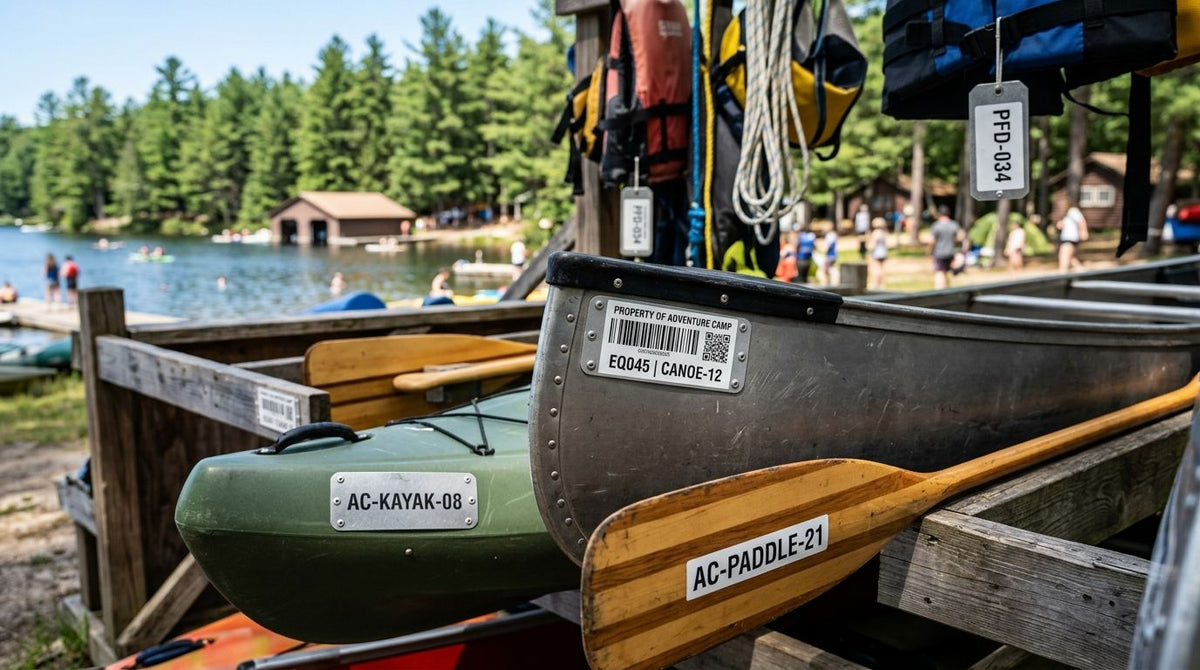
Asset tags for summer camp equipment are numbered, scannable stickers rated for sun, water and repeated handling that let camp and recreational facility staff track canoes, ropes-course gear, golf carts and AV equipment across a property used by hundreds of guests each season. A camp's equipment problem isn't inventory volume — it's turnover, exposure and staff who rotate every few weeks.
- Asset tags for summer camp equipment need 3M heavy-duty or metalized silver polyester, not paper labels or marker.
- McAuley Labels ships numbered barcode and QR asset tags built for waterfront and outdoor camp gear in 2026.
- Set a prefix numbering system by equipment category before ordering — retrofitting mid-season wastes tags and confuses staff.
- A desktop printer like the GoDEX GE300 lets a camp print replacement tags in-house after opening day.
Why asset tags matter for summer camps and recreational facilities
Waterfront equipment moves between the boathouse, the lake and the repair shed within the same afternoon. Ropes-course hardware gets shuffled between activity zones by counselors who rotate weekly. Sports gear migrates from the field house to cabins and back with campers who never remember where it came from.
None of that pressure is unique to camps, but the combination is: heavy outdoor exposure, high staff turnover measured in weeks not years, and shared-use gear touched by dozens of different hands in a single season. A paper label or a marker-written serial number survives maybe a week of pool spray and direct sun before it's unreadable. A tag that has to hold from Memorial Day through Labor Day needs a material spec built for that, not just a design that looks organized on day one.
Recreational facilities that run year-round — gyms, rec centers, ski lodges — face a milder version of the same problem: outdoor storage, seasonal part-time staff, and gear that gets checked out by name instead of tracked by number. The fix is the same in both cases: heavy-duty silver barcode asset tags that survive the environment, plus a numbering system staff can actually follow.
How to set up asset tags for camp equipment
Inventory every equipment category first
Start with a walk-through, not a label order. Group gear by where it lives and how it's exposed, because that grouping decides which tag material each category needs.
- Waterfront: canoes, kayaks, paddles, life jackets, dock hardware
- Ropes course and climbing: harnesses, carabiners, helmets, belay hardware
- Field sports: goals, cones, archery targets, bows, sports carts
- Vehicles and utility: golf carts, ATVs, maintenance tools, generators
- Indoor: AV equipment, kitchen tools, cabin furniture, first-aid stations
Match tag material to exposure
Don't buy one tag type for the whole property. A tag that survives a lake dock and a tag that survives an indoor supply closet don't need the same spec, and paying for heavy-duty adhesion on cabin furniture is a wasted budget line.
- Metalized silver polyester barcode tags for general gear that gets handled daily but stays mostly dry
- 3M heavy-duty tags for anything that touches water, direct sun or gets stored outdoors between seasons
- Semi-gloss white ID tags for indoor equipment like AV gear and kitchen tools where cosmetics matter more than weatherproofing
- QR code metalized silver tags where staff need to scan with a phone camera instead of a dedicated scanner
Set a numbering system before you order tags
Ordering tags before deciding on a numbering scheme is the single most common reason camps end up with duplicate numbers or gaps by July. Build the scheme on paper first.
- Assign a two-letter prefix per category — WF for waterfront, RC for ropes course, FS for field sports
- Start each category at 001 and leave headroom for gear purchased mid-season
- Decide barcode vs. QR before ordering, since the two use different scan hardware
- Log every assigned number in a spreadsheet before tags ship, not after they arrive
- Keep the numbering scheme identical across seasons so historical maintenance records still match
Print or order tags
The manual, no-equipment path works fine for most camps: order pre-printed, sequentially numbered tags direct from the manufacturer and apply them as gear arrives. That covers the bulk of a pre-season order in one pass.
The faster path matters mid-season, when new gear shows up after opening day and waiting on a reorder isn't practical. A desktop thermal transfer printer, like the GoDEX GE330, lets facilities staff print a handful of replacement or new-gear tags on demand instead of holding up the whole system for one canoe.
Apply tags so they survive the season
Adhesion failure is almost always an application problem, not a tag problem. A tag applied cold or to a dirty surface peels within weeks regardless of material.
- Clean the application surface with isopropyl alcohol before placing the tag
- Apply above 50°F — cold surfaces reduce adhesive tack immediately
- Avoid placing tags on edges or high-friction contact points where they'll rub off
- Press firmly across the full tag surface for 10-15 seconds after placement
- Let the adhesive cure 24 hours before submerging waterfront gear
Build a check-out and check-in workflow
A tag with no scanning process behind it is just a sticker. The workflow doesn't need to be complicated — it needs one consistent scan point per activity area.
- Station one staff member per zone (waterfront, ropes course, field house) to scan gear out and in
- Use a shared spreadsheet or a basic inventory app tied to the tag numbers
- Log condition at check-in so damaged gear gets flagged before the next group uses it
- Reconcile the full inventory weekly during peak season, not just at closing
Audit tags every off-season
Tags that survived one summer don't automatically survive storage. Cold, damp equipment sheds are harder on adhesive than a July afternoon on the lake.
- Check adhesion on outdoor and waterfront gear before the next season starts
- Replace faded, peeling or unreadable tags rather than re-scanning a guess
- Retire tag numbers for equipment that's been sold, donated or scrapped
- Reconcile the season's final count against the numbering log before reordering


Comparing tag options for camps and recreational facilities
| Option | Best for | Key limitation |
|---|---|---|
| Metalized silver polyester barcode tags | General gear handled daily, mostly dry storage | Needs a handheld barcode scanner, not just a phone |
| 3M heavy-duty metalized tags | Waterfront and ropes-course hardware exposed to sun and moisture | Higher cost per tag than standard polyester |
| Semi-gloss white ID tags | Indoor gear — AV equipment, kitchen tools, cabin furniture | Less abrasion resistance if moved outdoors |
| QR code metalized silver tags | Facilities wanting phone-camera check-out with no scanner hardware | Staff have to open a camera app for every scan |
Verdict: 3M heavy-duty tags win for any gear that touches water or lives outdoors between seasons; semi-gloss white covers everything that stays indoors.
“If a tag needs a handheld scanner to read, don't put it on gear counselors check out from a phone.”
Common mistakes camps make with equipment tagging
- Using paper labels or permanent marker for anything outdoors — both fade or smear within weeks of sun and pool spray.
- Running one numbering scheme across every category with no prefix, so a scan of "014" could mean a canoe or a cabin lamp.
- Skipping the numbering log and assigning numbers on the fly, which produces duplicates by the second week of camp.
- Assuming seasonal staff already know the system — a tagging workflow with no training step falls apart the first time a new counselor rotates in.
- Never retiring tags on gear that's sold or scrapped, so the inventory count never matches what's actually on site.
FAQ
What's the best asset tag material for summer camp equipment?
3M heavy-duty metalized polyester tags hold up best on waterfront and outdoor gear exposed to sun and moisture through a full 2026 camp season. Semi-gloss white tags are a lower-cost option for indoor-only equipment like AV gear and kitchen tools.
Do asset tags work on gear that goes underwater, like canoes and kayaks?
3M heavy-duty tags are built for repeated water exposure and hold adhesion after full curing, typically 24 hours post-application. Apply them above the waterline rather than on a fully submerged surface for the longest life.
Is QR code or barcode better for camp equipment tracking?
QR code tags let staff scan with any smartphone camera, which is faster to roll out for seasonal counselors with no scanner training. Barcode tags need a handheld scanner but scan faster at high volume, which suits large facilities with a dedicated check-out desk.
How do I number asset tags across different equipment categories?
Assign a short prefix per category — WF for waterfront, RC for ropes course, FS for field sports — before ordering any tags. Log every assigned number in a spreadsheet so numbering stays consistent season to season.
Can I print asset tags myself instead of ordering pre-printed ones?
Yes — a desktop thermal transfer printer like the GoDEX GE330 lets facilities staff print numbered tags in-house for gear added after the season starts. Most camps still order the initial batch pre-printed and only print in-house for mid-season additions.
How often should camps replace equipment asset tags?
Check tag adhesion and readability at the start of each off-season audit, replacing anything faded, peeling or scanning unreliably. Heavy-duty tags on outdoor gear are the most likely to need replacement after a full season of sun and water exposure.
Do asset tags work for recreational facilities that run year-round, not just camps?
Yes — gyms, rec centers and ski lodges face the same shared-use, seasonal-staff problem as summer camps, just spread across a longer calendar. The same tag material rules apply: heavy-duty for outdoor or high-moisture gear, standard tags for indoor equipment.
One last thing
The camps that keep tags readable past July aren't the ones with the fanciest labels — they're the ones that matched tag material to where the gear actually lives before ordering anything. Skip that step and you're reordering tags in August regardless of what you paid per sticker in 2026.