
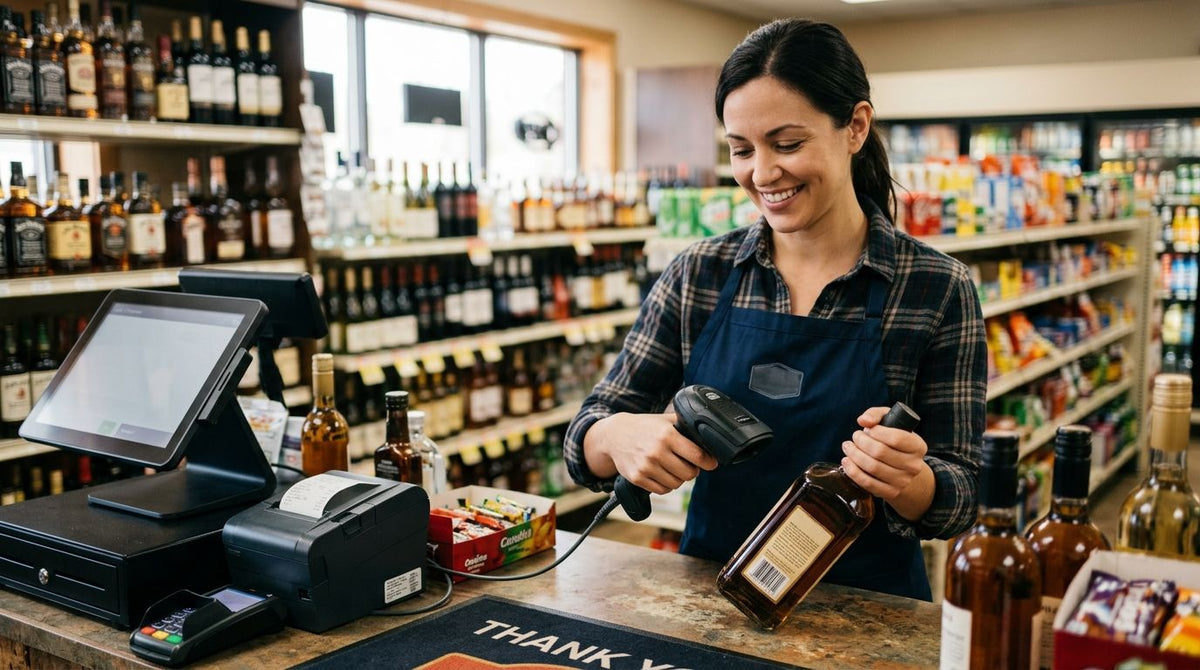
Convenience and liquor store counters need a barcode scanner that reads fast, survives spills, and — for liquor stores — reads the barcode on a driver's license, not just the UPC on a six-pack. The best barcode scanner for convenience stores in 2026 is the GoDEX GS220 USB scanner for single-lane checkout, with a 2D imager stepping in wherever age verification is part of the job.
- The best barcode scanner for convenience stores in 2026 is the GoDEX GS220 USB scanner for single-lane checkout.
- Liquor stores need a 2D imager to read the PDF417 barcode on a driver's license for age verification.
- Multi-register stores get more from a wireless Bluetooth 2D scanner than a second wired unit.
- Presentation scanners suit high-volume counters like delis but stay fixed to one spot.
Why this matters
A convenience store scans two different kinds of codes all day: UPC barcodes on merchandise and, at a liquor counter, the PDF417 barcode on a customer's driver's license. A basic 1D barcode scanner handles the first job fine. It cannot read the second.
Get this wrong and a store either buys a scanner that can't verify age, or overspends on a 2D unit for a register that only ever rings up soda and chips. The picks below split the decision by what actually happens at your counter, not by brand hype.
What makes the best barcode scanner for convenience stores
- Read type coverage — 1D-only for UPC/EAN codes, or 2D for QR codes and the PDF417 format used on driver's licenses
- Connection type — wired USB for a fixed lane, wireless Bluetooth for roaming or backup registers
- Age verification support — whether the scanner and its software can flag a birthdate against today's date
- Counter durability — a scanner dropped or splashed at a gas station register a few times a week needs a housing built for it
- POS integration — plug-and-play USB HID output versus a unit that needs configuration software
- Warranty backing — how long the manufacturer stands behind the hardware
At a glance
| Scanner type | Best for | Standout feature | Key limitation |
|---|---|---|---|
| GoDEX GS220 USB Barcode Scanner | Single-lane checkout | USB plug-and-play, no drivers to install | 1D only, wired to one register |
| 2D imager scanner | Age verification at the counter | Reads PDF417 barcodes on driver's licenses | Needs age-check logic in the POS software |
| Wireless Bluetooth 2D scanner | Multi-register or roaming stores | Cordless range between aisle and counter | Needs a charging dock and periodic pairing |
| Presentation (hands-free) scanner | High-volume single-lane counters | Auto-triggers without lifting the unit | Fixed mount, not portable between registers |
1. GoDEX GS220 USB Barcode Scanner: best barcode scanner for single-lane checkout
The GoDEX GS220 is a 1D USB scanner built for retail and warehouse counters that need one thing done reliably: scan a UPC and pass it straight to the POS. It plugs in as a USB HID device, so most point-of-sale software recognizes it without a driver install, and GoDEX backs it with a 3-year warranty.
GoDEX GS220 pros:
- Plug-and-play USB setup with no configuration software required
- Built for the scan volume of a daily retail counter
- 3-year manufacturer warranty
- Priced for a single-lane convenience store, not a distribution center
GoDEX GS220 cons:
- Reads 1D barcodes only — no QR codes, no PDF417 license barcodes
- Wired connection ties it to one register
- No built-in age-verification logic; that lives in the POS software
Best for: convenience stores where the register only needs to ring up merchandise, not check IDs.
Verdict: Buy if your counter never needs to verify age and you want one wired scanner that works the day it's plugged in.
2. 2D imager scanner: best barcode scanner for age verification at the counter
A liquor store counter has a job a plain UPC scanner can't do: reading the PDF417 barcode printed on the back of a US driver's license. Every US state encodes license data in that format under the AAMVA standard, and a 2D imager reads it the same way it reads a QR code on a coupon or an inventory tag — in a single pass, no typing required.
2D imager pros:
- Reads PDF417, QR, and 1D barcodes in one device
- Pulls a customer's date of birth directly from a license scan when paired with age-check POS software
- Doubles as the scanner for QR-coded inventory labels during stock counts
2D imager cons:
- Costs more than a 1D-only unit
- Age-verification logic still depends on the POS software recognizing the license format
- Overkill for a register that only scans merchandise barcodes
Best for: any liquor store counter, or a convenience store counter that also sells age-restricted tobacco or vape products.
Verdict: Buy if age verification happens at that register even occasionally — the read-everything capability pays for itself the first time a cashier stops manually typing a birthdate.
3. Wireless Bluetooth 2D scanner: best barcode scanner for multi-register convenience stores
Stores running two or three registers, or a counter that also does floor price checks, get more mileage from one cordless scanner than from wiring a second unit to every till. A Bluetooth 2D scanner pairs to whichever register needs it that shift and comes off the dock to check a shelf tag or restock label without walking back to the counter.
Wireless Bluetooth 2D scanner pros:
- Moves between registers or out onto the floor without recabling
- Reads the same 1D/2D/PDF417 range as a wired 2D imager
- Useful for cycle counts against shelf labels between customers
Wireless Bluetooth 2D scanner cons:
- Needs a charging dock and battery management
- Occasional re-pairing if the unit drops connection
- Higher unit cost than a fixed wired scanner
Best for: two-plus register convenience stores, or any store where the same scanner covers checkout and shelf work.
Verdict: Buy for multi-lane stores; Skip for a true single-register counter where a wired unit never leaves its spot anyway.
4. Presentation (hands-free) scanner: best barcode scanner for high-volume single-lane counters
A presentation scanner sits mounted on the counter and fires automatically when a barcode passes in front of it — no trigger pull. That matters at a high-throughput lane: a busy gas station register or a deli counter ringing up dozens of small items an hour benefits from a cashier who never has to pick up and re-holster a handheld unit between scans.
Presentation scanner pros:
- Hands-free triggering speeds up high-volume single-lane checkout
- Reduces wrist strain on a register scanning hundreds of items per shift
- Reads 1D and 2D codes depending on the model
Presentation scanner cons:
- Fixed mount — can't be carried to a shelf or a second register
- Awkward for oversized or bagged items that don't sit flat under the scan window
- Not the right pick for a low-volume counter
Best for: the single busiest lane in a store — the one where a handheld scanner would spend all day in someone's hand anyway.
Verdict: Hold unless one specific lane is genuinely high-volume enough to justify a fixed mount.


How we ranked
Each pick maps to one criterion from the list above: read-type coverage decided whether an item needed 2D capability, connection type split wired from wireless, and counter role decided whether age verification or high-volume throughput mattered most. No two items compete for the same job — that's deliberate. A store picking blind off a barcode scanner for retail checkout counters guide usually ends up buying capability it never uses, or missing the one feature (PDF417 read) that actually matters at a liquor counter.
Which barcode scanner should you choose?
If your counter never checks an ID, the GoDEX GS220 is the right call for 2026 — wired, plug-and-play, and built for daily retail scan volume. The moment age verification enters the picture, even occasionally, step up to a 2D imager that reads PDF417 as easily as a UPC. Multi-register stores should treat a wireless Bluetooth 2D scanner as an efficiency purchase, not a luxury, and a presentation scanner only earns its fixed mount on the single busiest lane in the building.
“If a scanner can't read the PDF417 barcode on a driver's license, it's the wrong scanner for a liquor counter.”
FAQ
What's the best barcode scanner for a convenience store?
For a single-lane counter that only rings up merchandise, a wired 1D USB scanner like the GoDEX GS220 covers the job in 2026. Stores that also check IDs need a 2D imager instead.
Do liquor stores need a special scanner for ID verification?
Yes. A liquor counter needs a 2D imager that reads the PDF417 barcode encoded on the back of a US driver's license, not just a 1D UPC scanner. The AAMVA standard used by all US states relies on that 2D format.
Is a 2D scanner better than a 1D scanner for convenience stores?
A 2D scanner reads more formats, including QR codes and PDF417 license barcodes, but it costs more than a 1D-only unit. A store that never checks IDs doesn't need the extra capability.
Can one barcode scanner handle both checkout and inventory counts?
A 2D imager can scan both merchandise UPCs at checkout and QR-coded inventory labels during a stock count. A 1D-only scanner like the GoDEX GS220 is limited to UPC-style codes.
What is a PDF417 barcode and why does it matter for liquor stores?
PDF417 is the 2D barcode format printed on US driver's licenses under the AAMVA standard. A liquor store scanner needs 2D read capability to pull a birthdate from that code during an ID check.
Do wireless barcode scanners work better than wired ones for small stores?
Wireless Bluetooth scanners help stores running more than one register or doing floor price checks, but a single-lane counter usually does fine with a wired unit that never leaves its spot.
What's the difference between a barcode scanner and a barcode label printer?
A scanner reads codes already printed on products or licenses; a label printer creates the barcode labels a scanner later reads, such as shelf tags or inventory stickers.
One last thing
The scanner is only half the loop. If a store is printing its own shelf tags or inventory stickers to pair with that scanner, resolution matters as much as the scanner spec sheet — a 300 DPI thermal transfer printer produces sharper small barcodes than a 203 DPI unit, which matters when a scanner has to read a code from a few inches away in low light at a gas station counter.