
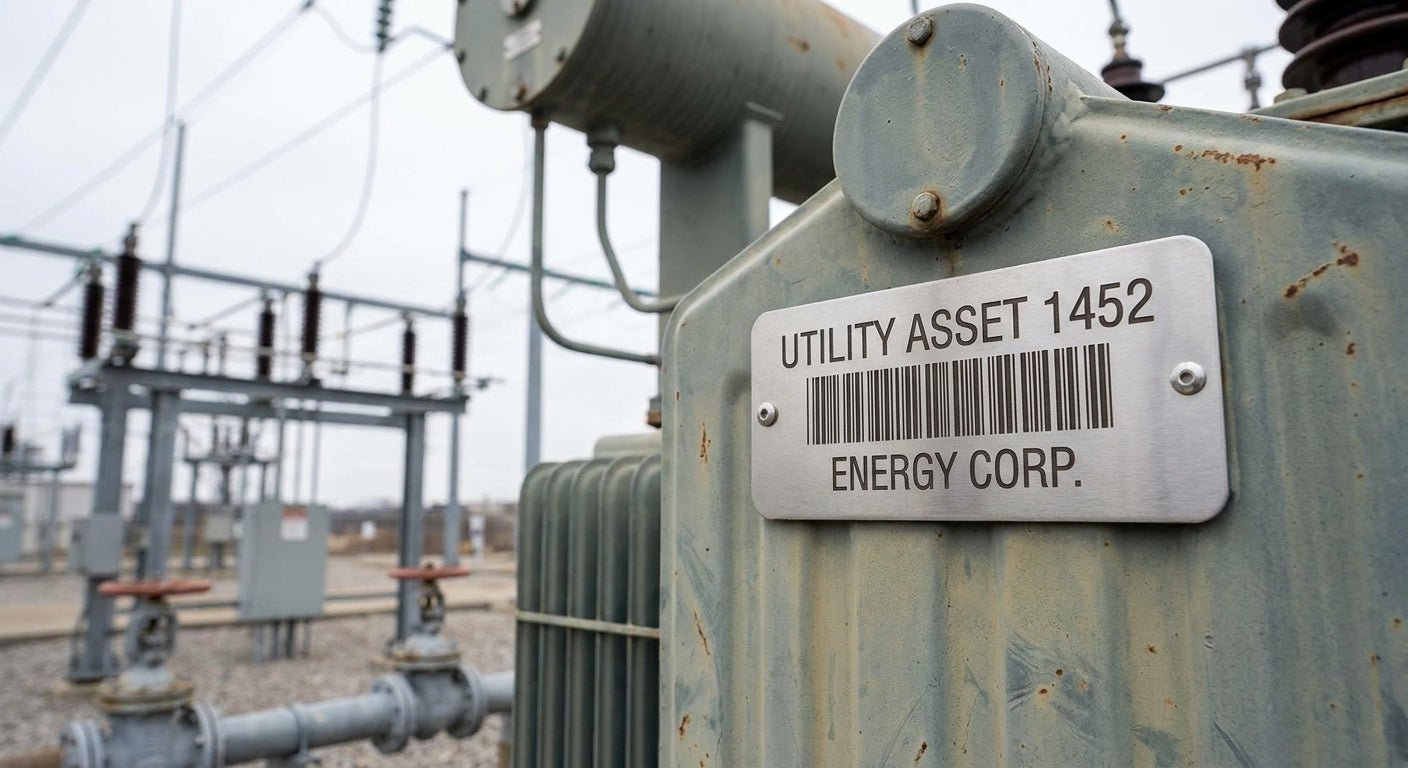
Utility and energy company equipment sits outside for decades — transformers, reclosers, padmount switches, and meter banks that a peel-and-stick label was never built to survive. This guide narrows the asset tag lineup at McAuley Labels down to the material and printer combinations that hold up on substation and field equipment through 2026, with a plain verdict on each one.
- 3M Heavy-Duty Silver Barcode Asset Tags at $115 survive outdoor substation exposure — the top asset tags for utility company equipment in 2026.
- Metalized Silver ID Asset Tags cost $67 and cover indoor meter rooms and control houses — buy.
- Heavy-Duty QR Code Asset Tags at $115 let crews scan straight into a work order from a phone — consider if your maintenance software reads QR.
- Semi-gloss white barcode tags fade within a season outdoors — skip for transformers, switchgear, and pole equipment.
Why this matters
A tag that fades or lifts off a breaker cabinet after one summer doesn't just look bad — it breaks the chain of custody that utility asset registers and public utility commission audits depend on. Re-tagging a substation after a crew has already been dispatched for maintenance costs more in labor than upgrading to a 3M heavy-duty tag in the first place would have.
Utility and energy companies also run longer replacement cycles than most industries. A transformer tagged in 2026 might still be in active service in 2046, and the tag material has to outlast the swap cycle of the equipment it identifies, not just survive until the next budget review. That's the real cost difference between a $67 tag and a $115 tag: one is priced for a five-year indoor asset, the other for a twenty-year outdoor one.
Who this is for
This guide is built for facilities and asset managers, GIS and asset-tracking coordinators, and maintenance supervisors at electric utilities, rural cooperatives, and energy companies who tag transformers, switchgear, meters, generators, breakers, and substation structures for inventory, maintenance scheduling, and compliance reporting. If your tags live indoors in a climate-controlled equipment room, most of this list is overbuilt for your needs — keep reading anyway, the printer and numbering sections still apply to indoor gear.
What to look for in asset tags for utility company equipment
Adhesive rated for metal and concrete through temperature swings
Substation hardware runs from below freezing in January to well over 140°F on a sun-facing steel cabinet in July. A tag with weak adhesive backing lifts at the corners in the first freeze-thaw cycle, and once one corner lifts, dust and moisture work under the rest of the label within a season. Look for adhesive rated specifically for outdoor metal, not general-purpose office-label stock.
UV and weather resistance built for multi-year exposure
Barcode contrast fades under UV faster than adhesive fails, and a barcode a scanner can't read defeats the tag entirely, no matter how well it's still stuck to the equipment. Metalized polyester or 3M-rated laminate construction holds contrast through repeated sun exposure; painted paper stock does not.
Barcode or QR contrast readable from a ladder or bucket truck
Field crews scanning a tag mounted on a 12-foot pole structure don't get to walk up and squint at it before logging a reading. High-contrast printing at 300 DPI or better keeps small barcodes legible at arm's length, which cuts down on re-scans and manual serial-number lookups during a maintenance visit.
Chemical resistance to transformer oil, diesel, and cleaning solvents
Equipment rooms and pad-mounted transformers get splashed with dielectric oil, diesel from backup generators, and solvent-based cleaners during routine maintenance. A tag surface that isn't chemical-resistant clouds over, and the barcode underneath stops scanning within months rather than years.
Sequential numbering for audit trails
Utility asset registers tied to compliance reporting need a unique, traceable ID per asset, not a repeating batch barcode. Sequential numbering built into the print run keeps the register clean without manual renumbering after equipment ships.
Printer compatibility for in-house reprints
Utilities add substations, swap meters, and retire equipment on a rolling basis year-round. Reordering a small batch of tags from a vendor every time adds days to onboarding new equipment, while an in-house thermal transfer printer removes that wait entirely and lets a facilities team print one tag or a hundred on the same afternoon.
Top picks for utility and energy company equipment
The workhorse pick: 3M Heavy-Duty Silver Barcode Asset Tags Metalized silver polyester construction with 3M-rated adhesive, priced at $115 per batch. This is the tag utilities reach for on transformers, switchgear cabinets, and any equipment that stays outdoors year-round. Verdict: Buy — 3M heavy-duty silver barcode asset tags hold contrast and adhesion through repeated freeze-thaw cycles that would peel a standard label within a year.
The budget staple: Metalized Silver ID Asset Tags Same metalized silver face at $67, built as an ID-format label rather than a barcode-first tag. This is the right call for meter rooms, control houses, and indoor panel equipment where exposure is lower and cost per tag matters more across a large register. Verdict: Buy for indoor and semi-protected equipment — metalized silver ID asset tags run roughly 42% cheaper than the heavy-duty barcode version.
The scan-and-log pick: Heavy-Duty QR Code Asset Tags Also $115, built on the same 3M heavy-duty metalized stock but printed with a QR code instead of a linear barcode. Crews already logging service visits on a phone or tablet scan the QR straight into a work order instead of typing a barcode number by hand in the field. Verdict: Consider — heavy-duty QR code asset tags make sense once your maintenance software reads QR natively; skip it if your system is still barcode-only, since the extra cost buys you nothing there.
The in-house control pick: GoDEX GE330 printer A 300 DPI thermal transfer printer priced at $446 that keeps tag production in-house instead of waiting on vendor reorders for every new substation. Utilities adding more than a few hundred tagged assets a year recover the printer cost fast in shipping time saved alone, and it prints both the metalized silver and semi-gloss stock lines at the same resolution. Verdict: Buy if your tagging volume runs past a few hundred units annually — otherwise stick with pre-printed batches ordered as needed.
What to avoid
Semi-gloss white barcode tags look nearly identical to the heavy-duty version in a photo, but the paper-adhesive combination isn't rated for sustained UV exposure and it clouds over on outdoor equipment within a single season. Skip it for anything mounted outside a building envelope, and reserve it strictly for indoor panels and shelving.
Generic barcode printers under 203 DPI struggle to print small serial numbers cleanly enough for a scanner to read at range, which matters more on utility gear scanned from a distance than in a warehouse where a worker can walk up and rescan by hand.
Don't confuse an asset ID tag with a control component. Crews tagging switchgear and reclosers already juggle enough hardware categories on a single cabinet, and mounting an asset tag near live terminals or moving parts — the kind of hardware covered in guides on utility interconnection disconnect switches — means keeping the tag clear of anything that opens, swings, or carries voltage during a service call.
Verdict comparison
| Product | Material | Price | Best use | Verdict |
|---|---|---|---|---|
| 3M Heavy-Duty Silver Barcode | Metalized silver polyester, 3M adhesive | $115 | Outdoor transformers, switchgear | Buy |
| Metalized Silver ID Label | Metalized silver polyester | $67 | Indoor meter rooms, control houses | Buy |
| Heavy-Duty QR Code Tag | Metalized silver polyester, 3M adhesive | $115 | Crews scanning via phone or tablet | Consider |
| GoDEX GE330 Printer | 300 DPI thermal transfer | $446 | In-house reprints, high volume | Buy for high-volume tagging |
| Semi-Gloss White Barcode | Semi-gloss paper stock | $67 | Indoor-only, low exposure | Skip for outdoor use |


FAQ
What are the best asset tags for utility company equipment in 2026?
3M Heavy-Duty Silver Barcode Asset Tags at $115 are the top pick for outdoor transformers and switchgear in 2026. Indoor equipment in meter rooms or control houses does fine on the $67 Metalized Silver ID version.
Is QR code or barcode better for utility asset tags?
QR code tags work better when field crews scan directly into a phone-based work order system, while barcode tags remain standard for legacy scanner hardware. Both come on the same 3M heavy-duty metalized stock, so the choice comes down to what your maintenance software reads.
How much do heavy-duty asset tags cost for utility equipment?
3M heavy-duty metalized asset tags for outdoor utility equipment run $115 per batch as of 2026, compared to $67 for the semi-gloss or metalized ID versions rated for lighter indoor use. The price difference reflects the 3M adhesive and UV-stable laminate, not just the material color.
Can regular barcode labels survive outdoor substation conditions?
No, standard paper barcode labels fade and lift within a single season of outdoor UV and temperature exposure. Substation and pole-mounted equipment needs metalized polyester construction with 3M-rated adhesive to hold up for the multi-year service life of the equipment.
Do utility asset tags need sequential numbering?
Yes, sequential numbering keeps an asset register traceable for compliance audits without manual renumbering after the fact. It matters most for utilities tracking transformers, breakers, and switchgear across multiple sites.
Should a utility company buy its own asset tag printer?
A utility tagging more than a few hundred assets a year benefits from an in-house printer like the GoDEX GE330 at $446, since it removes vendor reorder wait times entirely. Smaller registers under that volume are usually cheaper to order in pre-printed batches.
What DPI is needed for utility equipment asset tags?
300 DPI or higher keeps small serial numbers and barcodes legible when crews scan from a ladder or bucket truck rather than up close. Anything under 203 DPI risks blurred small text on tags mounted at a distance from the scanner.
One last thing
The metalized silver polyester used in the 3M heavy-duty line is the same tag material class that shows up on aerospace ground equipment and industrial machinery rated for decades of outdoor service — utilities aren't overpaying by choosing it, they're matching the tag lifespan to the equipment lifespan. A transformer tagged with a $67 semi-gloss label in 2026 will likely need re-tagging before the transformer itself needs its next inspection cycle.