
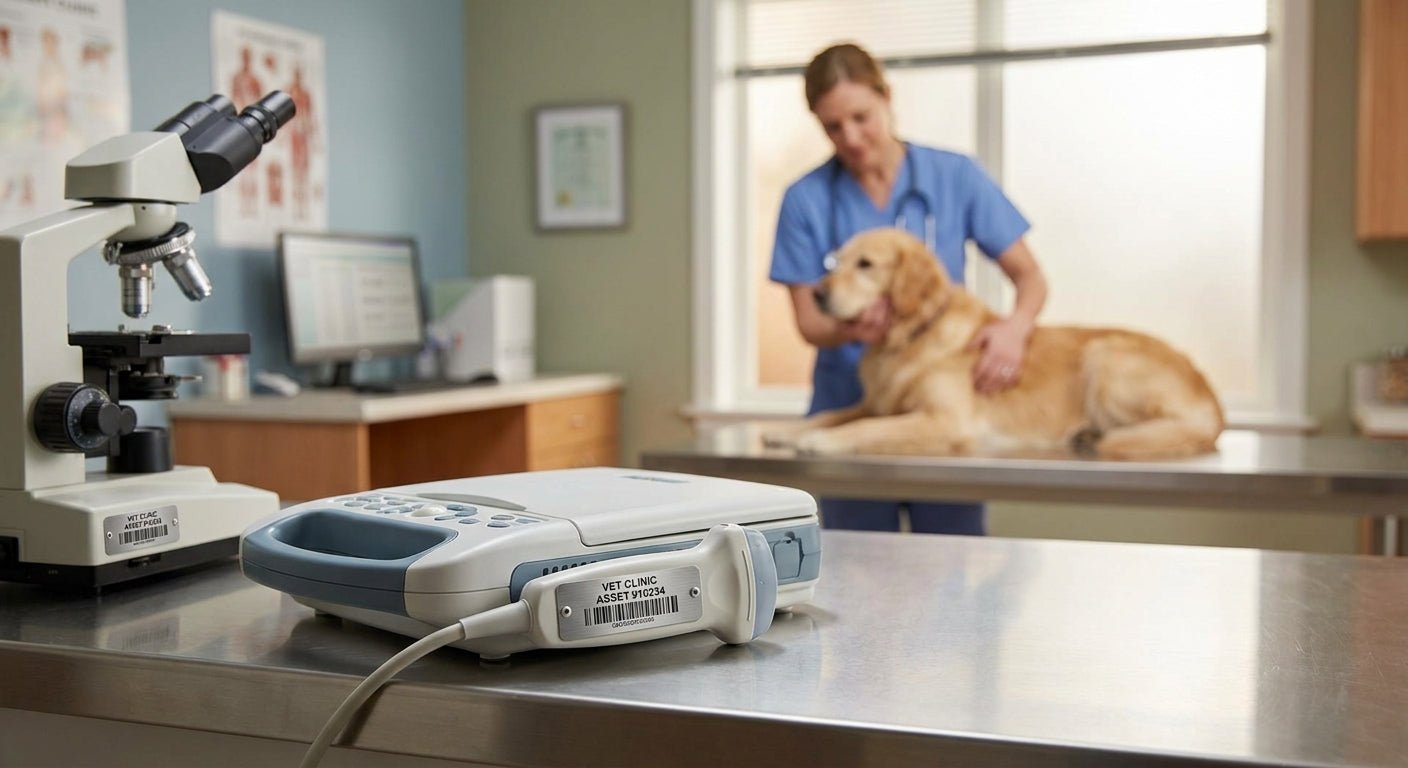
Veterinary clinics track more high-value, frequently-moved equipment per square foot than almost any other small business — otoscopes, dental units, anesthesia machines, ultrasound probes — and most of it gets wiped down with disinfectant or run through an autoclave weekly. Asset tags for veterinary equipment need to survive that environment while staying scannable for inventory audits.
TL;DR
For veterinary clinic equipment, metalized silver barcode asset tags are the default buy in 2026 because they hold up under alcohol wipes and autoclave-adjacent heat without the barcode degrading. Heavy-duty 3M-backed silver ID labels are the Buy pick for equipment that gets moved between exam rooms daily, while semi-gloss white barcode tags are a Consider for lower-wear items like reception scales. Paper labels and laser-printed stickers are a Skip — they lift within weeks in a clinical setting. McAuley Labels supplies all three tiers with barcode or sequential ID formats built for this exact use case.
Why This Matters
Search interest around equipment tagging for clinics sits at roughly 90 monthly searches with a difficulty score of 13 out of 100 as of 2026 — low competition, which means most clinics are still tagging equipment with whatever label roll came with their printer. That is a mistake once you factor in disinfectant exposure and insurance audits.
A standard paper label loses its printed barcode within 10 to 15 wipe-downs. A metalized silver barcode asset tag is built with a polyester face that shrugs off alcohol, isopropyl, and quaternary ammonium disinfectants — the three most common cleaners in a vet clinic supply closet. That single material difference is the reason clinics that switch report fewer unidentified-equipment write-offs during annual asset reviews.
Who This Is For
This guide is built for practice managers, clinic owners, and office administrators responsible for equipment inventory across one or multiple locations — the person who gets the call when an ultrasound probe or dental scaler cannot be traced back to a purchase order. If you are tagging fewer than 20 pieces of equipment, the buying logic still applies; you just need less material.
What to Look For in Asset Tags for Veterinary Equipment
Chemical and Disinfectant Resistance
Exam rooms get wiped down between every patient, sometimes 15 to 20 times a day. A label that is not rated for alcohol and quaternary disinfectants will fade or peel within a month, and a faded barcode is functionally a lost asset tag.
Adhesion to Curved and Metal Surfaces
Ultrasound machines, anesthesia carts, and dental units are mostly curved metal or painted steel. Standard adhesive labels lift at the edges within weeks on these surfaces — you need an adhesive rated for curved and low-surface-energy substrates specifically.
Barcode Scan Reliability
If your clinic runs any kind of inventory or maintenance-tracking software, the barcode has to scan cleanly on the first pass, every time, for years. A tag that scans fine on day one but degrades by month six defeats the purpose of tagging at all.
Tamper-Evidence for Controlled Equipment
Anesthesia machines and controlled-substance storage often fall under compliance review. A tamper-evident tag that shows a VOID pattern if peeled gives you a paper trail if equipment gets moved or swapped between locations without authorization.
Legibility After Repeated Wipe-Downs
Beyond the barcode, the printed ID number or asset name needs to stay human-readable for staff doing a quick visual check without a scanner handy. Thermal-transfer printing at 300 DPI holds sharper text through repeated cleaning cycles than a 203 DPI print run.
Top Picks for Veterinary Clinics
Metalized Silver Barcode Asset Tags — the safe pick. Polyester face, barcode-ready, rated for chemical exposure. This is the tag most clinics should default to for anesthesia machines, dental units, and diagnostic imaging equipment. Buy.
Heavy-Duty Silver ID Label — the workhorse. Backed by 3M heavy-duty adhesive built for curved metal and repeated wipe-downs, this is the tag for equipment that gets physically relocated between exam rooms, like portable ultrasound units or crash carts. It holds up in the 2026 mix of disinfectant chemistries better than a standard-adhesive tag. Buy.
Semi-Gloss White Barcode — the budget pick for low-wear areas. Good for reception-area scales, office computers, and equipment that never touches an exam room. It is a step down in chemical resistance from the metalized silver line, so keep it away from anything that gets alcohol-wiped daily. Consider.
What to Avoid
- Plain paper labels from a general-purpose printer — they look fine on day one and delaminate within a month under disinfectant exposure.
- Laser-printed sticker sheets — the toner does not bond well to glossy or metallic label stock, so the barcode smudges the first time it is handled with gloved, sanitized hands.
- Labels with no barcode or sequential ID — a tag that only shows a logo is not an asset tag, it is decoration. You need a scannable or at least a uniquely numbered field for any real inventory system.
Verdict Comparison
| Tag Type | Adhesive | Chemical Resistance | Scan-Ready | Verdict |
|---|---|---|---|---|
| Metalized Silver Barcode | Standard | High | Yes | Buy |
| Heavy-Duty Silver ID | 3M Heavy-Duty | High | ID only | Buy |
| Semi-Gloss White Barcode | Standard | Moderate | Yes | Consider |
| Paper Label | Standard | Low | Degrades fast | Skip |
For clinics tagging more than a couple dozen devices or running multiple locations, a custom quote gets you sequential numbering and consistent stock across every site instead of ordering rolls one at a time.
FAQ
What is the best material for asset tags for veterinary equipment? Metalized silver polyester is the strongest all-around choice for 2026 because it resists the alcohol and quaternary disinfectants used in exam rooms without the barcode degrading.
Is a barcode necessary or is a printed ID number enough? A barcode speeds up scanning during audits, but a printed sequential ID number works fine for clinics doing manual visual checks instead of a scanner-based system.
Can asset tags survive autoclave sterilization? Most adhesive asset tags are not rated for direct autoclave cycles — tag the equipment housing or cart instead of anything that goes through the autoclave itself.
How often should a veterinary clinic re-tag equipment? Heavy-duty silver tags typically do not need replacement unless the equipment itself is retired, while lower-grade paper tags often need replacing every 6 to 12 months in high-wipe-down areas.
Semi-gloss white or metalized silver for exam room equipment? Metalized silver wins on chemical resistance for exam rooms; semi-gloss white is fine for office equipment that never gets disinfected.
Do small clinics need asset tags, or is that overkill for under 20 items? Even a single-doctor clinic benefits once equipment gets shared across rooms — untagged gear is the first thing that goes missing during a staff transition or insurance claim.
Can a clinic print these tags in-house instead of ordering pre-printed? Yes, with a thermal transfer printer rated for the label stock — a clinic printing its own tags in 2026 gets faster reorders and can add new equipment the same day it arrives.
One Last Thing
The equipment clinics lose track of most is not the expensive imaging gear — it is the small, frequently-shared items like otoscope heads and dental hand tools that move between rooms without anyone logging it. A sequential numbering system on even the small stuff, backed by the McAuley Labels heavy-duty silver ID line, catches that drift before it shows up as a write-off during your next equipment audit.