
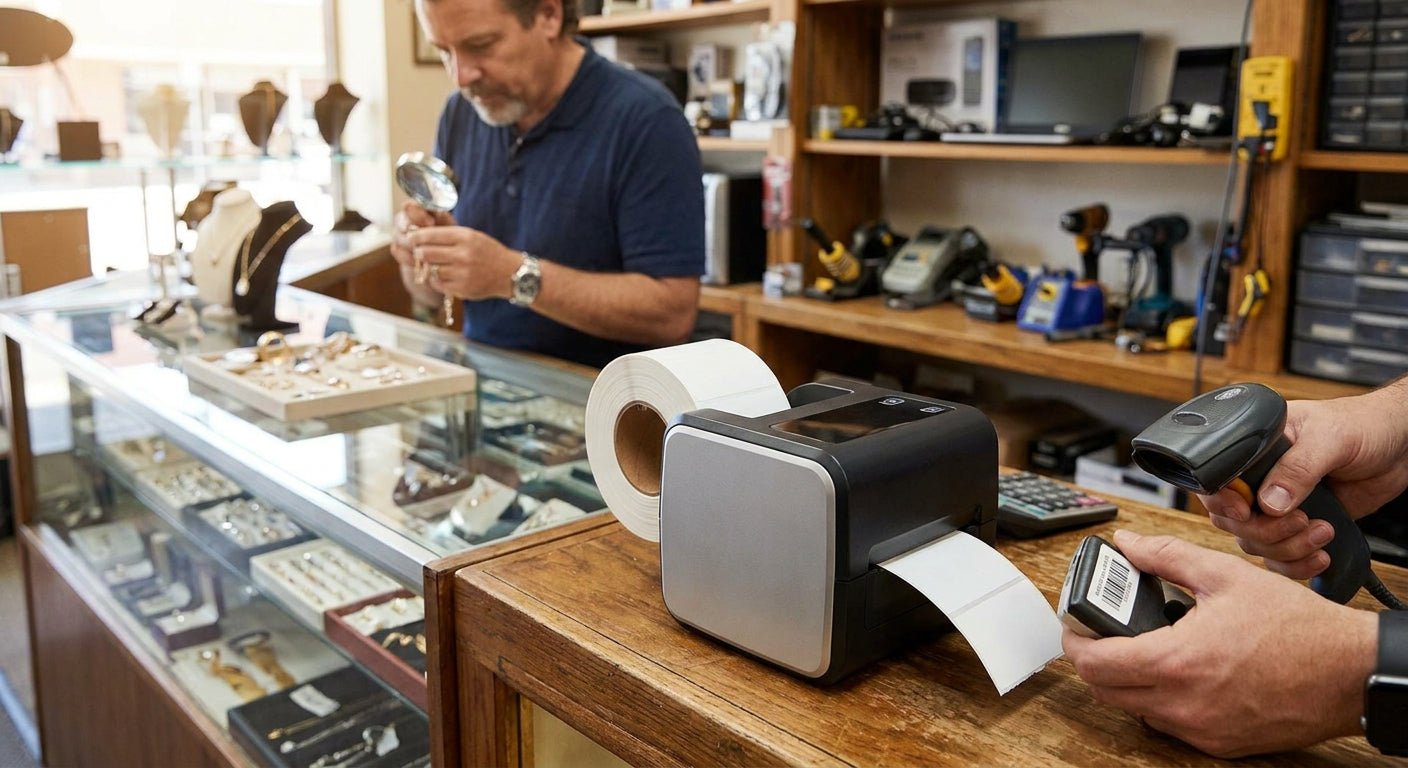
A barcode printer for pawn shops needs to print small, scannable codes on jewelry tags and durable labels on tools, electronics, and firearms without slowing down intake at the counter.
- GoDEX G530 wins for pawn shops tagging jewelry and small electronics at 300 DPI for $554 — Buy.
- GoDEX RT700i+ is the safe all-around barcode printer for pawn shops at $581 with a color display for multi-user counters.
- Skip 203 DPI printers for ring and watch tags — the barcode gets too dense to scan reliably below 300 DPI.
- Metalized silver asset tags hold up on handled collateral better than paper labels in 2026 intake environments.
Why this matters
Pawn shop inventory is not uniform. A single intake day can include a chainsaw, a diamond ring, a laptop, and a guitar — each needing a barcode that survives handling and scans clean at resale. Get the printer wrong and staff end up hand-keying serial numbers, which slows compliance reporting and creates the exact tracking gaps state reporting systems flag.
A barcode printer for pawn shops has to do two jobs a general-purpose office printer can't: print fine enough detail for a barcode the size of a ring tag, and hold up to the adhesive and material demands of tagging metal, leather, and electronics. Metalized silver asset tags solve the second half of that problem; the printer solves the first.
Who this is for
This guide is for pawn shop owners and managers running their own intake counter — one to five locations, printing tags in-house rather than outsourcing, and needing barcodes that survive months on a shelf before resale. It's built for shops tagging a mix of jewelry, electronics, tools, and firearms, not single-category retailers with uniform SKUs.
What to look for in a barcode printer for pawn shops
Print resolution for small items
A barcode on a ring tag or watch band is smaller than one on a shipping box, and the code needs more dots per inch to stay scannable. 203 DPI printers struggle once a barcode drops under an inch wide — bars blur together and scanners reject the read. For jewelry-heavy intake, 300 DPI is the practical floor.
Tag durability and adhesive strength
Collateral gets handled by staff, customers, and appraisers before it's ever sold. Paper labels peel or smear under that traffic. Metalized silver or 3M heavy-duty stock holds a printed barcode through months of shelf time and repeated handling without the code degrading.
Print speed at the intake counter
A busy Saturday can mean a line of customers waiting on loan paperwork. A printer rated for 6-8 inches per second keeps tag printing from becoming the bottleneck between appraisal and cash-out.
Connectivity with existing pawn software
Most pawn shop management systems generate the barcode data — the printer just needs to talk to it. USB, serial, and Ethernet options cover both single-terminal counters and multi-station shops networking several printers to one system.
Barcode scanner compatibility
The printer prints the code; a 1D scanner reads it back at resale. Pairing a USB plug-and-play scanner with the printer from day one avoids a second buying decision later and keeps intake and checkout on the same barcode format.


Top picks
The safe pick — GoDEX RT700i+ Thermal Printer. This 4-inch dual thermal printer runs at 203 DPI with a color display, priced at $581. It's built for high-volume, professional printing and covers the majority of pawn shop tags — tools, electronics, larger accessories — where barcode size isn't the constraint. Link: GoDEX RT700i+ color display printer. Verdict: Buy for general counter use.
The sharp-detail pick — GoDEX G530 Thermal Printer. At 300 DPI and $554, this printer resolves the fine barcodes needed for ring tags, watch bands, and small jewelry lots that 203 DPI can't handle cleanly. It's a dual thermal 2-in-1 unit, so it runs both direct thermal and thermal transfer without switching hardware. Link: GoDEX G530 300 DPI printer. Verdict: Buy if jewelry is a meaningful share of intake.
The budget pick — GoDEX RT200i Thermal Printer. A 203 DPI unit aimed at shops that mostly tag larger collateral — power tools, electronics, musical instruments — and don't need micro-detail resolution. It gets barcodes on the shelf fast without the premium of a 300 DPI unit. Link: GoDEX RT200i 203 DPI printer. Verdict: Consider if jewelry volume is low.
The tag-stock pick — Heavy Duty Silver Barcode Asset Tags. The printer is only half the system; the tag material handles the wear. These metalized silver tags are built for repeated handling on metal, leather, and hard plastic surfaces without the barcode fading before resale. Link: heavy duty silver barcode asset tags. Verdict: Buy as the standard tag stock for collateral.
“If the barcode is smaller than a rice grain, 203 DPI won't read it — you need 300 DPI or higher.”
What to avoid
- Consumer label printers marketed for shipping. They're fast at 4x6 labels but max out around 203 DPI and aren't built for the daily on/off cycling of an intake counter running all day.
- Paper barcode labels on metal collateral. Paper peels off rings, tools, and electronics faster than the item sells — it looks like a cost savings until the tag falls off mid-shelf-life.
- Printers without USB/Serial/Ethernet options. A single-connection printer locks you into one workstation; multi-counter shops need the flexibility to network a printer to more than one terminal.
Verdict comparison
| Item | Best for | Resolution | Verdict |
|---|---|---|---|
| GoDEX RT700i+ | General counter tagging | 203 DPI | Buy |
| GoDEX G530 | Jewelry and small items | 300 DPI | Buy |
| GoDEX RT200i | Budget, larger collateral | 203 DPI | Consider |
| Heavy Duty Silver Tags | Metal and handled collateral | N/A (tag stock) | Buy |
FAQ
What is the best barcode printer for pawn shops in 2026?
The GoDEX G530 at 300 DPI is the best barcode printer for pawn shops handling jewelry, since 203 DPI printers blur out on small ring and watch tags. Shops tagging mostly tools and electronics can run the GoDEX RT700i+ at 203 DPI instead.
Is 300 DPI better than 203 DPI for jewelry tags?
Yes, 300 DPI resolves fine barcode lines on tags under an inch wide, while 203 DPI struggles once the code shrinks that small. For general collateral like tools and electronics, 203 DPI is fine.
How much does a barcode printer for pawn shops cost?
Counter-ready thermal printers for pawn shop intake run from about $554 to $581 for 203-300 DPI models in 2026. Higher-resolution 600 DPI units cost more and are typically overkill for most pawn inventory.
What barcode tag material holds up best on pawn shop collateral?
Metalized silver or 3M heavy-duty barcode tags hold up best on handled collateral like tools, electronics, and equipment. Paper labels peel and smear faster under repeated handling before resale.
Do pawn shops need a separate barcode scanner?
Yes, the printer creates the tag but a 1D USB barcode scanner reads it back at resale or compliance reporting. Pairing both from the same barcode format keeps intake and checkout consistent.
Can one barcode printer handle both jewelry tags and tool tags?
A 300 DPI printer like the GoDEX G530 handles both, since higher resolution covers small jewelry barcodes and still prints clean codes on larger tags. A 203 DPI-only printer is fine for tools but limits jewelry tagging.
What connection type should a pawn shop barcode printer support?
USB, Serial, and Ethernet cover single-terminal counters and multi-station shops running several printers off one pawn management system. Ethernet matters most once a shop adds a second intake station.
One last thing
The printer gets the attention, but the tag material is what determines whether a barcode is still scannable six months after intake — a $67 roll of metalized silver tags outlasts a bin of paper labels that started peeling in week three. Buy the resolution the jewelry case demands, then spend the rest of the budget on tag stock that survives the shelf.