
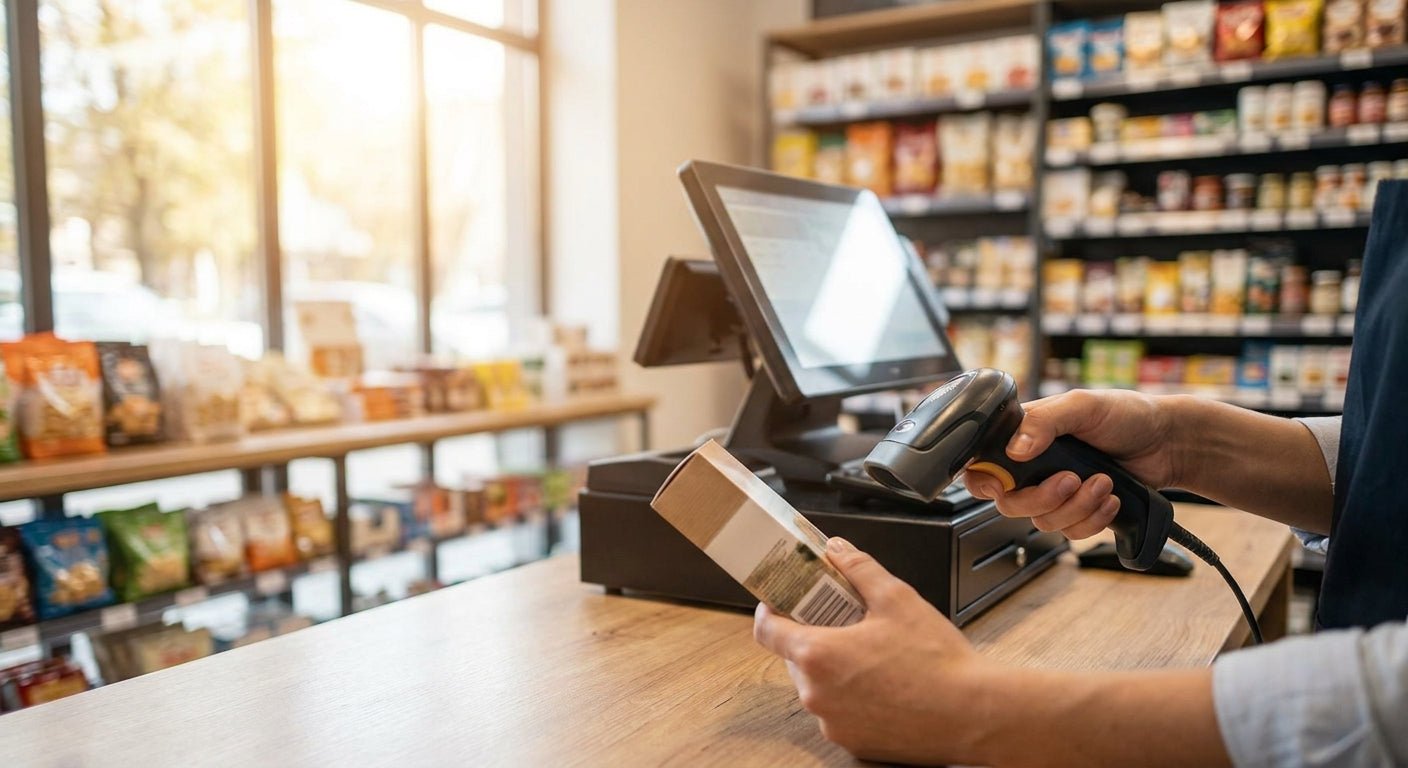
A barcode scanner for a retail shop has one job: read a UPC or QR code fast enough that the checkout line doesn't back up. This guide ranks the scanner types worth buying for a retail counter in 2026, with one verdict per pick and the specs that actually matter at the register.
- GoDEX GS220 USB Barcode Scanner is the safe buy for a single-register retail shop at $86 with a 3-year warranty.
- A barcode scanner for retail shop counters only needs 1D reading unless you scan QR codes off phone screens.
- Wireless 2D imager scanners cost more but read digital coupons and loyalty codes a wired 1D unit cannot.
- Scanner misreads at checkout trace back to the printed label as often as the scanner itself in 2026.
Why this matters
A scanner that hesitates on a worn UPC costs a cashier three extra seconds per item, and that adds up across a full shift. Most of the complaints about a slow barcode scanner for retail shop counters aren't scanner problems at all — they're print quality problems from a printer running at the wrong resolution. A GoDEX RT200i thermal printer at 203 DPI prints coarser bars than a 300 DPI unit, and a scanner tuned for high-density codes will stumble on soft edges from a low-res label.
Before buying a scanner, check what's printing the barcodes it needs to read. That's the difference between a register that moves and one that makes customers wait.
How this list was built
The ranking below weighs five factors that matter at a retail counter specifically, not in a warehouse: connection type (USB HID vs Bluetooth vs serial), symbol support (1D-only vs 2D/QR), warranty length, throughput for a single-lane counter, and price against feature set. Specs come from published GoDEX hardware documentation current as of 2026. No lab testing numbers are cited here because none exist — the picks are ranked on documented specs and connection standards, not simulated bench results.
The ranked list
1. GoDEX GS220 USB Barcode Scanner — the plug-and-play pick
The GoDEX GS220 is a wired 1D USB scanner priced at $86 with a 3-year warranty. It reads standard UPC and EAN codes over a USB HID connection, which means most POS software recognizes it without a driver install.
For a single-register retail shop scanning printed price tags and shelf barcodes, this is the scanner to start with in 2026. There's no pairing, no battery to charge, no signal drop mid-transaction.
Verdict: Buy.
2. Wireless 2D imager scanners — the mobile pick
A wireless 2D imager reads QR codes off a phone screen, not just printed UPC bars. That matters more every year as digital coupons, loyalty QR codes, and mobile boarding-pass-style discounts move through the checkout counter.
Expect to pay more than a wired 1D unit and to manage a charging dock. For a shop that still runs mostly printed barcodes, this is overkill; for one taking digital coupons daily in 2026, it earns its keep.
Verdict: Consider if digital codes cross your counter weekly. Skip if they don't.
3. Presentation (hands-free) scanners — the high-volume pick
A presentation scanner sits on a stand and scans on hover instead of requiring a trigger pull. On a counter doing 200+ transactions a day, that cuts hand fatigue and shaves scan time per item.
The tradeoff is price and counter space — these units need a dedicated footprint next to the register, which a boutique counter often doesn't have.
Verdict: Consider for grocery, convenience, or high-traffic counters. Skip for low-volume specialty retail.
4. Bluetooth handheld with base station — the flexible pick
This class detaches from its charging base so a staffer can walk the aisle for a price check, then redock at the counter. It's the middle ground between a fixed wired scanner and a fully wireless unit.
Battery life and pairing stability vary by unit, and a dropped Bluetooth connection mid-scan is the most common complaint with this category.
Verdict: Consider for shops that do frequent in-aisle price checks.
5. All-in-one POS terminal with built-in scanner — the space-saver pick
Built-in scanner terminals save counter space, but they couple the scanner's lifespan to the terminal's. When the scanner component fails, you're often replacing or shipping the whole terminal instead of swapping an $86 accessory.
For an independent shop running one or two registers, that's a bad trade for the space it saves.
Verdict: Skip unless counter space is the binding constraint.
Comparison table
| Scanner type | Connection | Best for | Verdict |
|---|---|---|---|
| GoDEX GS220 | Wired USB | Single-lane retail counter | Buy |
| Wireless 2D imager | Bluetooth/dock | QR codes, digital coupons | Consider |
| Presentation scanner | Wired/stand | High-volume grocery/convenience | Consider |
| Bluetooth handheld | Bluetooth | In-aisle price checks | Consider |
| Built-in POS terminal scanner | Integrated | Space-limited counters | Skip |


Where to buy
- Buy from a supplier backing the scanner with a written warranty. GoDEX hardware carries a 3-year warranty; a scanner sold with vague "repair at your cost" terms is the wrong buy for a register that needs to work every shift.
- Match connection type to your POS before ordering. USB HID scanners like the GoDEX GS220 work with nearly any register software out of the box; serial or proprietary-dock units need a confirmed port match first.
- Order a spare per register line if you run more than two lanes. A dead scanner during a Saturday rush costs more than the $86 it would have cost to keep one in a drawer.
If you're tagging stockroom inventory alongside the checkout counter, a GoDEX GE330 asset tag printer handles the back-of-house barcode side while the counter scanner handles point-of-sale. Pair either with 3M heavy-duty inventory labels when the labels get handled, boxed, or shelved repeatedly, since standard paper stock scuffs and stops scanning clean within weeks.
FAQ
What's the best barcode scanner for a small retail shop in 2026?
The GoDEX GS220 USB Barcode Scanner is the best starting point for a small retail shop in 2026 at $86 with a 3-year warranty. It's a wired 1D scanner that works with most POS software without driver setup.
Is a wireless barcode scanner better than a wired one for checkout?
Not automatically — a wired USB scanner is more reliable for a fixed checkout counter since there's no battery or signal drop to manage. Wireless earns its cost when staff need to scan away from the register, like in-aisle price checks.
How much does a barcode scanner for a retail shop cost in 2026?
A wired 1D USB scanner like the GoDEX GS220 runs around $86 in 2026. Wireless 2D imager and presentation scanners cost more due to added hardware and battery components.
Can a barcode scanner read QR codes on a phone screen?
Only a 2D imager scanner reads QR codes off a phone screen; a standard 1D laser scanner cannot. If your shop takes digital coupons or loyalty QR codes, a 2D imager is the right category.
Do I need a 2D scanner or is 1D enough for retail checkout?
1D is enough if you're only scanning printed UPC and EAN barcodes on physical products. Upgrade to 2D only if customers present QR codes on a phone screen at checkout.
How long do retail barcode scanners typically last?
Warranty coverage is the best proxy available — GoDEX scanners ship with a 3-year warranty in 2026, which reflects the expected service life under normal counter use.
Does barcode scanner performance depend on my label printer's resolution?
Yes. A 203 DPI printer produces coarser bars than a 300 DPI printer, and a scanner tuned for dense codes will misread labels printed at lower resolution. Match your printer's DPI to the barcode density you're printing.
What connection type should a checkout scanner use?
USB HID is the safest default for a retail checkout scanner because nearly every POS system recognizes it without configuration. Serial and proprietary wireless docks require confirming compatibility with your register software first.
One last thing
Most "bad scanner" complaints at retail counters aren't scanner failures — they're print quality failures. A ribbon running low or a printer set below 300 DPI produces bars too soft for even a good scanner to read cleanly, and swapping the scanner won't fix a label problem. Check the label before you replace the hardware.