
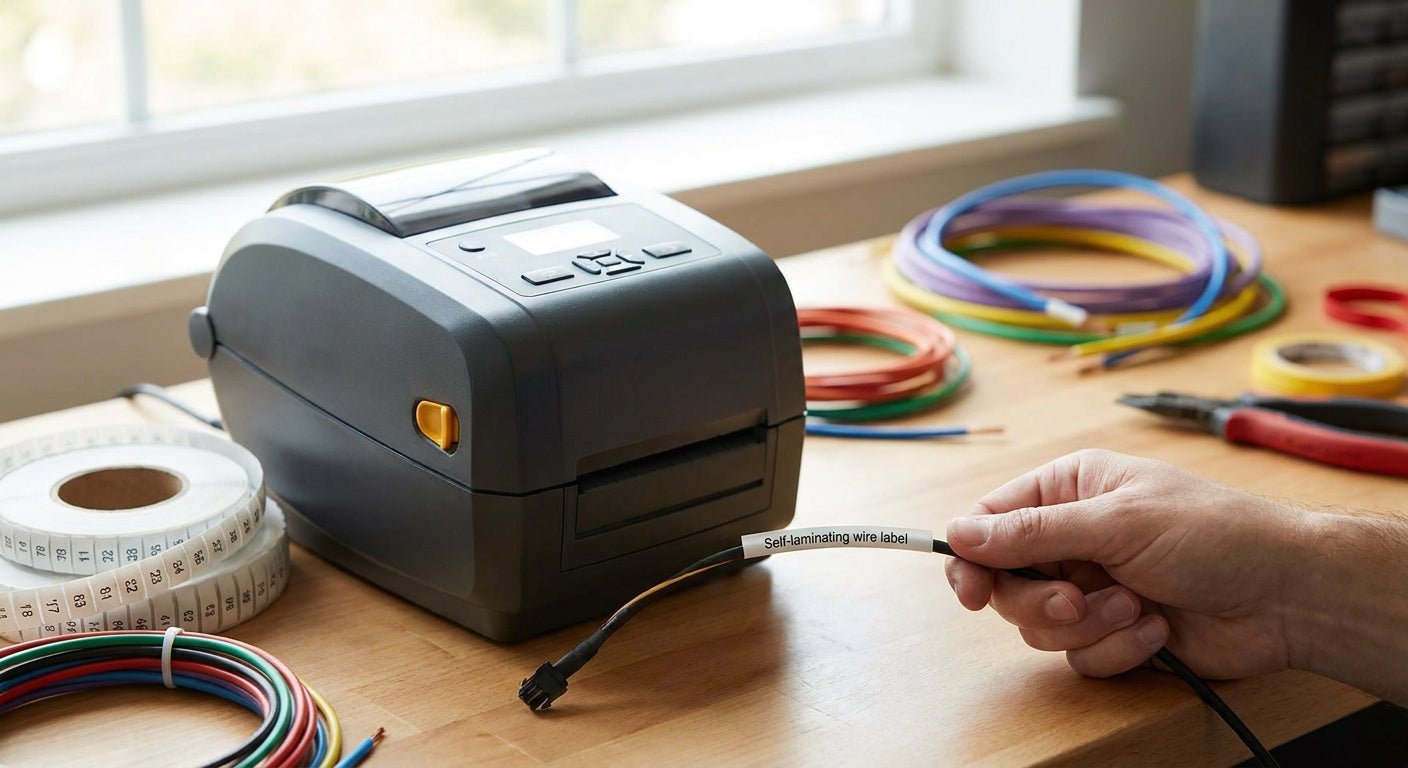
Cable and wire identification needs a thermal transfer printer running resin ribbon, not a standard shipping-label printer, because wire wraps and self-laminating tags see heat, oil, and abrasion that direct thermal print fades against within weeks. This guide ranks the printers that hold up on a rack, a panel, or a service van floor in 2026.
- The GoDEX RT730i thermal transfer printer is the top pick for cable and wire labels in 2026 -- Buy.
- 600 DPI matters for wire flag labels under 0.5 inches wide -- 203 DPI text turns to mush at that size.
- Direct thermal printers like the GoDEX DT230 fade under heat and oil -- Skip for cable ID, fine for shipping labels.
- A $9 resin ribbon roll covers roughly 243 feet of wire wrap labels before it needs replacing.
- Budget entry-level printers like the GoDEX RT200i work for low-volume shops running under 50 labels a day.
Why this matters
Wire and cable labels are small, curved, and permanent -- once wrapped, nobody is repositioning a smudged tag on a bundle of Cat6 running through a ceiling. A label printer for cable and wire labels has to print sharp text at tiny point sizes and hold that print through heat cycling near HVAC lines or engine bays.
The GoDEX RT730i thermal transfer printer is built for exactly that job -- resin ribbon compatibility plus the print head precision that self-laminating wire wrap stock demands. Get the printer wrong and you're reprinting the same rack every six months as labels fade or peel.
McAuley Labels sells the thermal transfer hardware and the ribbon that make wire ID labels last, and the picks below are ranked on print method, resolution, and duty cycle -- not on shelf price alone.
How this list was ranked
Ranking criteria for a label printer for cable and wire labels come down to three things: print method (thermal transfer beats direct thermal for anything touching heat or chemicals), resolution (600 DPI resolves small wire flag text that 203 DPI blurs), and duty cycle (how many labels a day the printer is built to push without the print head overheating).
Each printer below is scored against those three factors using published GoDEX specs -- DPI rating, interface options, and ribbon compatibility. Price is noted where available from current 2026 listings. No printer here gets a pass on print method: direct thermal units are flagged even when the DPI number looks competitive, because print method is the first filter for wire and cable work.
The ranked list
1. GoDEX RT730i Thermal Transfer Printer -- the workhorse pick
This is a thermal transfer unit built to run resin ribbon daily, which is the print method wire ID labels actually need. It handles both direct thermal and thermal transfer media, so one printer covers wire wraps and general shipping stock without a hardware swap.
Shops running continuous cable labeling -- data center racks, panel builds, fleet wiring -- get the longest print head life out of a dedicated thermal transfer unit like this one. Verdict: Buy.
2. GoDEX G530 (600 DPI) -- the fine-print specialist
600 DPI is the number that matters here. Wire flag labels under half an inch wide need that resolution to keep small text and barcodes legible, where a 203 DPI head turns the same text into a smear.
If the job is labeling 22-gauge control wire with 6-point circuit IDs, this is the resolution tier to buy into. Verdict: Buy for small-format wire flags.
3. GoDEX ZX430i+ -- the mid-range all-rounder
At $945, the ZX430i+ runs 4-inch, 300 DPI thermal transfer with a color display for on-printer job selection. That resolution splits the difference -- sharper than 203 DPI, less specialized than the 600 DPI G530.
It's a reasonable single-printer answer for a shop that labels wire bundles some days and asset tags or shelf stock other days. Verdict: Consider.
4. GoDEX GX4300i -- the high-volume production printer
This is a $2,425.50 industrial unit with a 5-inch touchscreen and 300 DPI thermal transfer output built for shift-length print runs, not occasional labeling. Ethernet and serial connectivity mean it drops into a networked print queue on a production floor.
A five-person electrical contracting shop doesn't need this throughput. A manufacturing plant printing wire ID for every subassembly does. Verdict: Consider for high-volume facilities, Skip for small shops.
5. GoDEX RT200i (203 DPI) -- the budget entry point
203 DPI is fine for larger wire wrap labels and general equipment tags, and this is the lowest-cost thermal transfer option in the lineup. It won't resolve tiny wire flag text as cleanly as the 600 DPI G530, but for standard 1-inch wire wraps it's adequate.
Shops under 50 labels a day that don't need micro-text resolution get a working printer here without overspending. Verdict: Consider for low-volume shops.
6. GoDEX DT230 Direct Thermal (300 DPI) -- the one to skip for wire ID
300 DPI looks competitive on paper, but this is a direct thermal printer, and direct thermal print fades under heat, sunlight, and oil exposure. Wire and cable labels routinely sit near heat sources or get handled with greasy hands.
Direct thermal is a strong pick for shipping labels or short-term inventory tags. It is the wrong print method for anything expected to stay legible on a wire bundle past a few months. Verdict: Skip for cable and wire ID.
“Direct thermal fades under heat and oil in weeks -- that's not a wire ID label, that's a placeholder.”


Running a thermal transfer printer without matching it to resin thermal transfer ribbon is the fastest way to get faded wire labels anyway -- wax ribbon smears under oil, resin doesn't. A single roll covers 243 feet and runs $9, which is not the line item to cut corners on.
Comparison table
| Printer | Print method | Resolution | Best for | Verdict |
|---|---|---|---|---|
| GoDEX RT730i | Thermal transfer | Standard | Daily wire and cable ID runs | Buy |
| GoDEX G530 | Thermal transfer | 600 DPI | Small wire flag text under 0.5 in | Buy |
| GoDEX ZX430i+ | Thermal transfer | 300 DPI | Mixed wire ID and general labeling | Consider |
| GoDEX GX4300i | Thermal transfer | 300 DPI | High-volume production floors | Consider |
| GoDEX RT200i | Thermal transfer | 203 DPI | Low-volume, larger wire wraps | Consider |
| GoDEX DT230 | Direct thermal | 300 DPI | Shipping labels, not wire ID | Skip |
Where to buy
- Buy the printer and the resin ribbon together -- a thermal transfer printer loaded with the wrong ribbon type still fades. Match wax/resin ribbon to polyester or vinyl wire wrap stock.
- Confirm interface compatibility before ordering. Ethernet and serial ports matter for shops networking a printer into a shared print queue; USB-only is fine for a single workstation.
- Read the direct thermal vs thermal transfer breakdown before buying if the printer will also run general shipping or shelf labels, since the two print methods aren't interchangeable on the same ribbon-free media.
For panel-specific label formats and wire number conventions, the electrical panel identification guide covers the layout side of the job once the printer is picked.
FAQ
What's the best label printer for cable and wire labels in 2026?
The GoDEX RT730i thermal transfer printer is the top pick for cable and wire labels in 2026 because it runs resin ribbon daily without the fading issues direct thermal units show under heat and oil.
Is thermal transfer better than direct thermal for wire labels?
Yes -- thermal transfer print resists heat, oil, and abrasion, while direct thermal print fades within weeks in the same conditions. Wire and cable labels routinely sit near heat sources, so thermal transfer is the standard.
How much does a wire label printer cost in 2026?
Entry-level thermal transfer printers like the GoDEX RT200i cost less than mid-range units, while the GoDEX ZX430i+ runs $945 and industrial units like the GoDEX GX4300i run over $2,400. Price scales with duty cycle and resolution.
What DPI do I need for wire flag labels?
600 DPI resolves small wire flag text under half an inch wide, where 203 DPI often blurs at that size. Standard 1-inch wire wraps print fine at 203 or 300 DPI.
Can I use a direct thermal printer for cable labels?
You can, but the print fades under heat and oil exposure within weeks, which makes direct thermal a poor fit for anything mounted near equipment or handled with greasy hands. Use it for shipping labels instead.
How long does a resin ribbon roll last?
A standard 2.25 inch by 243 foot resin ribbon roll covers roughly that linear footage of wire wrap labels before replacement, priced around $9 per roll in 2026.
Do wire ID labels need to be self-laminating?
Self-laminating wire wrap labels protect the printed text with a clear overlay, which matters more with direct thermal print since it has less inherent fade resistance. Thermal transfer print holds up with or without the laminate layer.
What's the difference between wire wrap labels and asset tags?
Wire wrap labels are sized to circle a cable and usually print small circuit or run numbers, while asset tags identify equipment and often carry a barcode or QR code for tracking. Both can run on the same thermal transfer printer.
One last thing
The print method decision matters more than the DPI number on the spec sheet -- a 300 DPI direct thermal printer will lose to a 203 DPI thermal transfer unit on a wire bundle sitting near a heat source, every time, in 2026 or any other year. Pick the print method first, then shop resolution inside that category.