
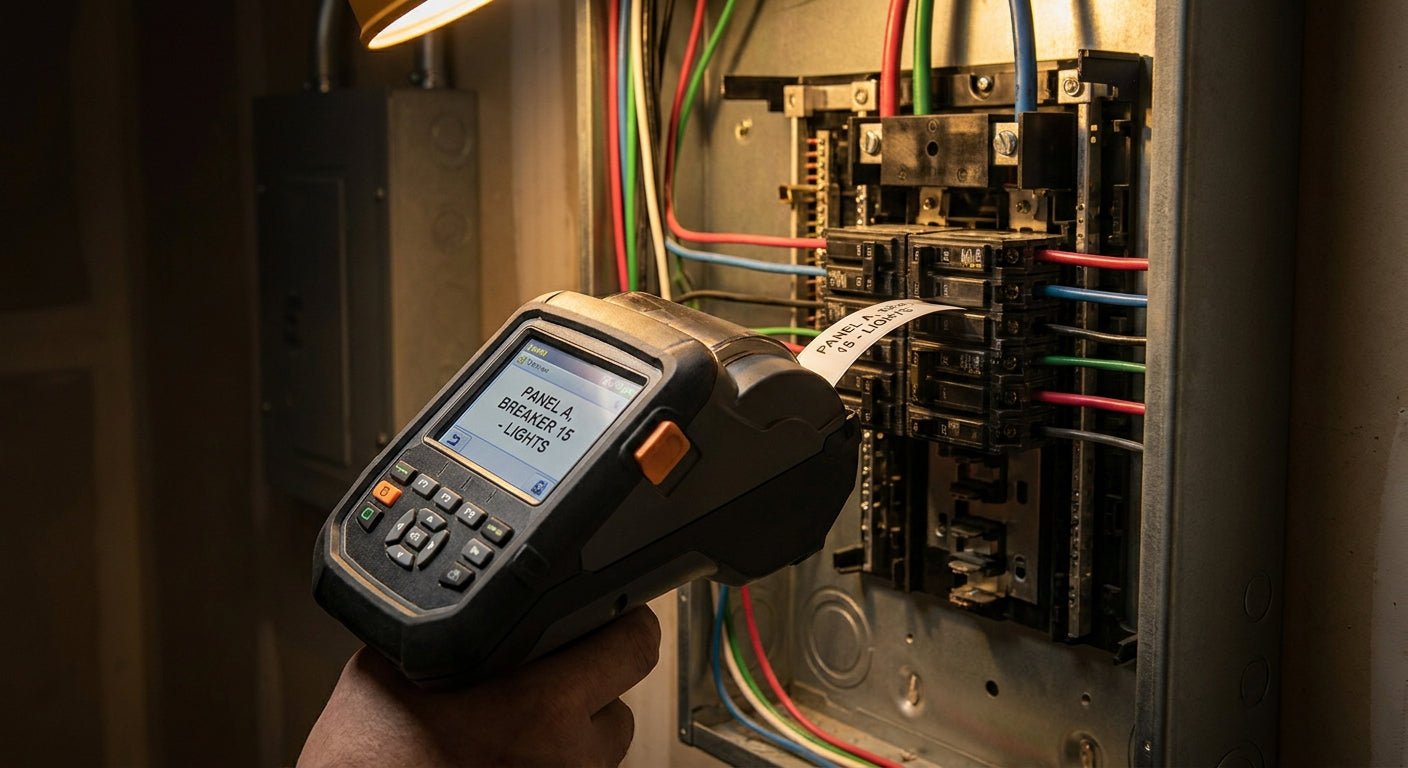
Electrical panel labels have one job: stay legible after years of heat, dust, vibration, and the occasional grease-slicked hand reaching for a breaker. Picking the wrong label printer for electrical panel work means reprinting the same tags every 18 months instead of every 8 years.
TL;DR
The GoDEX RT863i (4", 600 DPI) is the best label printer for electrical panel identification in 2026 when labels carry small text, dense barcodes, or QR codes for maintenance tracking — its resolution keeps 6-point circuit numbering sharp on 0.5-inch labels. For standard panel schedules and breaker tags at readable sizes, the GoDEX GE330 thermal transfer printer at 203 DPI is the Buy for most electrical contractors because it pairs with heavy-duty 3M and metalized polyester stock that survives panel-room heat. Budget desktop shops can go with the GoDEX RT230i at 300 DPI as a Consider. Skip direct-thermal-only printers for anything mounted near breakers or transformers — the labels fade under sustained heat within a year.
Why this matters
Electrical panel labels aren't decorative. NFPA 70E and NEC Article 110.16 require legible arc-flash and circuit identification, and inspectors flag faded or peeling labels during audits. A panel label printed on the wrong stock with the wrong printer starts yellowing behind glass-front panels within 12 to 18 months, which means relabeling an entire panel schedule mid-lease or mid-lease-renewal.
The fix isn't a fancier label — it's matching print resolution and print method to the label material before you buy a machine. McAuley Labels builds that match into its printer lineup, and the picks below reflect what actually holds up in panel rooms rather than spec-sheet claims.
How we ranked
Each printer here is scored against three panel-specific requirements: minimum readable resolution for 6-point NEC labeling, compatibility with thermal transfer ribbon and heavy-duty polyester or 3M stock (direct thermal alone doesn't survive panel-room heat cycling), and print speed for batch runs across a full electrical room. Machines that only handle paper labels or cap out below 203 DPI were excluded outright.
Resolution matters more here than most label applications — see the breakdown in this DPI comparison if you're deciding between 203, 300, and 600 DPI for your panel schedule. In 2026, most panel labeling jobs still run fine at 203 or 300 DPI; 600 DPI only earns its keep when text drops below 8-point or you're printing dense QR codes for asset tracking tied to the panel.
The ranked list
1. GoDEX RT863i — the precision pick
The GoDEX RT863i prints at 600 DPI across a 4-inch web, the highest resolution in the McAuley Labels lineup. That resolution turns 6-point circuit numbering and dense QR codes into clean, scannable output instead of a blurred smear — critical when a panel schedule crams 42 breaker positions onto a single 1x3-inch label. It runs thermal transfer ribbon, so it pairs with metalized silver or heavy-duty 3M polyester stock rated for panel-room heat.
Why now: facilities teams standardizing on QR-linked maintenance records in 2026 need resolution headroom this printer delivers and lower-DPI machines don't. Buy if your panel labels include small text or QR codes; Skip if you're only printing simple breaker numbers at 12-point or larger.
2. GoDEX GE330 — the heavy-duty workhorse
The GoDEX GE330 runs thermal transfer at 203 DPI on a 4-inch print width, which is the sweet spot for most panel schedule and breaker directory labels. It handles ribbon-based printing on 3M heavy-duty and metalized polyester stock without choking on longer batch runs — a full panel directory of 40+ labels prints in one pass.
Why now: 203 DPI is plenty for circuit labels printed at 10-point or larger, and the GE330's ribbon compatibility means the labels resist the heat cycling that breaks down direct-thermal-only prints within a year. Buy — this is the default recommendation for electrical contractors labeling standard panel schedules in 2026.
3. GoDEX RT230i — the balanced choice
The GoDEX RT230i splits the difference at 300 DPI, sharper than the GE330 without the premium of 600 DPI. It handles both direct thermal and thermal transfer ribbon, giving you flexibility if a job mixes short-term paper labels with permanent panel tags.
Why now: shops that print both shipping labels and panel identification off one machine get more mileage from the RT230i's dual-mode capability than from a single-purpose unit. Consider for mixed-use shops; Buy if 300 DPI matches your smallest label text size.
4. GoDEX RT700i — the high-volume option
The GoDEX RT700i adds a 4-color display and handles larger ribbon rolls, which matters for facilities teams labeling multiple electrical rooms across a campus in one printing session. It's built for volume, not for squeezing out extra resolution.
Why now: if you're relabeling 15+ panels across a building in 2026 rather than one panel at a time, the larger ribbon capacity cuts changeovers. Consider for multi-site facilities work; Skip for single-panel jobs where the added capacity goes unused.
5. GoDEX G500 — the budget desktop model
The GoDEX G500 is a compact desktop unit suited to smaller electrical contractors printing panel labels in batches of a dozen or fewer at a time. It won't out-produce the industrial models, but it covers occasional panel labeling without the footprint of a floor-standing printer.
Why now: a one- or two-person electrical service business doesn't need industrial throughput. Consider for low-volume shops; Skip if you're labeling more than a few panels a week.
6. GoDEX DT230 — the direct-thermal shortcut
The GoDEX DT230 runs direct thermal only at 300 DPI, meaning no ribbon and lower running cost per label. That trade-off works for temporary or interior-only labeling but direct thermal print fades under sustained heat exposure near breakers and transformers.
Why now: useful for pre-installation staging labels that get replaced once the panel is live. Consider for temporary tags only; Skip for any label meant to last past a year in a panel room.
7. GoDEX RT730i — the compact industrial unit
The GoDEX RT730i fits panel-labeling shops that need industrial durability in a smaller physical footprint than the RT700i or GE330. It runs thermal transfer and handles the same heavy-duty stock as the larger machines.
Why now: electrical contractors working out of a service van or small shop benefit from the smaller footprint without sacrificing ribbon compatibility. Consider for space-constrained shops; Buy if desk space is the deciding factor over raw throughput.
Comparison table
| Printer | Resolution | Print method | Best for | Verdict |
|---|---|---|---|---|
| GoDEX RT863i | 600 DPI | Thermal transfer | Small text, dense QR codes | Buy |
| GoDEX GE330 | 203 DPI | Thermal transfer | Standard panel schedules | Buy |
| GoDEX RT230i | 300 DPI | Direct thermal / transfer | Mixed-use shops | Consider |
| GoDEX RT700i | 203 DPI | Thermal transfer | Multi-site, high volume | Consider |
| GoDEX G500 | Standard | Direct thermal / transfer | Low-volume shops | Consider |
| GoDEX DT230 | 300 DPI | Direct thermal only | Temporary labels | Consider |
| GoDEX RT730i | 203 DPI | Thermal transfer | Compact industrial use | Consider |
Where to buy
- Buy the printer and the ribbon-compatible label stock together — a thermal transfer printer without heavy-duty polyester or 3M stock defeats the purpose of the ribbon system.
- Confirm print width matches your panel label size before ordering; a 4-inch web wastes stock on 1-inch breaker tags but underserves large panel directory sheets.
- For custom sizing or ribbon color matching an existing panel schedule, request a quote rather than guessing at stock specs from a catalog listing.
FAQ
What's the best label printer for electrical panel identification in 2026? The GoDEX RT863i at 600 DPI is the top pick for panels needing small text or QR-linked maintenance tracking; the GoDEX GE330 at 203 DPI covers standard panel schedules and breaker directories at lower cost per label.
Is a 600 DPI printer overkill for panel labels? For most breaker labels printed at 10-point text or larger, yes — 203 DPI thermal transfer handles it fine. 600 DPI only pays off when text drops below 8-point or labels carry dense barcodes.
Do I need thermal transfer or direct thermal for electrical panel labels? Thermal transfer, in almost every case. Direct thermal print fades under the heat cycling that panel rooms produce, while ribbon-based thermal transfer on heavy-duty polyester or 3M stock holds up for years.
What label material survives inside an electrical panel enclosure? Metalized silver polyester and 3M heavy-duty polyester are the standard choices — both resist heat, chemical exposure, and UV fading better than paper or vinyl stock.
Can these printers produce NEC-compliant arc flash labels? GoDEX thermal transfer printers at 203 DPI or higher print the resolution needed for standard arc flash text sizing; compliance depends on your label design meeting NFPA 70E formatting, not the printer alone.
Is 203 DPI enough for panel labeling? 203 DPI covers the vast majority of panel schedule and breaker tag printing where text runs 10-point or larger. Drop to a 600 DPI machine like the RT863i only for small or dense label content.
How does GoDEX compare to Zebra for electrical panel labeling? Both brands cover the resolution and ribbon requirements panel labeling needs; the deciding factor usually comes down to software compatibility and per-unit cost rather than print quality. See the GoDEX vs. Zebra comparison for a side-by-side on that decision.
What's the typical lifespan of a properly printed panel label? Thermal transfer prints on heavy-duty polyester or 3M stock typically outlast the panel's service interval — years rather than months — while direct-thermal-only prints in the same environment degrade within 12 to 18 months.
One last thing
Most panel labeling failures aren't printer failures — they're stock failures. A shop running a GoDEX RT863i loaded with standard paper labels gets the same fading problem as a budget printer, because the resolution never mattered if the adhesive and film can't handle panel-room heat. Match the printer to ribbon-compatible heavy-duty stock first, then worry about DPI.