
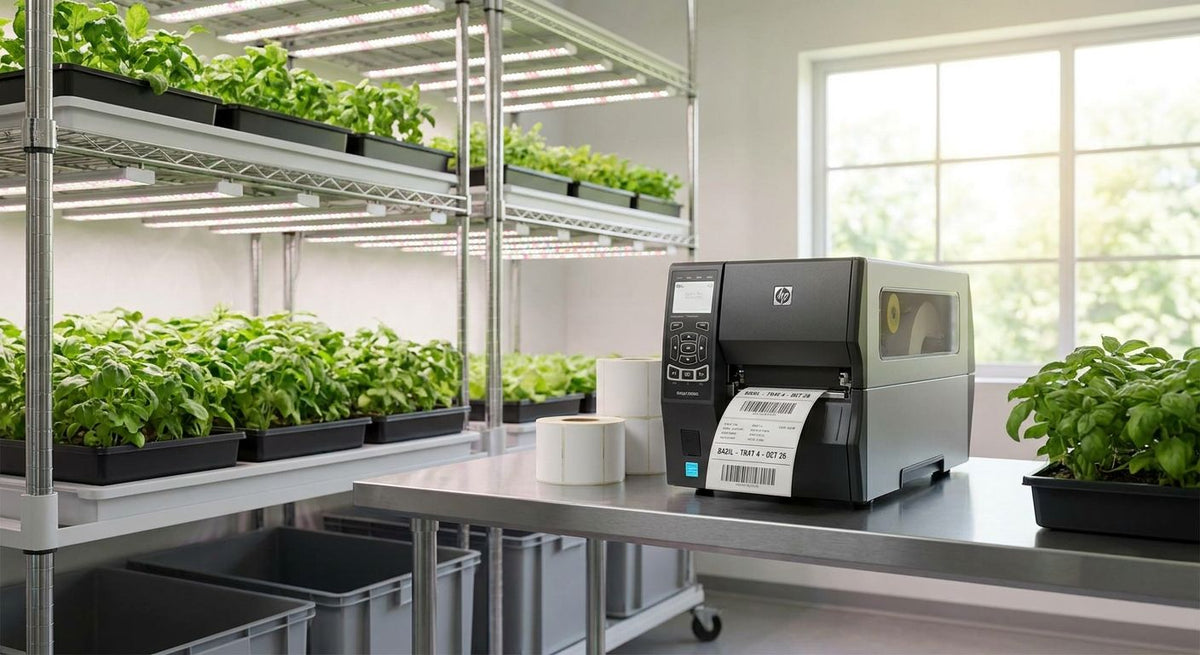
Hydroponic racks and vertical farm towers generate more labels per square foot than almost any other operation — tray tags, nutrient reservoir IDs, harvest lot codes, QR traceability stickers — and most desktop printers stall out under grow-room humidity. This guide ranks the best label printer for hydroponics and vertical farming setups running in 2026, with a straight verdict on which printer fits which grow operation.
- McAuley Plant Label Printer (203 DPI) is the best overall label printer for hydroponics in 2026 for daily tray and stake tagging.
- GoDEX RT700i+ at $581 fits tight grow room benches with a compact footprint and color touchscreen.
- GoDEX ZX430i+ at $945 prints 300 DPI QR codes clean enough for crop traceability scans.
- Skip plain paper stock in a grow room — condensation and nutrient splash smear standard labels fast.
Why this matters
A label that peels off a nutrient reservoir after two weeks of humidity isn't a cosmetic problem — it's a traceability gap. Vertical farms and hydroponic operations run tighter margins than field agriculture, and a mislabeled tray means someone re-checks crop IDs by hand mid-shift. The label printer for hydroponics you pick has to survive condensation on the print head, splash from nutrient dosing, and daily runs of a few hundred tags without jamming.
Resolution matters more here than in a typical warehouse. A 203 DPI unit like the McAuley Plant Label Printer handles basic plant tags and stake labels fine, but QR codes used for lot-level traceability need finer dot density to stay scannable after a full grow cycle under LED lights. That split — daily-use printers versus higher-resolution compliance printers — is what this list is built around. Most 2026 vertical farm operators buying their first dedicated printer land in the wrong DPI bracket on the first purchase; this guide is built to skip that mistake.
What makes the best label printer for hydroponics
- Humidity and splash resistance — waterproof polyester or coated stock outperforms plain paper in a grow room
- Print resolution matched to the label — 203 DPI for plant tags, 300 DPI for dense QR or traceability codes
- Print speed for batch runs — transplant days shouldn't turn into an hour of relabeling
- Footprint that fits a grow room bench, not an office desk
- Ribbon-free operation where possible — fewer consumables to manage in a wet environment
- Connectivity that scales — USB, Ethernet, or standalone keyboard entry across multiple grow zones
Label printers for hydroponics at a glance
| Printer | Best for | Standout feature | Starting price | Key limitation |
|---|---|---|---|---|
| McAuley Plant Label Printer (203 DPI) | Daily plant tag printing | Compact precision built for tag stock | — | Not built for dense QR codes |
| GoDEX RT700i+ (203 DPI) | Tight grow room space | Color touchscreen, 4-inch dual thermal | $581 | 203 DPI ceiling on small QR codes |
| GoDEX ZX430i+ (300 DPI) | QR traceability labeling | 300 DPI with USB/Serial/Ethernet | $945 | Nearly double the RT700i+ cost |
| GoDEX RT730i | Multi-zone, high-volume farms | Sized for sustained daily print runs | — | Larger footprint, needs bench space |
| GoDEX RT200i (203 DPI) | Budget small setups | Lowest-cost 203 DPI GoDEX model | — | No display, no Ethernet |
1. McAuley Plant Label Printer (203 DPI): best label printer for hydroponics for daily plant tag printing
The McAuley Plant Label Printer is a compact 203 DPI direct thermal unit built for plant tag and stake label printing — no ribbon required for standard grow tags. It handles the bulk of hydroponic labeling: tray IDs, clone tags, nutrient schedule stickers, and shelf position tags on vertical racks.
McAuley Plant Label Printer pros:
- 203 DPI direct thermal engine sized for plant tag stock, not an oversized industrial footprint
- No ribbon needed for standard tags, cutting the consumables you manage in a wet grow room
- Built for daily, repeat print runs rather than occasional labeling
McAuley Plant Label Printer cons:
- 203 DPI isn't fine enough for dense QR traceability codes at small label sizes
- One printer per station — not built for networked, multi-zone printing across a large facility
Best for: growers running one or two label stations for daily plant tag and tray ID printing. Verdict: Buy.
2. GoDEX RT700i+: best for tight grow room space
The GoDEX RT700i+ is a 4-inch dual thermal printer with a color touchscreen, built into a footprint small enough for a grow room bench next to irrigation controls. At 203 DPI it prints clean tray tags and inventory labels without needing bench space you don't have.
GoDEX RT700i+ pros:
- 4-inch dual thermal engine (direct thermal and thermal transfer) in one unit
- Color touchscreen simplifies label selection without a connected PC
- Starts at $581, the lowest-cost GoDEX unit on this list with a display
GoDEX RT700i+ cons:
- 203 DPI ceiling makes dense QR codes under an inch harder to scan reliably
- Thermal transfer mode needs ribbon stock, adding one more consumable in a humid room
GoDEX RT700i+ pricing: starts at $581. Best for: grow operations with limited bench space that still want on-unit label editing. Verdict: Buy.
3. GoDEX ZX430i+: best for QR-code traceability labeling
The GoDEX ZX430i+ steps up to 300 DPI with USB, serial, and Ethernet connectivity, which matters once a vertical farm needs crop lot codes that scan reliably after handling. The finer dot density holds up on small QR codes used for harvest traceability and food-safety documentation.
GoDEX ZX430i+ pros:
- 300 DPI resolution for dense barcode and QR printing
- Ethernet connectivity supports networked printing across grow zones
- Color display for on-unit label management
GoDEX ZX430i+ cons:
- $945 starting price is nearly double the RT700i+
- Overkill for operations only printing simple plant tags
GoDEX ZX430i+ pricing: starts at $945. Best for: vertical farms selling produce that needs lot-level QR traceability. Verdict: Buy.
4. GoDEX RT730i: best for multi-zone, high-volume vertical farms
The GoDEX RT730i is built for continuous daily print runs across a facility running multiple grow zones — the kind of volume a single-tier hydroponic setup won't generate but a stacked vertical farm will.
GoDEX RT730i pros:
- Sized for sustained daily print volume, not occasional runs
- Fits into a facility already standardized on GoDEX hardware
GoDEX RT730i cons:
- Larger footprint than the RT700i+, needs dedicated bench or cart space
- Not worth the investment for a single grow tent
Best for: multi-zone vertical farms centralizing label printing at one station. Verdict: Buy at facility scale, Skip for a single tent.
5. GoDEX RT200i (203 DPI): best budget label printer for small hydroponic setups
The GoDEX RT200i is the entry-level 203 DPI option in the GoDEX lineup — no color touchscreen, no Ethernet, just a straightforward printer for basic plant tags.
GoDEX RT200i pros:
- Lowest-cost 203 DPI GoDEX printer on this list
- Straightforward setup for a single hydroponic tent or small grow rack
GoDEX RT200i cons:
- No display, no advanced connectivity
- Not built for high-volume, multi-zone printing
Best for: hobbyist-to-small-commercial growers testing dedicated label printing for the first time. Verdict: Buy for small setups, Wait if you expect to scale within the year.
“If a QR code can't be scanned three feet under grow lights, the DPI is too low for that label.”


How we ranked
Ranking runs on published specs, not review scores: print resolution against the QR/barcode density hydroponic and vertical farm labels actually need, footprint against grow room bench space, connectivity against multi-zone operations, and starting price where it's published. The McAuley Plant Label Printer and GoDEX RT700i+ win the daily-use slots; the ZX430i+ earns the traceability slot on DPI alone.
Which label printer for hydroponics should you choose?
For most hydroponic and vertical farm operations in 2026, start with the McAuley Plant Label Printer (203 DPI) for daily tray and stake tagging. Add a GoDEX ZX430i+ once QR-code crop traceability becomes a buyer or compliance requirement, and reach for the GoDEX RT730i only once one label station can't keep up with a multi-zone facility's print volume.
FAQ
What's the best label printer for hydroponics in 2026?
The McAuley Plant Label Printer (203 DPI) is the best overall pick for daily hydroponic tray and stake tagging in 2026. For QR-code crop traceability, the GoDEX ZX430i+ at 300 DPI is the better fit.
Do hydroponic labels need to be waterproof?
Yes — grow room condensation and nutrient splash smear standard paper labels within days. Waterproof polyester or coated stock holds up through a full grow cycle.
Is 300 DPI necessary for plant tag printing?
Not for basic plant tags — 203 DPI is standard and sufficient. 300 DPI only matters once you're printing dense QR codes for lot-level crop traceability.
How much does a label printer for hydroponics cost?
The GoDEX RT700i+ starts at $581 and the GoDEX ZX430i+ starts at $945 in 2026. Pricing on the McAuley Plant Label Printer and other GoDEX models is listed on their product pages.
Can I print QR codes for crop traceability on a thermal printer?
Yes, but resolution matters. A 300 DPI printer like the GoDEX ZX430i+ holds QR code density better than a 203 DPI unit once the code has been through handling and grow-light exposure.
What's the difference between direct thermal and thermal transfer for grow room labels?
Direct thermal labels need no ribbon and print directly on heat-sensitive stock, which means fewer consumables in a humid room. Thermal transfer uses a ribbon and tends to hold up longer under heavy handling.
Is GoDEX or Zebra better for vertical farming?
This guide covers GoDEX models specifically, ranked on DPI, footprint, connectivity, and starting price for hydroponic and vertical farm labeling needs in 2026.
One last thing
The detail growers miss until their first humid season: ribbon-free direct thermal stock, like the waterproof plant label printer buying guide covers, removes one whole point of failure in a wet grow room — no ribbon to jam, no ribbon to run out mid-batch. If your operation is still running plain paper tags on a grow rack in 2026, that's the first swap to make before upgrading the printer itself.