

Asset tags can be removed and reapplied without damage only when their adhesive is specifically designed for repositioning or reuse on the intended surface. Treat permanent asset tags as single-use: peeling them off can damage the label, leave adhesive behind, or affect the equipment finish, and an intact label does not prove the adhesive will bond reliably again. Tamper-evident tags are designed to reveal removal, not transfer cleanly.
- Can asset tags be removed and reapplied? Only tags specified for repositioning or reuse support that workflow.
- Permanent asset tags need replacement after removal; an intact face does not establish reliable adhesion.
- McAuley Labels asset tags suit long-term equipment identification, not an assumed peel-and-reapply workflow.
- Keep the asset ID with the equipment, even when you replace its barcode label.
Can asset tags be removed and reapplied without damage?
Not as a general rule. Removable, repositionable, and permanent describe different adhesive functions. A tag that comes off cleanly is not automatically suitable for another application.
Use the adhesive specification—not the label's appearance—to decide whether transfer is acceptable. If removal must also reveal interference, review the purpose of tamper-evident asset tags for IT assets before choosing a replacement.
| Adhesive or tag type | Best for | Useful property | Limitation after removal |
|---|---|---|---|
| Permanent adhesive | Long-term equipment identification | Intended to remain attached | Do not assume clean removal or dependable reuse |
| Removable adhesive | Temporary identification | Designed for removal under specified conditions | Removable does not necessarily mean reusable |
| Repositionable adhesive | Placement adjustments within stated conditions | Allows adjustment as specified by the manufacturer | Do not assume unlimited transfers or long-term reuse |
| Tamper-evident construction | Identification that must show interference | Reveals removal through its specified mechanism | Removal can permanently alter the label or leave evidence |
These categories describe intended functions, not guarantees for every surface. Check the actual construction and application instructions. For your 2026 purchasing specification, state whether you need clean removal, placement adjustment, repeated reuse, or permanent attachment.
Why this matters
A removed asset tag presents 3 separate checks: label condition, surface condition, and adhesive condition. Passing one check does not establish the others.
A barcode can remain readable while the adhesive becomes contaminated. A label can peel away intact while taking a weak coating with it. Conversely, a surface can remain undamaged while the label tears and needs replacement.
Separate the physical tag from the asset record, too. Moving equipment to another room normally calls for a location update, not moving its identification label to a different machine. Treat the tag as the link to the record, rather than a reusable office sticker.
Permanent asset tags: replace after removal
Permanent adhesive is intended to hold the label in place. It does not promise that removal is impossible, but it also does not establish that the label can be removed cleanly and used again.
During peeling, the label face can bend, stretch, or tear. Adhesive can remain on the equipment, collect contamination, or become uneven across the back of the removed label. Those changes matter even when the printed number still looks correct.
Replace a removed permanent tag instead of relying on its remaining tack. If the same equipment still needs the same identifier, issue a replacement label through your normal record-control process. Confirm that the replacement points to the existing asset rather than creating a duplicate entry.
For a 2026 relabeling procedure, make replacement the default for permanent constructions. Any exception should come from the label manufacturer's documented instructions, not an informal peel test.
Removable asset tags: removal is not reuse
Removable adhesive addresses taking a label off a compatible surface under specified conditions. That is useful for temporary identification, but it is a different requirement from attaching the same label again.
Check the technical information for explicit reapplication instructions. Look for the intended surfaces, application conditions, removal conditions, and any restrictions on repositioning. Do not interpret the word removable as permission for repeated transfers.
The trade-off is straightforward: temporary identification prioritizes removal, while permanent identification prioritizes staying attached. Neither description alone establishes how a particular label performs on your painted housing, textured case, or coated panel.
Choose removable labels for planned removal; choose documented reusable constructions for planned reuse. If the specification is silent about reuse, replace the label after removal.
Repositionable asset tags: follow the stated limits
Repositionable adhesive supports placement adjustment within the conditions set for that construction. It is relevant when you need to correct alignment during application. It does not automatically establish repeated reuse throughout an asset's working life.
Keep placement adjustment separate from transferring an old label after extended service. Exposure, handling, and contamination change the condition of an applied label. A construction suitable for initial adjustment is not necessarily suitable for later removal and reattachment.
Before adopting repositionable labels, test the actual label on the intended equipment surface according to its instructions. Check attachment and scanning after adjustment. Do not turn a successful initial placement correction into a general reuse policy.
Tamper-evident asset tags: preserve the evidence
Tamper-evident labels are intended to show interference through their specified construction. Depending on the product, removal can fracture the label, separate layers, or reveal a transfer pattern. Verify the actual mechanism before choosing one.
Their advantage is evidence of disturbance. Their limitation is that clean transfer conflicts with that purpose. A visibly altered tag should not return to service as though its identification function were unchanged.
If removal is authorized, document it and replace the tag. For unexplained damage, preserve the condition for review before cleaning the surface. Follow your organization's equipment-control process rather than treating every damaged security label as a routine maintenance task.
Why asset tag removal results vary
The label face is only part of the construction. Adhesive, equipment finish, and service conditions determine what happens when you start peeling.
- Adhesive specification: Permanent, removable, and repositionable adhesives serve different purposes. Confirm the exact construction rather than judging by initial tack.
- Surface material and finish: Bare metal, painted metal, plastic, and textured surfaces do not present the same bonding conditions. The coating's attachment to the equipment matters as well.
- Label construction: Paper, polyester, and tamper-evident materials behave differently during peeling. A durable face material is not proof of reusable adhesive.
- Application and service conditions: Surface preparation, application temperature, and subsequent exposure affect the label-and-surface combination. Follow the stated application and service limits.
- Removal method and handling: Pulling, scraping, heat, and cleaning chemicals introduce different risks. Contact with fingers, dust, or residue also affects the exposed adhesive.
There is no universal safe removal temperature, solvent, or waiting period. Use the equipment manufacturer's care instructions alongside the label manufacturer's removal guidance. If those instructions conflict, stop and obtain an approved method.
How do you remove an asset tag without damaging equipment?
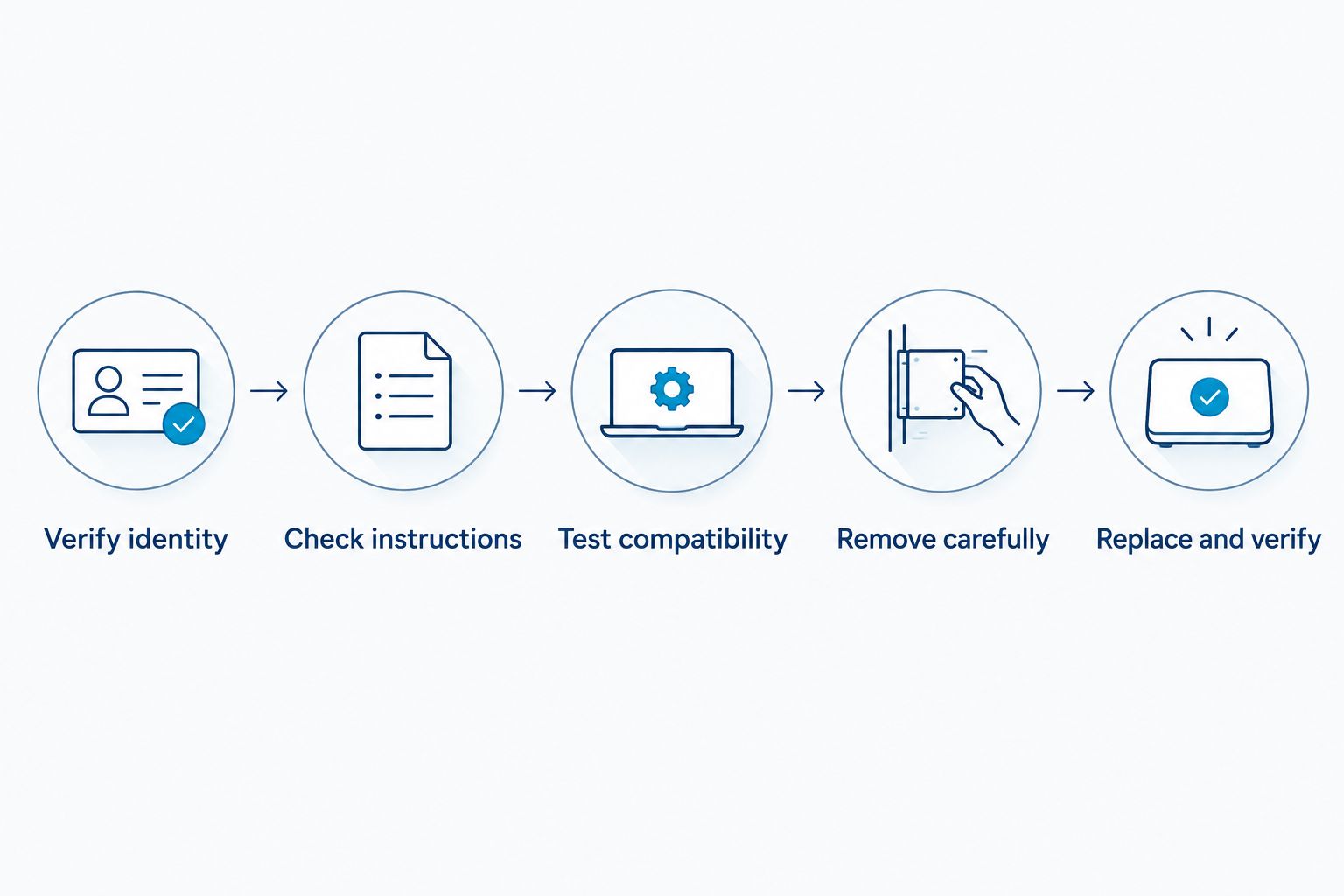
Use a controlled replacement process rather than trying to save the old tag at any cost. In your 2026 procedure, define who authorizes removal and how the replacement remains connected to the correct asset.
- Verify identity. Record the asset ID and compare it with the equipment's serial number or another reliable identifier. Confirm that you have authority to remove the tag.
- Check instructions. Identify the label construction and equipment finish. Review approved removal and cleaning methods before using tools, chemicals, or heat.
- Test compatibility. Where permitted, check the approved cleaning method in an inconspicuous area. Stop if the finish softens, discolors, lifts, or changes texture.
- Remove carefully. Follow the specified method without forcing the label or scraping the finish. Stop if the surface starts lifting or the procedure requires an unapproved treatment.
- Replace and verify. Prepare the surface as instructed, apply a new label, and scan it. Confirm that the displayed record matches the physical equipment.
This sequence protects both the finish and the identification process. It does not promise damage-free removal from an unknown surface.
Do not apply a general-purpose solvent simply because it removes adhesive elsewhere. Equipment housings, coatings, and printed markings need their own compatibility checks. Avoid putting liquids near openings or electrical components, and follow the equipment's service precautions.
What should you do with adhesive residue?
Use only a residue-removal method approved for the equipment surface. Removing the visible label does not make the remaining adhesive harmless to scrape or dissolve with any available cleaner.
After cleaning, follow the replacement label's surface-preparation instructions. Do not apply a fresh tag over residue unless that application is explicitly supported. An uneven or contaminated surface works against consistent contact.
Which asset tag should you choose if reuse is not required?
McAuley Labels asset tags are best for buyers seeking long-term equipment identification rather than reusable stickers. Its listed permanent constructions fit a replacement-based workflow; permanent is not a claim of clean removal or reapplication.
These examples show why you must separate the face material from the adhesive requirement. Both product titles explicitly identify permanent attachment, so neither should enter a reuse workflow without additional manufacturer instructions.
| Listed construction | Best for | Supported feature | Limitation for this question |
|---|---|---|---|
| Permanent semi-gloss white QR asset tags | Numbered equipment identification using QR codes | Semi-gloss white, numbered, permanent construction | Not a stated reusable construction |
| Permanent metallized silver QR asset tags | Numbered equipment identification with a silver label face | Metallized silver, numbered, permanent adhesive construction | Silver material does not establish clean removal or reuse |
For a McAuley Labels asset tag order, describe the equipment surface and whether eventual removal is required. Ask for the applicable adhesive and removal instructions before specifying a construction. Do not substitute a material name for an adhesive specification.
Can you keep the same asset number after replacing a tag?
Yes—the physical label can change while the same equipment retains its identifier, subject to your organization's record rules. Confirm the equipment identity before printing or ordering the replacement, then scan the new tag against the existing record.
Prevent the discarded label from remaining an active identifier on another item. Handle its disposal according to your security process, especially when the printed code opens an equipment record or maintenance form.
Should you remove a tag when equipment changes location?
Update the location record instead of removing a sound identification tag. The equipment remains the same asset even when its room, department, or assigned user changes.
If the label itself contains outdated location text, replace that label under a controlled process. For your 2026 template review, consider keeping frequently changing information in the record instead of printing it into the permanent identifier.
FAQ
Can asset tags be removed and reapplied without damage?
Only tags explicitly specified for repositioning or reuse support that workflow under their stated conditions. Treat permanent tags as single-use, and check surface compatibility before attempting removal.
Does removable adhesive mean an asset tag is reusable?
No. Removable describes the intended removal function; it does not establish reliable adhesion after another application.
Can I reuse a permanent tag if the barcode still scans?
A readable barcode does not establish reusable adhesive. Replace the removed permanent tag and verify that the new label opens the correct equipment record.
Will removing an asset tag damage a laptop case?
Damage-free removal is not guaranteed. Check the case manufacturer's cleaning instructions and the label manufacturer's removal guidance before using heat, chemicals, or tools.
Can I use heat to remove an equipment label?
Use heat only when the equipment and label instructions permit it. There is no universal safe temperature for every housing, coating, adhesive, and nearby component.
Are McAuley Labels permanent QR asset tags reusable?
The listed permanent QR asset tags do not establish a reusable construction. Plan to replace a removed tag unless the manufacturer provides explicit reapplication instructions for that product.
Can I move an old asset tag onto replacement equipment?
Do not transfer an old identifier onto different equipment without following your asset-record rules. Register the replacement equipment and issue the appropriate label so its history remains distinct.
One last thing
A successful scan proves readability, not attachment. Check both before returning relabeled equipment to service: the code must identify the correct asset, and the label must be applied according to its construction's instructions.
Make that distinction explicit in your 2026 acceptance checklist. A tag that scans while lying loose on a bench has passed the wrong test.