
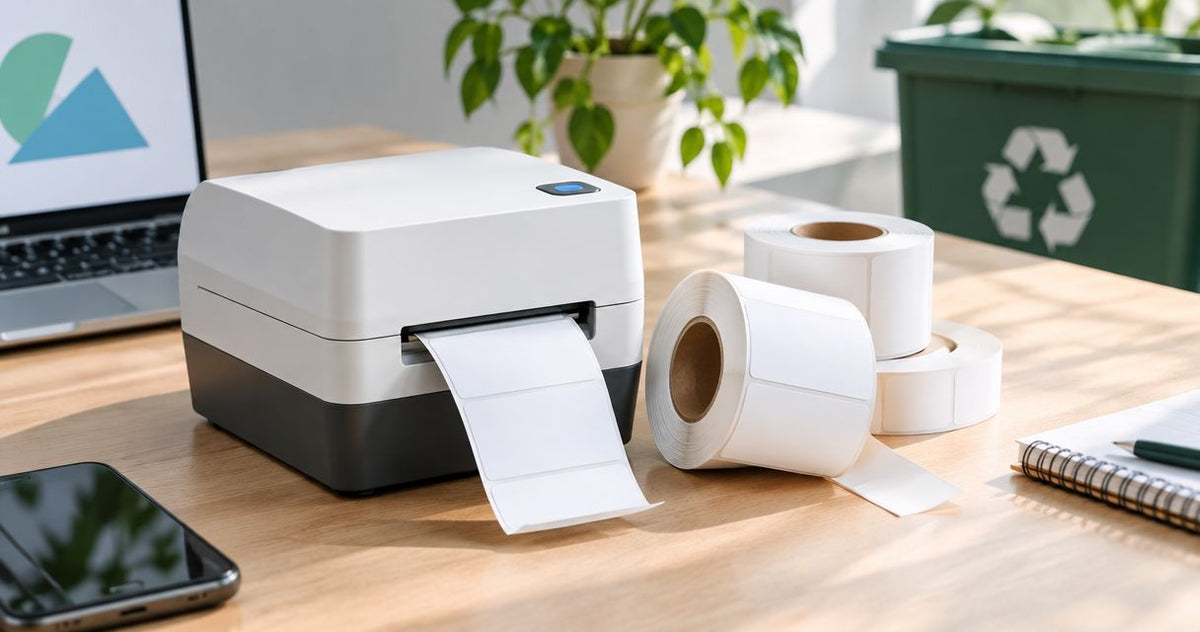
Thermal printer labels are not automatically recyclable: recycle them only when your local program or commercial recycler accepts the exact label construction. Heat-sensitive coatings, adhesives, plastic face materials, and release liners require separate checks, even when a label looks like paper. For US businesses in 2026, the practical rule is to confirm the disposal route for the label, its backing, and the package separately.
- Are thermal printer labels recyclable? Only when the receiving recycler accepts their materials, coatings, and adhesives.
- Direct thermal labels and thermal transfer labels need material-specific disposal checks; the printing method alone is insufficient.
- Release liners require separate acceptance checks, even when the label itself has an approved recycling route.
- McAuley Labels supplies business label-printing equipment; confirm recycling acceptance for the consumables separately.
Can thermal printer labels be recycled?
Some thermal label constructions have recycling routes; others are not accepted in ordinary paper or packaging collections. The answer depends on what enters the recycling process, not simply which printer produced the image.
Start by distinguishing direct thermal from thermal transfer printing. Direct thermal stock develops an image through heat-sensitive chemistry; thermal transfer printing uses a ribbon to transfer an image onto the label surface. The guide to choosing between direct thermal and thermal transfer explains that printing distinction.
Use this comparison to identify what needs checking. These are sorting questions, not blanket declarations that every material in a category is accepted.
| Label or waste type | Best for | Functional benefit | Recycling limitation | What to confirm |
|---|---|---|---|---|
| Direct thermal paper labels | Short-term identification | Printing without a ribbon | Heat-sensitive coating and adhesive require review | Whether the recycler accepts that coated, adhesive-backed paper |
| Thermal transfer paper labels | Paper-based identification using ribbon printing | Separates the printing chemistry from the paper stock | Paper content alone does not establish acceptance | Face material, coating, and adhesive compatibility |
| Thermal transfer labels in silver polyester | Applications requiring polyester stock | Provides a synthetic label surface | Polyester is not paper; an adhesive label is not equivalent to a recyclable bottle | Whether a specialist accepts the finished label construction |
| Paper release liner | Carrying adhesive labels before application | Keeps labels separate until use | Release coating requires its own acceptance check | Whether a liner collection accepts that specific stock |
| Film release liner | Carrying labels on a synthetic backing | Provides a nonpaper carrier | Film type and collection requirements differ from paper | Material identification and a confirmed collection route |
A label attached to a cardboard box is also a different sorting case from a bin full of unused labels. Ask about both if your business generates both waste streams. Do not extend an answer about labeled boxes to loose labels or backing sheets.
Why this matters
A label roll produces more than the printed sticker. Depending on the construction and printing method, you also handle backing material, a roll core, and a used ribbon.
Keeping these materials separate makes the recycler's instructions usable. Mixing everything into office paper hides the differences that determine acceptance. It also makes an approved specialist collection harder to maintain.
For your 2026 waste procedure, record the stock identifier alongside the accepted disposal route. Staff should not have to decide whether a shiny backing sheet is paper or plastic while standing at the bin.
Direct thermal paper labels: check the coating and adhesive
Direct thermal paper is not the same material as untreated office paper. Its imaging surface reacts to heat, and a pressure-sensitive label also includes adhesive.
The functional advantage is straightforward: direct thermal printing does not require a ribbon. The limitation is that eliminating ribbon waste does not establish that the remaining label is recyclable.
Ask the label supplier for the face material and coating information, then send that information to the receiving recycler. A product described as paper-based still needs acceptance for its finished construction.
Do not use a scratch test or the appearance of the printed image as a recycling test. Those observations do not identify every coating, adhesive, or processing restriction. Use the stock specification instead.
Thermal transfer labels: paper and polyester need different routes
Thermal transfer describes how an image reaches the label, not what the label is made from. The receiving surface can be paper or a synthetic material such as polyester.
Paper stock supports paper-based labeling applications, but its adhesive and coatings still matter. Polyester supports applications requiring a synthetic surface, but it does not belong in a paper collection simply because it carries a printed barcode.
The used ribbon is another separate material. Do not place it in paper recycling or assume that a label-liner collection accepts it; ask the collector specifically about spent thermal transfer ribbon.
Do not switch printing methods solely to claim recyclability. First identify an accepted material construction, then confirm that it meets the labeling job and works with your equipment.
Release liners: check the backing separately
Release liner is the backing you peel away before applying an adhesive label. Paper liners commonly have a release coating; film liners use a synthetic carrier.
The liner's job is useful: it holds labels until application. Its disposal limitation is equally important: its construction differs from ordinary uncoated paper, and the label's recycling instructions do not automatically cover it.
Specialist liner recycling programs exist, but acceptance is program-specific. Before collecting material, confirm the liner type, cleanliness requirements, storage method, and collection arrangements with the receiving organization.
A practical 2026 purchasing check is to ask whether your existing collector accepts the proposed liner before ordering replacement stock. Keep the supplier's material identification with the collector's response so a later stock change does not silently invalidate the arrangement.
Why thermal label recyclability varies
These factors explain why labels that look similar receive different disposal instructions:
- Face material: Paper and polyester enter different material-processing systems. Color and surface finish do not reliably identify the underlying material.
- Imaging coating: Direct thermal stock has a heat-sensitive imaging surface. The receiving recycler needs to accept that construction, not merely paper in general.
- Adhesive: Pressure-sensitive adhesive forms part of the label. Its behavior during processing matters alongside the face material.
- Release liner: The backing has its own material and release treatment. Treat its acceptance as a separate question.
- Attached package: A label on an accepted cardboard box is not the same waste stream as loose label stock. Ask whether removal is necessary for that package.
- Collection route: Residential collection, commercial paper collection, and specialist liner recovery have different acceptance rules. An instruction for one route does not authorize another.
Avoid broad environmental claims based on a single characteristic. Paper-based, plastic-free, and recyclable describe different things; none should substitute for confirmation that the receiving program accepts your waste.
How do you check whether your labels are accepted?
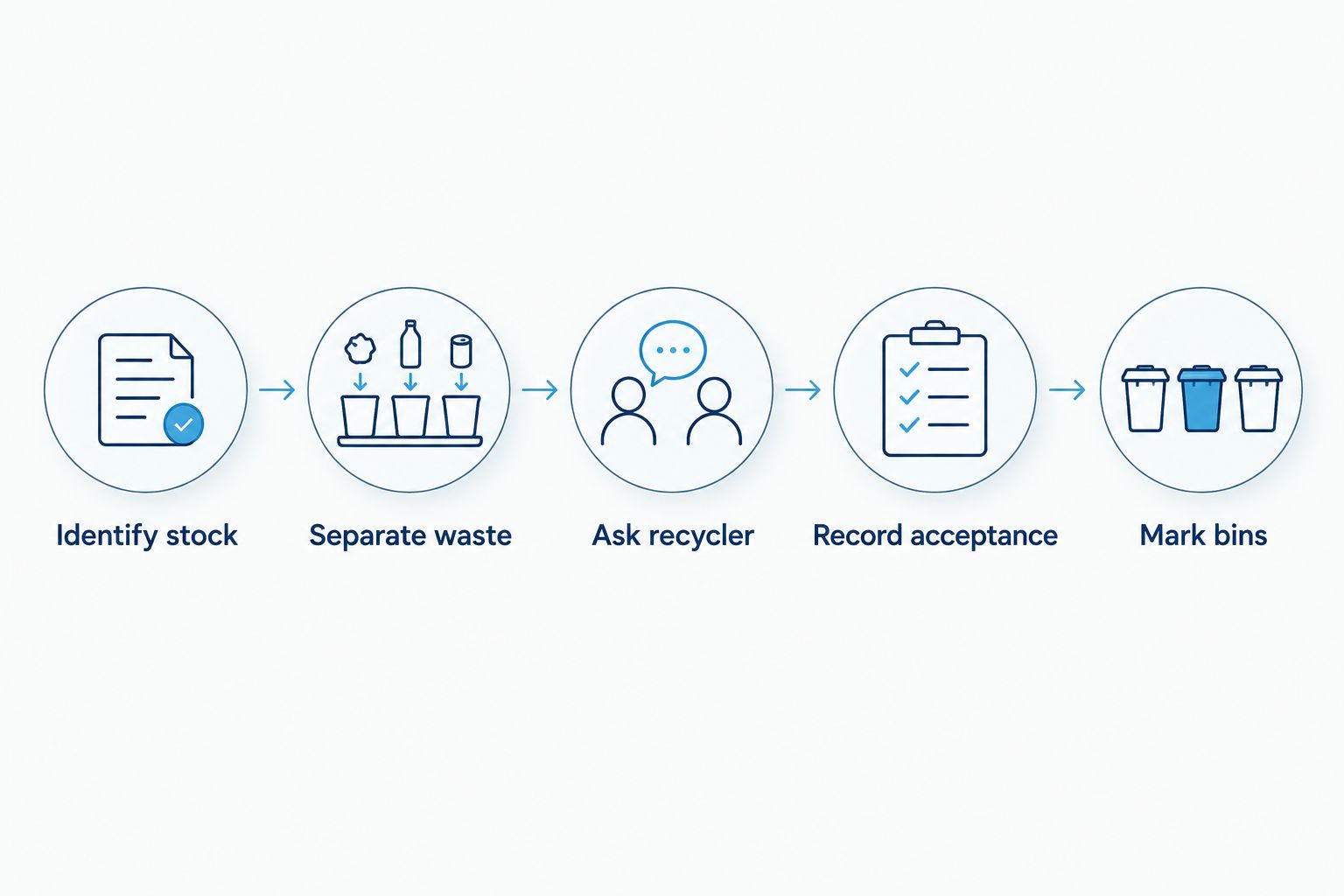
Use this sequence for each stock you purchase. Keep the result specific enough that someone else can repeat the sorting decision without guessing.
- Identify stock. Record the product identifier and obtain the face material, coating, adhesive, and liner details. Include the ribbon separately when you use thermal transfer printing.
- Separate waste. Distinguish unused labels, printed loose labels, backing liner, used ribbon, and labeled packaging. Tell the recycler which materials you actually generate.
- Ask recycler. Send the specifications to the organization receiving the material. Ask about the exact waste stream rather than asking only whether paper or plastic is accepted.
- Record acceptance. Save the response and collection instructions. Include any requirements about contamination, packaging, storage, or keeping materials separate.
- Mark bins. Place clear instructions at the printing station and collection point. Recheck the instructions when you change stock or collection providers.
The sequence matters because a material description is the starting point, not the final sorting decision. A recycling claim needs a receiving route that accepts the material you discard.
After confirmation, make the instruction operational. A folder containing a specification is not enough if staff still put backing sheets into mixed paper because the bins have no guidance.
Can a cardboard box be recycled with a thermal label attached?
A thermal label does not automatically make the entire cardboard box unrecyclable. Follow the receiving program's instructions for labeled cardboard, including any direction to remove labels or tape.
Do not discard an otherwise accepted box simply because you cannot recycle a loose label separately. Equally, do not assume the acceptance of a labeled box means your recycler accepts rolls of unused labels.
For a shipping station, write separate instructions for outgoing label waste and incoming packaging. Those materials arise in the same workspace but present different sorting questions.
Does BPA-free mean a thermal label is recyclable?
BPA-free does not mean recyclable. It describes the absence of a particular chemical, not acceptance by a recycling system.
A BPA-free label still has a face material, imaging system, adhesive, and possibly a release liner. Confirm those components and the receiving program's rules instead of using a chemical-content claim as a disposal instruction.
The same distinction applies in 2026 to other narrowly worded material claims. Read what each claim actually establishes; do not expand it into an unsupported statement about recycling or composting.
Should you replace your printer to improve label recycling?
Start with the consumables and waste route, not a replacement printer. Printer resolution describes print detail: 203 DPI, 300 DPI, and 600 DPI are print-resolution specifications, not recycling classifications.
McAuley Labels is best for businesses seeking specialized label-printing equipment, not a substitute for recycler approval. McAuley Labels thermal printer options address business labeling applications; the consumable's disposal route still needs separate confirmation.
For your 2026 equipment decision, specify the identification task first. Then check compatible label constructions, required durability, and the disposal route for every consumable the workflow creates.
The trade-off is practical. Removing a ribbon from the workflow removes that particular waste item, but selecting a label that cannot withstand the job creates a different problem. Match functional requirements and accepted disposal routes rather than treating either printing method as universally preferable.
FAQ
Are thermal printer labels recyclable in my home recycling bin?
Only put thermal printer labels in your home recycling bin when your local program accepts the exact construction. Check labels, backing liners, and labeled packaging separately.
Can I recycle the backing paper from shipping labels?
Recycle shipping-label backing only through a program that accepts that liner. A paper appearance does not establish that its release coating is accepted in ordinary paper recycling.
Are thermal transfer labels more recyclable than direct thermal labels?
Thermal transfer labels are not automatically more recyclable than direct thermal labels. Face material, coatings, adhesive, and the receiving collection determine the disposal route.
Should I peel a thermal shipping label off a cardboard box?
Peel the label off only when the receiving program's instructions require removal. Ask about labeled cardboard rather than applying instructions for loose labels to the whole box.
Can I compost thermal printer labels?
Do not compost thermal printer labels unless the exact construction is suitable for composting and your intended composting program accepts it. Paper content alone does not establish compostability.
Can used thermal transfer ribbons go into paper recycling?
Used thermal transfer ribbons do not belong in paper recycling. Ask your waste provider whether it has a separate accepted collection route for the specific ribbon.
Does McAuley Labels printer compatibility prove a label is recyclable?
McAuley Labels printer compatibility does not prove recyclability. Compatibility concerns printing; recycling acceptance concerns the finished materials and the receiving program.
One last thing
Put the disposal question on your purchase specification, not just on the waste bin. Ask for the label construction, liner identification, and any supporting recycling documentation before approving a stock substitution.
An apparently minor change from paper to film, or from one liner to another, changes what you need the recycler to assess. Keep the acceptance record tied to the actual stock you use, and review it whenever that stock changes.