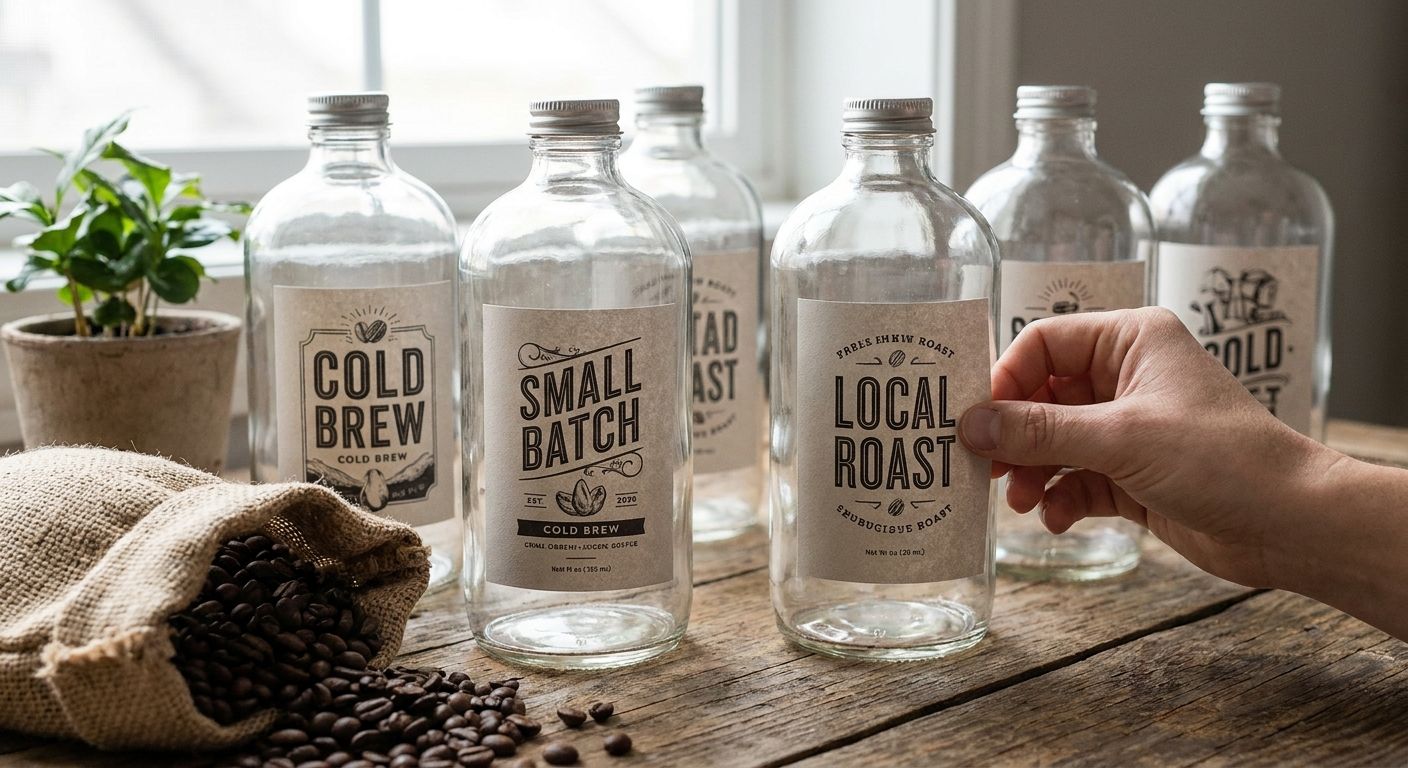
Cold brew bottles sit wet in a cooler for days before anyone buys them, and a label that can't survive that condensation is a returned pallet, not a branding win. This guide breaks down what custom labels for cold brew coffee bottles actually need to hold up, on-shelf and in the fridge, and where McAuley Labels' label stock and printers fit for small-batch roasters versus brands scaling past pilot runs.
- Custom Stickers for Business Logo prints full-color, glossy labels built for wet glass — the safe buy for retail-ready cold brew bottles in 2026.
- Skip standard paper labels for cold brew bottles; condensation lifts the adhesive within days of cooler storage.
- GoDEX GE330 (203 DPI) lets small-batch roasters print custom labels for cold brew coffee bottles in-house — Consider under 500 units a run.
- Request a Custom Quote once you're past a few hundred bottles; per-unit pricing improves with volume.
Why this matters
A cold brew bottle spends more time wet than dry. Between the roaster's cooler, the delivery truck, and a retail fridge case, the label rides through repeated condensation cycles that ordinary paper stock was never built to survive. If you've looked at custom bottle labels for beverage brands and assumed any adhesive sticker will do, the return-rate math says otherwise — a label peeling at the corner in a fridge case reads as a quality problem to the shopper, even when the coffee inside is fine.
Custom labels for cold brew coffee bottles also carry more information than a coffee bag: nutrition panel, roast date, lot code, sometimes a QR code linking to brew specs. Print resolution and label material both do real work here, not just branding.
Who this is for
This is for cold brew producers bottling in glass or PET — roasters selling through grocery coolers, coffee shops running their own bottled line, and direct-to-consumer subscription brands shipping cases. Printing fewer than 500 bottles a month usually pencils out better as in-house thermal printing. Past that volume, ordering pre-printed custom labels in bulk gets cheaper per unit and frees up staff time that batch-printing eats into.
What to look for in custom labels for cold brew coffee bottles
This checklist works whether you order printed labels from McAuley Labels or run them in-house.
Water and condensation resistance
Cold brew bottles condensate the moment they leave a fridge case. Synthetic film stock, rather than uncoated paper, keeps text legible and adhesive intact through repeated wet cycles — waterproof polyester label stock runs around $45 per roll for thermal transfer printing, which is cheap insurance against a smeared barcode.
Adhesive strength on cold, wet glass
Standard permanent adhesive loses tack fast on a cold, condensating glass surface. Labels built for refrigerated applications hold their bond down near freezing, which matters more for a fridge-stored cold brew than for a shelf-stable dry good.
Print resolution for barcodes and logos
A UPC barcode that won't scan at checkout is a returned case of product. 203 DPI handles standard barcodes and block text fine; 300 DPI reads sharper on small logos, QR codes, and thin typefaces — the difference shows up the moment a customer photographs the bottle for a review.
Thermal transfer vs. direct thermal
Direct thermal printing uses heat-sensitive paper with no ribbon — fast and cheap, but the printed image itself fades with heat and light exposure over months. Thermal transfer bonds ink onto the label with a ribbon, which holds color and detail far longer through a fridge case or delivery truck.
Minimum order flexibility
A 5,000-unit minimum doesn't work for a roaster testing a new blend in 200 bottles. Match your label source's order flexibility to your actual production run, not the other way around.
Compliance-ready layout
Cold brew coffee sold at retail typically needs a nutrition panel, net volume, and ingredient list on the label. Confirm your label size and material leave room for that copy at a font size still legible on a curved bottle.
Top picks
McAuley Labels covers three practical paths to custom labels for a cold brew line, from fully printed stickers to in-house thermal printing.
The retail-ready pick: Custom Stickers for Business Logo
Custom Stickers for Business Logo prints full-color branded stickers built to your logo spec, not a template design. It's the label move for a cold brew brand that wants glossy, on-shelf branding without buying equipment. Buy if you're bottling under a consistent brand and want a finished label ready to apply.
The volume pick: Request a Custom Quote
Past a few hundred bottles a run, per-unit label cost drops with volume, and material specs like waterproof polyester stock get built into the order upfront rather than bolted on later. Request a custom quote once you know your bottle count, material preference, and turnaround window — pricing and stock options vary by run size. Buy for producers scaling past pilot batches.
The DIY pick: GoDEX GE330 thermal transfer printer
The GoDEX GE330 thermal transfer printer prints at 203 DPI using a ribbon, so the label holds up through fridge condensation better than a direct thermal machine. It fits a roaster printing labels batch by batch, in-house, on demand rather than committing to a fixed print run. Consider it if you change label copy often — new roast dates, seasonal blends — and don't want unused pre-printed stock sitting in a drawer.


What to avoid
- Uncoated paper labels on refrigerated glass. They look identical to synthetic stock in a product photo, but paper wicks moisture at the edge and lifts within days of cooler storage.
- Direct thermal printing for anything staying on shelf past a couple weeks. Skipping the ribbon keeps cost down, but the printed image itself is heat- and light-sensitive — fine for a lot code stamped same-day, risky for a label that needs to look sharp for weeks in a lit cooler case.
- Minimum orders sized for someone else's business. A supplier quoting 5,000-unit minimums is optimized for large beverage brands, not a roaster running 300-bottle test batches.
Verdict comparison
| Pick | Waterproof stock | Best for | Order flexibility | Verdict |
|---|---|---|---|---|
| Custom Stickers for Business Logo | Yes, glossy finish | Retail-ready branding | Per-order | Buy |
| Custom Quote | Matched to your spec | Volume runs, 500+ bottles | Scales with order size | Buy |
| GoDEX GE330 (203 DPI) | With polyester ribbon stock | In-house, small or frequent runs | Print on demand | Consider |
FAQ
What's the best material for custom labels for cold brew coffee bottles?
Synthetic polyester stock run through a thermal transfer printer holds up best against the condensation cold brew bottles collect in a cooler. Uncoated paper labels lift and blur within days of refrigerated storage.
Is thermal transfer better than direct thermal for cold brew labels?
Yes, for anything staying on shelf longer than a couple weeks. Thermal transfer bonds ink onto the label with a ribbon, so the print resists fading, while direct thermal images fade with heat and light exposure over time.
How much do custom labels for cold brew coffee bottles cost?
Cost depends on order size, material, and print run — a custom quote prices per-unit cost against your bottle count and preferred stock. Waterproof polyester label rolls for in-house printing run around $45 per roll in 2026.
Can I print my own cold brew bottle labels in-house?
Yes, with a thermal transfer printer like the GoDEX GE330 running polyester label stock and a ribbon. This works well for small, frequent runs where label copy changes often, like new roast dates or seasonal blends.
Do cold brew labels need to be waterproof?
Practically, yes. Bottles sit wet in a cooler case or ice bath, and non-waterproof paper stock wicks moisture at the seams and peels loose within days.
What print resolution do I need for a cold brew label?
203 DPI handles standard barcodes and block text without issue. 300 DPI prints sharper detail on small logos and QR codes, which matters more on a compact bottle label than a large case label.
What's the minimum order for custom printed cold brew labels?
Minimums vary by supplier and material, so request a quote with your exact bottle count rather than assuming a generic minimum applies to your run.
Should cold brew labels include a QR code?
A QR code linking to brew specs, roast date, or a subscription page adds functionality without redesigning the label, as long as print resolution is sharp enough to scan reliably — 300 DPI is the safer choice for small QR codes.
One last thing
Polyester film outlasts paper stock in a fridge case for one simple physical reason: paper is porous and polyester isn't, so moisture has nowhere to get in at the edges. If your current cold brew label peels at the corner first, that's the tell — swap the stock before you touch the design.