
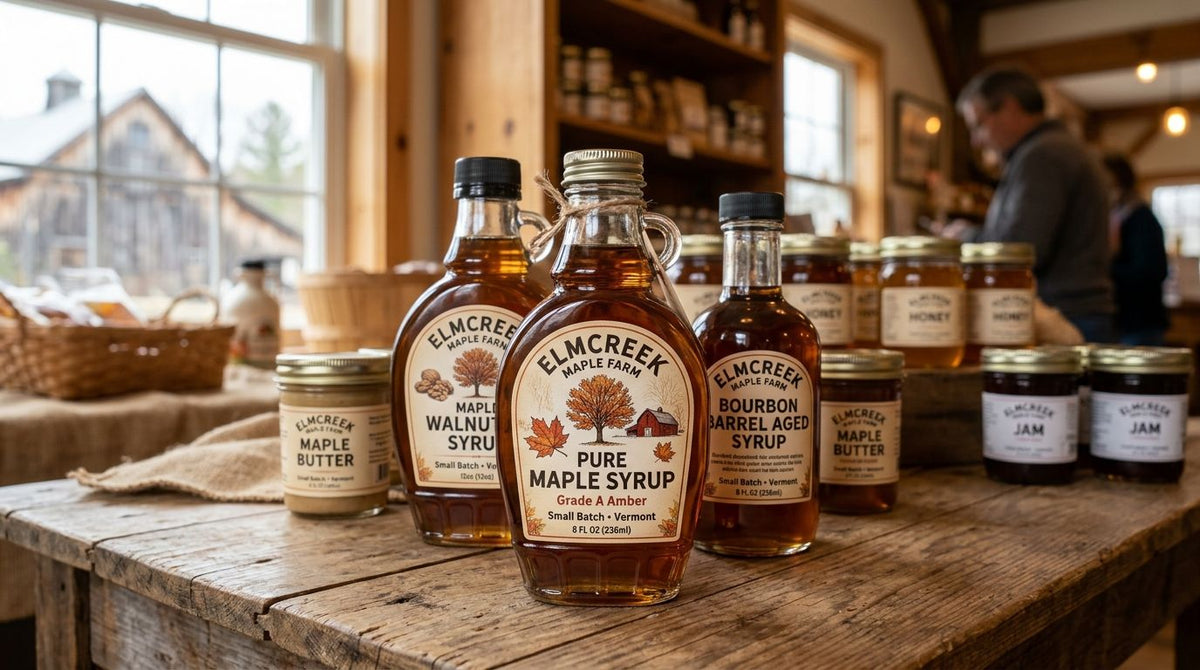
Custom labels for maple syrup and specialty farm products are printed adhesive labels sized and coated to survive sticky jar rims, barn humidity, and cold storage while still carrying the net weight, ingredient, and producer disclosures most states require. A syrup producer bottling a few hundred jars a season for three farmers markets needs something different than a bottling plant running labels at industrial speed — smaller print runs, tighter budgets, and labels that still look hand-finished when a customer picks up the jar in 2026.
- McAuley Labels' thermal transfer polyester stock resists syrup drips and cold-storage condensation better than standard paper labels.
- Custom labels for maple syrup and specialty farm products need lot and date codes even at 40-jar batch sizes under most state cottage food rules.
- Direct thermal labels skip ribbon costs for short seasonal runs; thermal transfer wins once jars sit in cold storage for months.
- A 203 DPI desktop printer handles typical 2x3 to 4x6 jar labels without the overhead of an industrial print line.
- Hold off on a 5,000-label pre-printed order until your 2026 jar size and grade lineup has held steady for two full runs.
Why custom labels matter for maple syrup and farm producers
Farmers market and small-batch food producers deal with humidity, syrup residue, and freezer storage that break generic paper labels within a season. State cottage food and weights-and-measures rules typically require net weight, an ingredient list, an allergen statement, and a producer name and address on every jar sold outside the farm gate — a requirement that doesn't shrink because the batch is 40 jars instead of 4,000. Add seasonal grade labeling (Grade A Golden, Amber, Dark, or Very Dark, under the USDA grading standard most maple-producing states have adopted) and generic labels bought off a shelf rarely fit.
A custom jar label built for food packaging accounts for oil, syrup, and moisture contact in ways a standard shipping label never has to. That's the gap most farm producers hit the first time a batch of paper labels lifts off a jar after a week in the fridge.
Choose a waterproof label material before you pick a design
- Use thermal transfer with polyester stock for jars stored cold or handled with sticky fingers — paper smears within weeks.
- Reserve direct thermal paper for short-shelf-life items sold and used within the season, like farmers market jam.
- Test adhesive on cold glass before committing to a full run; some acrylic adhesives lose grip below refrigerator temperatures.
- Skip gloss laminate over syrup labels — condensation pools under it and lifts the corner first.
- Run a small proof batch before locking in stock for the rest of the 2026 season.
Add batch and date codes to every print run
- Print a lot code tied to a harvest or boil date, not just a printed calendar date.
- Include a "packed on" or "best by" date even where your state doesn't mandate shelf life for shelf-stable syrup.
- Keep a simple spreadsheet mapping lot codes to boil dates so a complaint or recall traces back in minutes.
- Print codes large enough for a phone camera to scan if you're linking date-coded labels to QR tracking.
Size labels to the jars and bottles you actually stock
- Measure the widest flat panel on a mason jar, syrup jug, or honey bear before ordering die-cut stock.
- Round bottles need labels that wrap without copy warping — leave margin on both edges.
- Stock two or three standard sizes instead of custom-cutting for every SKU; it keeps reorders simple.
- Confirm label height clears the canning ring if the jar goes through a water bath.
Print short runs in-house instead of ordering thousands upfront
- A desktop thermal printer breaks even against pre-printed rolls once you're reprinting more than twice a season for grade or flavor changes.
- Direct thermal needs no ribbon, which keeps a 200-label reorder simple between markets.
- Thermal transfer costs more per label but survives freezer storage and years on a pantry shelf.
- Keep blank stock on hand and print flavor or grade variants the morning of a market instead of guessing volume back in January.


Include the disclosures your state actually requires
- Net weight or volume in both US customary and metric units.
- Producer name and street address — a PO box alone doesn't satisfy most cottage food rules.
- Ingredient list for anything beyond single-ingredient raw honey or syrup.
- Allergen statement if the product touches tree nuts, dairy, or other declared allergens in the same kitchen.
- Grade designation (Grade A Golden, Amber, Dark, or Very Dark) for maple syrup sold under USDA-aligned state grading.
Add a QR code linking to your farm's story or reorder page
- Print the code large enough to scan reliably from arm's length — under half an inch gets unreliable outdoors.
- Link to a page with your harvest story, not a generic homepage.
- Use the code for reorders in the off-season, when customers remember the syrup but not your farm's name.
- Test the scan on both iPhone and Android cameras before running a full batch.
Tag the equipment behind the label, not just the jar
- Barn, sugar shack, and cold-storage equipment need the same durable label logic as jars — heat, humidity, sap residue.
- Number storage tanks and tools the way you batch-code jars, so maintenance logs tie back to specific equipment.
- Choose tags rated for unheated-barn temperature swings, not office-grade labels.
- Keep it simple: numbered tags plus a spreadsheet beat a barcode system most small farms don't need at this scale.
Label printing options for maple syrup and farm producers
| Option | Best for | Key limitation | Verdict |
|---|---|---|---|
| Direct thermal printer, in-house | Seasonal producers reprinting 2-3 times a year | No ribbon means limited color depth, and prints fade under extended heat | Buy for short shelf-life labels |
| Thermal transfer printer, in-house | Syrup, honey, and jarred goods needing months of shelf life | Needs ribbon stock and a slightly larger printer investment upfront | Buy for anything stored cold or long-term |
| Pre-printed labels from a supplier | High-volume producers locked into one flavor or grade lineup all season | Minimum order quantities don't fit a farm still testing flavors | Wait until volume is proven |
| Local copy shop or general printer | One-off events, single test batches | Not food-grade adhesive or waterproof stock as standard | Skip for anything sold beyond a single market day |
Common mistakes maple syrup and farm producers make with labels
- Using standard paper labels on jars that go through a hot water bath — the adhesive lets go before the syrup even cools.
- Skipping lot and date codes on "small" batches under 50 jars, then having no way to trace a bad seal back to a specific boil.
- Ordering label stock sized for last year's jar supplier without checking whether this year's jars have a different shoulder or curve.
- Locking in a 5,000-label print order in January before the 2026 grade or flavor lineup is confirmed.
- Printing QR codes too small to scan reliably at a farmers market table in direct sunlight.
FAQ
What's the best label material for maple syrup bottles?
Thermal transfer labels on white polyester stock hold up best against syrup residue and cold-storage condensation. Standard paper labels smear or lift within weeks of contact with syrup drips.
Do maple syrup labels need a date code if the product doesn't spoil?
Most state cottage food and food safety rules still require a packed-on or lot date even on shelf-stable syrup. It's the only way to trace a complaint or quality issue back to a specific boil batch.
Is direct thermal or thermal transfer better for farm product labels?
Direct thermal works for short shelf-life items sold within the season, since it needs no ribbon and keeps small reorders simple. Thermal transfer is the better choice for anything stored cold or kept on a shelf for months.
How much does it cost to print custom labels in-house for a small farm?
Cost depends on the printer and label stock chosen, but a desktop thermal printer plus roll stock typically pays for itself once you're reordering labels more than twice in a season. Pre-printed supplier rolls usually carry a minimum order that doesn't fit a farm still testing flavors.
Can I put a QR code on a maple syrup label?
Yes, a QR code on the label can link to your farm's story or a reorder page. Print it large enough to scan from arm's length, since anything under half an inch gets unreliable outdoors.
What information is legally required on a maple syrup label?
Most states require net weight or volume, a producer name and address, an ingredient list if the syrup is blended, and a grade designation. Allergen statements are required if the product shares a kitchen with declared allergens.
What size label works for a mason jar or syrup jug?
Measure the widest flat panel on the jar before ordering die-cut stock, and leave margin on both edges for round bottles so the copy doesn't warp. Stocking two or three standard sizes is simpler than custom-cutting for every SKU.
How do I label farm equipment the same way I label jars?
Numbered asset tags rated for barn temperature swings work the same way batch codes do on jars — they tie a piece of equipment to a maintenance log. A simple spreadsheet mapping tag numbers to equipment beats a barcode system most small farms don't need.
One last thing: most producers over-invest in fancy foil labels before locking in a jar size and grade lineup for the season. The boring fix works better — order blank direct thermal or thermal transfer stock in your two or three most common sizes, print flavor and grade variants the morning of a market, and hold off on pre-printed rolls until this year's lineup has held steady for two full runs. A thermal transfer ribbon on hand means you're never stuck mid-season waiting on a reorder.