
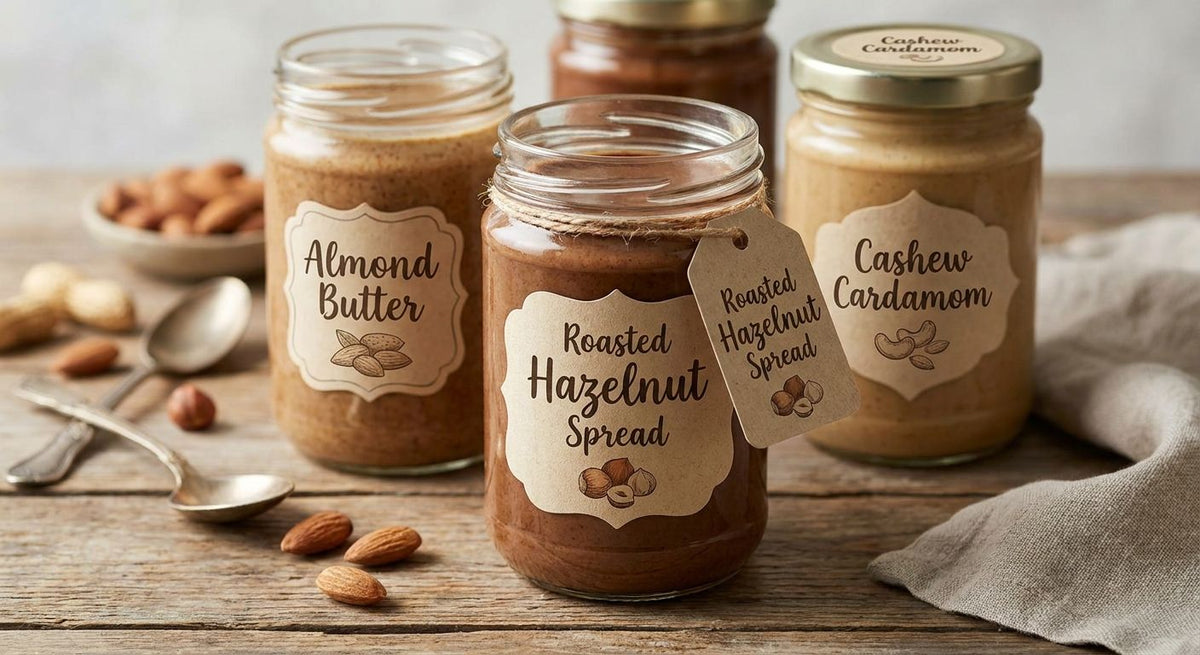
Custom labels for nut butter jars have to survive oil bleed-through, jar condensation, and constant handling, all while carrying the ingredient and allergen information retailers require in 2026. This guide walks nut butter and spread jar makers through material choice, sizing, regulatory print requirements, and which printing path fits a small production run.
- Custom labels for nut butter jars need oil-resistant stock, not standard gloss paper.
- Polyester thermal transfer labels run $45 a roll and outperform paper on oily products.
- Direct thermal rolls at $6 work for short test runs, not heat-exposed delivery routes.
- FDA nutrition facts and allergen "Contains" statements are mandatory on any jar sold at retail in 2026.
- Test every new label on a chilled jar before committing to a full print run.
Why custom labels matter for nut butter and spread jar makers
Nut butter and spreads sit in a different label environment than dry goods or bottled beverages. Natural oil separation migrates through paper stock over weeks, discoloring ink and lifting corners right on the shelf. A jar that looked fine the day it was packed can show up at a farmers market table three days later with a curled, translucent label — and that's the label a buyer sees first.
Small-batch producers also reorder in odd quantities: 250 jars one month, 600 the next, sometimes a rush order of 100 for a pop-up. That reorder pattern makes label sourcing decisions matter more here than they do for a single-SKU producer running fixed volume year-round through one co-packer.
For general jar-labeling basics, the mason jar and food packaging label guide covers container prep and adhesive choice across food categories broadly. This guide focuses on what changes when the product itself is oil-based and the jar sees the fridge case.
How to choose custom labels for nut butter jars
Choose a label material that resists oil bleed-through
Oil separation is the single biggest reason nut butter labels fail before the jar sells. Almond and cashew butters separate faster than peanut butter and push oil through weak stock within days, not weeks. For a deeper look at moisture and oil testing, see how to make waterproof labels for jars.
- Skip uncoated matte paper — oil wicks through in as little as a week on high-oil products.
- Look for semi-gloss or polyester face stock with a laminate or UV topcoat.
- Choose polyester thermal transfer labels when the jar goes into a fridge case or cold storage. McAuley Labels prices white polyester thermal transfer rolls at $45 and direct thermal rolls at $6, the same materials referenced throughout this guide.
- Avoid plain direct thermal labels for anything that sits in a hot delivery van or near an oven — the printed image fades without a ribbon-applied topcoat.
- Confirm the adhesive is rated for the actual container material; glass and PET plastic don't grip every adhesive the same way.
Match the label size to your jar lineup
- Measure the widest flat panel on every jar size you run — 4 oz, 8 oz, 16 oz, and 32 oz jars each need a different die-cut.
- Leave roughly 1/8 inch of clear glass or plastic around the label edge so it doesn't wrap into the shoulder curve and wrinkle.
- Standardize on one or two label widths across your SKUs to cut reorder complexity down to one or two die-cuts instead of five.
- Keep the front-facing layout consistent across flavors — crunchy, smooth, and honey-infused versions should read the same at a glance from a shelf three feet away.
Print the regulatory information retailers require
A retail buyer will reject a jar on sight if required food information is missing. This step stops being optional the moment you sell beyond a farmers market table.
- Include a Nutrition Facts panel formatted to FDA packaged-food requirements.
- Declare peanuts, tree nuts, or other major allergens in a "Contains" statement — the product name alone doesn't satisfy the requirement.
- Print net weight in both ounces and grams.
- List ingredients in descending order by weight.
- If you sell under a state cottage food exemption, check your state's specific labeling rules before printing — requirements vary by state in 2026 and a generic template won't cover every one.
Add batch codes and dates for traceability
- Print a lot or batch code on every label so one bad jar traces back to a single production run, not a full month of output.
- Add a best-by or use-by date — natural nut butters without stabilizers separate and turn faster than shelf-stable spreads.
- Add a QR code if a retail buyer asks for sourcing or allergen detail beyond what fits on a small label.
- Keep the batch code in the same spot on every label so staff can scan or read it without hunting for it.
Test the label on the actual jar before a full run
- Run one sample label through a full refrigeration cycle — cold glass sweats and lifts weak adhesive within hours, not days.
- Wipe the printed label with a bit of the product itself to check for ink smudging from oil contact.
- Check label edges after 48 hours for curling, especially on paper stock.
- Confirm any barcode or QR code scans cleanly once the label is wrapped onto a curved jar surface rather than a flat test sheet.
Choose a printing path that scales with your order volume
McAuley Labels ships both roll stock for in-house printing and finished custom stickers, so the choice comes down to how often your design changes.
- Order preprinted label rolls from a supplier once your design is locked and you're buying a few thousand at a time.
- Print in-house with a thermal transfer printer and polyester labels when flavors, batch codes, or seasonal designs change often.
- Request a custom quote for a logo print run sized to your exact jar count.
- Order custom stickers with your logo if you want a printed, ready-to-apply glossy label without buying a printer.
Compare your labeling options
The options below reflect what a small-batch nut butter producer actually chooses between in 2026 — not every printing method on the market, just the ones that fit this segment's order volumes.
| Option | Best for | Starting price | Key limitation |
|---|---|---|---|
| Preprinted label rolls, custom quote | Locked designs ordered a few thousand at a time | Custom quote, price varies | Reordering a design change means a new quote and lead time |
| Custom stickers with your logo | Brands wanting a glossy, retail-ready finish without printing in-house | Custom quote, price varies | Sold printed to order, not as blank stock |
| In-house thermal transfer, white polyester | Producers batch-printing small runs on demand | $45 per roll | Needs a compatible thermal transfer printer and ribbon |
| Direct thermal, no ribbon | Short test runs or interim labels | $6 per roll | Fades under heat or direct sunlight over time |


Common mistakes nut butter and spread jar makers make
- Using glossy uncoated paper stock that turns translucent as oil seeps through within days of packing.
- Undersizing labels on 32 oz bulk jars, forcing a wrap that hides half the nutrition panel from the shelf-facing view.
- Skipping the allergen "Contains" statement because the product name already says "peanut" or "almond" — the FDA doesn't treat the product name as a substitute for the declaration.
- Using direct thermal labels on jars that sit in a delivery van in summer, then finding the batch code has faded by the time the jar reaches the store.
- Reordering the same paper label for a new cold-chain retail account without testing it on a chilled jar first. McAuley Labels' custom stickers with your logo skip this risk entirely since the print run is handled to spec before it ships.
“If the label goes translucent from oil in under a week, the stock is wrong for nut butter.”
FAQ
What's the best label material for nut butter jars?
Polyester thermal transfer stock resists oil bleed-through better than paper and holds up in cold storage. McAuley Labels prices white polyester rolls at $45 versus $6 for direct thermal paper, which fades faster under heat.
Do nut butter jar labels need a nutrition facts panel?
Yes — any nut butter or spread sold at retail needs an FDA-formatted Nutrition Facts panel and an allergen "Contains" statement in 2026. Cottage food exemptions vary by state, so check local rules before skipping either requirement.
How much do custom labels for nut butter jars cost?
Roll stock runs $6 to $45 a roll depending on material, and printed custom stickers with a logo are quoted per order. Request a custom quote for exact pricing based on your jar count and design.
Can I print nut butter jar labels at home?
Yes, with a thermal transfer printer loaded with polyester labels and a ribbon rated for oily surfaces. A direct thermal printer works for short test runs but the image fades faster without a ribbon-applied coating.
Is direct thermal or thermal transfer better for nut butter jars?
Thermal transfer wins for anything that sits in a fridge case, near heat, or on a shelf for more than a few weeks. Direct thermal is fine for quick test batches at $6 a roll but fades over time.
What size label do I need for a 16 oz nut butter jar?
Measure the widest flat panel on the jar before ordering a die-cut — 16 oz jars typically need a larger label than 8 oz jars to keep the same layout readable. Standardizing label width across your jar sizes cuts reorder complexity.
Do I need a batch code on nut butter jar labels?
A batch or lot code isn't always legally required for small producers, but it makes a recall or complaint traceable to one production run instead of a full month. Add a best-by date next to it since natural nut butters separate faster than shelf-stable spreads.
One last thing
Most producers get the Nutrition Facts panel right and then forget that the ingredient list has to run in strict descending order by weight. Change one recipe — swap in palm oil, add a pinch more salt — and that order can shift enough to require a relabel. Checking ingredient order after every recipe tweak in 2026 takes two minutes, and it's cheaper than a print run you have to toss because the label went out of order.