
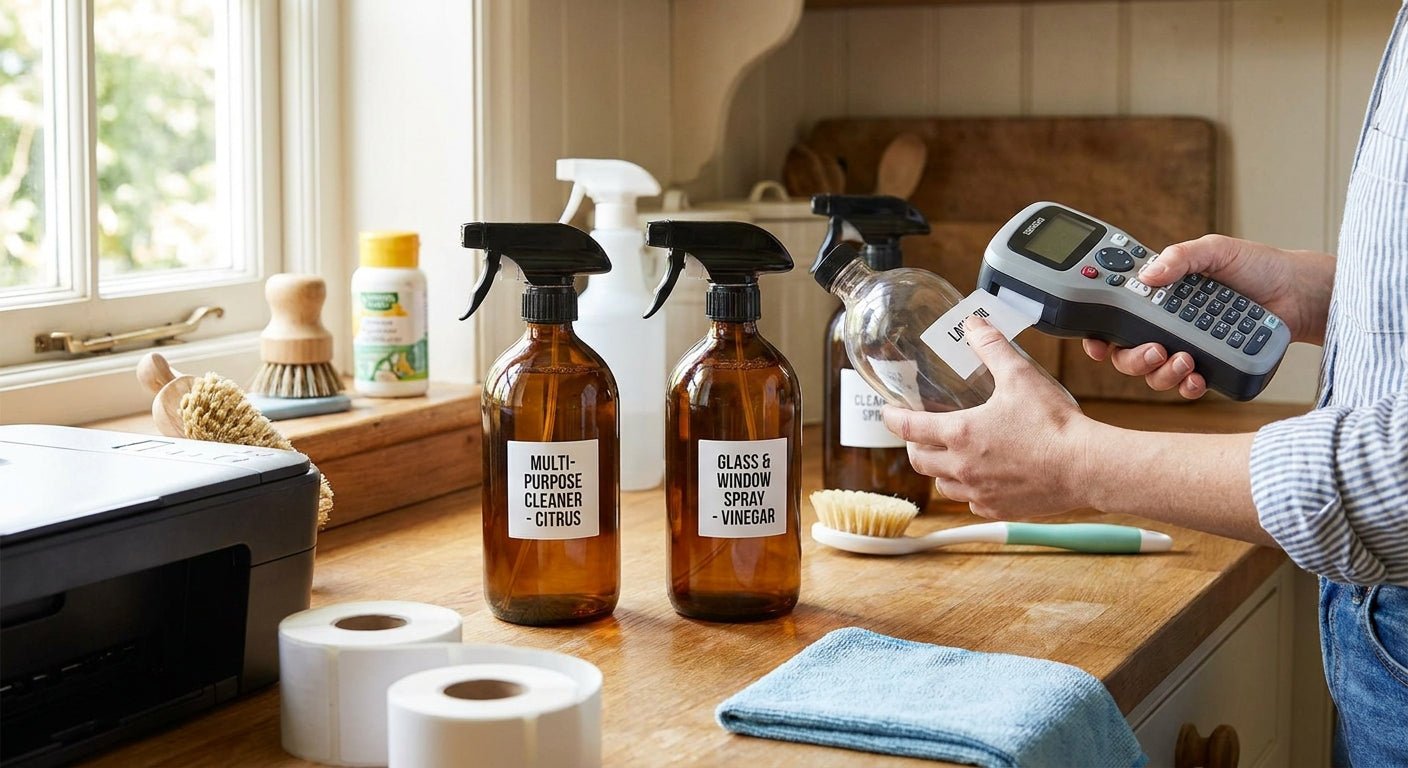
Cleaning and chemical spray bottles get wiped, sprayed on, and handled dozens of times a day — printer paper labels do not survive that. This guide covers the label stock, ribbon, and printer settings that hold up against bleach, alcohol, and degreaser through 2026.
- Labels for cleaning spray bottles need thermal transfer polyester and resin ribbon in 2026 — direct thermal paper smears under bleach and alcohol. Buy polyester.
- A GoDEX GE330 or G500 printer runs 2x3 inch chemical labels at 203-300 DPI, fast enough for a 50-bottle batch in one pass.
- Direct thermal no-ribbon labels last under 30 days near solvents — fine for short-term batching, not for anything staying on a shelf past a month.
- 3M heavy-duty polyester holds text past 140°F on bottles stored near heat or in a vehicle; standard paper stock fails around 100°F.
Why this matters
Most cleaning bottle labels fail for one reason: the wrong print method touching the wrong chemical. Direct thermal paper reacts to isopropyl alcohol within hours — the image goes gray and unreadable before the bottle is empty. Bleach does the same to inkjet-printed stickers within a single wipe-down.
The fix in 2026 is straightforward: thermal transfer printing onto polyester facestock with a wax/resin ribbon. That combination resists chemical contact, handle friction, and UV exposure if bottles sit near a window. Get the stock and ribbon right and the label outlasts the bottle.
What you'll need
- Label stock: white polyester for general cleaning bottles, or 3M heavy-duty polyester for bottles exposed to heat or solvents
- Ribbon: wax/resin thermal transfer ribbon matched to polyester — direct thermal paper skips this step but won't survive chemical contact
- Printer: a 203-300 DPI thermal transfer desktop printer such as the GoDEX GE330 or a comparable G-series model
- Design software: GoLabel or similar label design software for text, barcodes, and QR codes
- Prep supplies: isopropyl wipe for the bottle surface before applying the label
- Optional: die-cut custom stickers with your logo if the label doubles as branding on client-facing bottles
The steps
1. Choose label stock based on chemical exposure
This is the single decision that determines whether the label survives. Bleach, ammonia, and citrus degreasers all attack paper facestock within days. Polyester holds up against every common cleaning chemical, including bleach, alcohol, and solvent-based degreasers, without curling or fading through 2026 and beyond.
Common mistake: ordering standard paper stock because it's cheaper per roll, then reprinting the same batch three times in a year.
2. Match the ribbon to the facestock
Polyester labels only resist chemicals when paired with the right ribbon — the facestock alone does nothing. A wax/resin or full resin ribbon bonds to polyester and resists smearing under a wet wipe; a straight wax ribbon on polyester scratches off with a fingernail.
Common mistake: reusing a wax ribbon meant for paper labels on a polyester run — the print rubs off before the bottle leaves the shop.
3. Set DPI and label size before printing
Spray bottle labels run small — most fit a 2x3 inch or 2x4 inch footprint on a 16-32 oz bottle. At that size, small text and barcodes need at least 300 DPI to stay legible; 203 DPI works fine for larger text and icons but blurs on tight barcodes.
Set the label size and DPI in GoLabel before the first print, not after a batch comes out crooked.
4. Design the label with required handling text
Include the product name, dilution ratio, and any hazard icon required for the chemical inside. Keep hazard text at 10pt or larger — anything smaller becomes unreadable once the bottle's been handled a few dozen times.
Common mistake: cramming full safety data sheet text onto a 2x3 inch label instead of a QR code linking to the full document.
5. Print a test batch of 5-10 labels
Run a short batch before committing a full roll. Check barcode scan rate, text sharpness, and edge alignment on the actual bottle shape — curved bottles show print stretch that a flat test sheet won't reveal.
Expected outcome: sharp text, a barcode that scans on the first pass, and no ribbon wrinkle across the printed area.
6. Clean and apply to a dry surface
Wipe the bottle with isopropyl alcohol and let it dry fully before applying. Adhesive bonds poorly to a damp or oily surface, and a spray bottle picks up residue from its own contents during filling.
Common mistake: applying labels straight out of the box onto bottles still wet from a rinse — the label lifts at the corner within a week.
7. Store unused rolls away from heat and direct sun
Unused label stock and ribbon degrade in storage just like applied labels do. Keep rolls under 100°F and out of direct sunlight to preserve adhesive strength for the next batch.


Troubleshooting
- Label peels within days: wrong adhesive for the surface temperature or chemical. Switch to a 3M heavy-duty polyester rated for solvent contact.
- Print smears when wiped: direct thermal was used instead of thermal transfer. Direct thermal has no ribbon layer to resist chemical wipe-down.
- Barcode or QR won't scan: print resolution was set below 300 DPI on a small barcode. Bump the DPI in GoLabel before reprinting.
- Label curls on curved bottles: facestock is too rigid. Conformable polyester flexes with the bottle shape without lifting at the edges.
- Text rubs off after handling: a wax-only ribbon was paired with polyester stock. Move to a wax/resin or full resin ribbon.
- Ribbon wrinkles mid-print: printhead pressure or ribbon tension is off. Recalibrate the printer before running the next roll.
Tools and resources
- Thermal transfer ribbon matched to your facestock — wax/resin for polyester
- GoLabel software for label design and printer control
- A 203-300 DPI thermal transfer printer sized for 2-4 inch labels
- Isopropyl wipes for bottle surface prep before application
What to do next
If your cleaning chemicals include anything stored in bulk — drums, totes, or refill containers — the labeling requirements shift toward compliance and hazard marking rather than branding. McAuley Labels covers that ground in a guide on how to label chemical storage drums in a warehouse setting, which applies the same polyester-and-resin logic at a larger label size.
FAQ
What's the best label material for cleaning spray bottles?
White polyester printed with a wax/resin ribbon on a thermal transfer printer is the best material for cleaning spray bottles in 2026. It resists bleach, alcohol, and degreaser contact without smearing or peeling.
Is direct thermal printing good enough for chemical spray bottles?
Direct thermal works only for short-term use under 30 days with minimal chemical exposure. For anything staying on a shelf longer or touching solvents regularly, thermal transfer polyester holds up far better.
How much does it cost to print labels for cleaning spray bottles in-house?
A roll of thermal transfer polyester labels runs in the tens of dollars depending on size and quantity, with a compatible ribbon roll priced separately. A desktop thermal transfer printer is a one-time purchase that prints thousands of labels afterward.
What DPI do I need for small text on a spray bottle label?
Use at least 300 DPI for small text, fine barcodes, or QR codes on a 2x3 inch spray bottle label. 203 DPI is fine for larger icons and bold text but blurs on tight detail.
Do chemical spray bottle labels need to be waterproof?
Yes. Spray bottles get wet from their own contents and from wipe-downs, so the label needs a waterproof facestock and adhesive rated for wet, chemical-exposed surfaces.
Can I use the same printer for spray bottle labels and asset tags?
Yes, a 203-300 DPI thermal transfer desktop printer handles both spray bottle labels and asset tags — the difference is facestock and ribbon choice, not the printer itself.
What size label fits a standard 32 oz spray bottle?
A 2x3 inch or 2x4 inch label fits most 16-32 oz spray bottles with room for a hazard icon, dilution ratio, and a small QR code linking to full safety data.
How long do thermal transfer labels last on chemical bottles?
Thermal transfer polyester labels routinely outlast the bottle itself when paired with the correct ribbon, holding legible text and scannable barcodes through repeated chemical contact and handling.
One last thing
The adhesive matters as much as the facestock — a polyester label with a paper-grade adhesive still lifts at the corner within a week of chemical contact. Check that the adhesive is rated for the specific chemical inside the bottle, not just "waterproof," before ordering a full roll in 2026.