
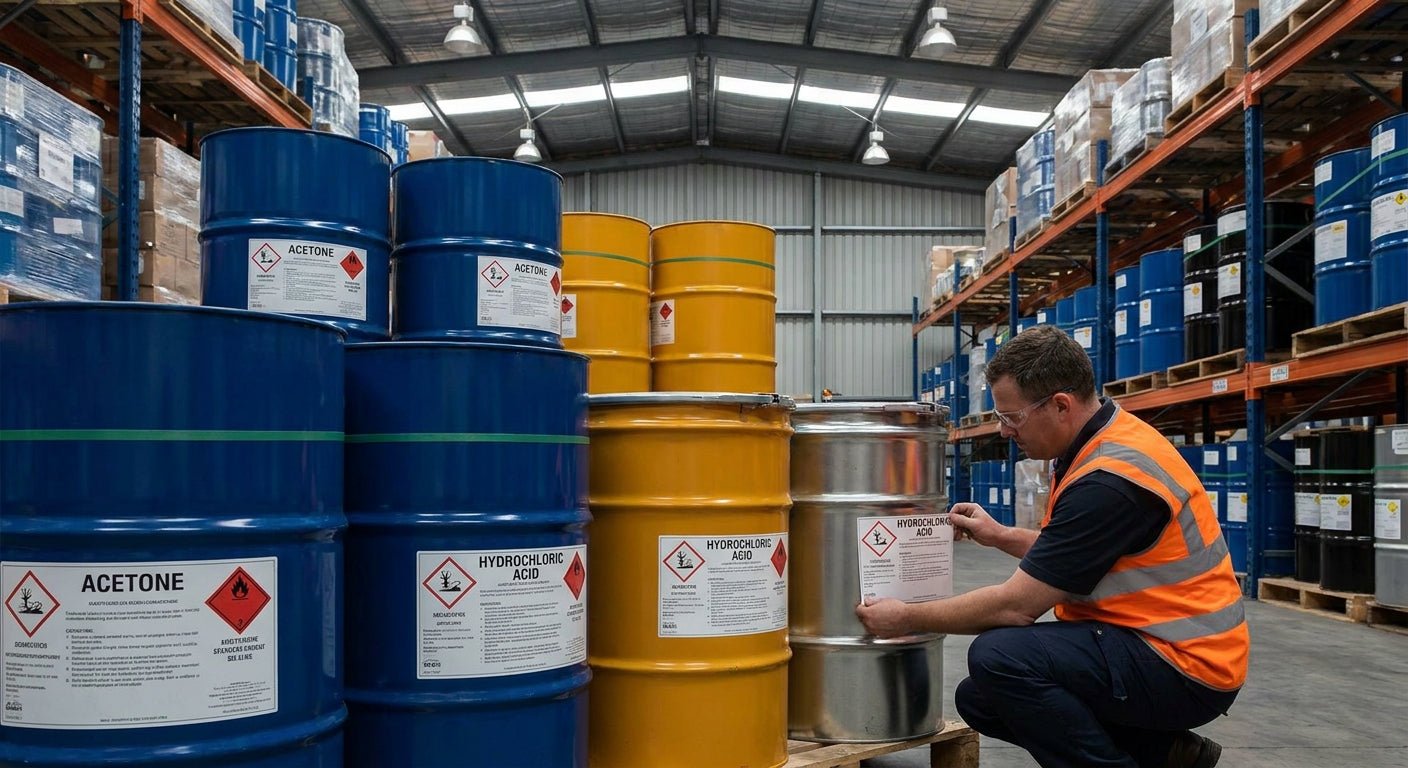
Chemical storage drums need labels that survive forklift traffic, spills, UV exposure, and OSHA inspections — not labels that peel off after the first humid week. This guide walks through the exact steps for labeling 55-gallon and 30-gallon drums in a warehouse setting, plus which materials actually hold up in 2026.
TL;DR: For labels for chemical storage drums, the winning combination in 2026 is a 3M heavy-duty polyester or metalized silver label printed on a thermal transfer printer like the GoDEX GE330, not a direct thermal label that fades under warehouse lighting within months. Skip static-cling or paper labels entirely — they fail GHS/HazCom compliance checks and don't survive drum washdowns. Verdict: 3M heavy-duty polyester with thermal transfer ribbon — Buy. Direct thermal paper labels for drums — Skip.
Why this matters
OSHA's Hazard Communication Standard (29 CFR 1910.1200) requires legible, durable labeling on chemical containers, and a faded or peeling label on a drum is a citation waiting to happen during an inspection. Beyond compliance, warehouses lose real time every year hunting down mislabeled drums, cross-checking SDS sheets, and re-labeling containers that got hosed down or handled with gloves covered in solvent. A drum label that survives forklift contact, forklift straps, and outdoor storage yards for 12+ months costs less over time than a paper label reprinted every quarter.
The difference between a label that lasts and one that doesn't usually comes down to two choices: the label material and the print method. Get those two things right and the rest of the process — placement, content, verification — is mechanical.
What you'll need
- A thermal transfer printer (not direct thermal — drums need ribbon-based printing for chemical and abrasion resistance)
- 3M heavy-duty polyester or 3M heavy-duty barcode inventory labels rated for outdoor and chemical exposure
- A resin thermal transfer ribbon matched to your label stock
- SDS data for each chemical stored (name, hazard class, GHS pictograms, supplier info)
- A barcode or QR code scheme if you're tracking drums by inventory number
- Isopropyl alcohol wipes for surface prep before application
- A drum labeling template or design software (GoLabel or similar)
If you're setting up label production for the first time, a printer like the GoDEX GE330 handles 4-inch label widths at 203 DPI, which is enough resolution for barcodes and small GHS pictograms without bleeding.
The steps
1. Choose a label material rated for chemical exposure
Not every "heavy-duty" label is built for drum service. Polyester and metalized polyester resist solvents, oils, and UV fading better than vinyl or paper stock, and they won't delaminate after repeated washdowns. Common mistake: using a general-purpose asset tag label meant for indoor equipment — it looks fine on day one and starts lifting at the corners within 60 days of outdoor storage.
2. Match the printer to the label
Direct thermal printers use heat alone to darken the label surface, and that image fades under UV light and warm storage conditions — a real problem for drums stored near loading dock doors or outside. Thermal transfer printing, which melts resin ribbon onto the label, produces a print that resists smearing, chemical splash, and sun exposure for well over a year. The GoDEX GE330 thermal transfer printer is built for exactly this kind of continuous industrial labeling. Common mistake: running polyester label stock through a direct thermal printer — the two aren't compatible and the print will smear off almost immediately.
3. Design the label with required GHS elements
Every drum label needs the product identifier, signal word (Danger or Warning), hazard statement, precautionary statement, GHS pictograms, and supplier contact information per OSHA HazCom rules. Keep pictograms at least 1 inch square so they're readable from a few feet away on a warehouse floor. Common mistake: shrinking pictograms to fit more text — inspectors flag illegible symbols even when the wording is technically correct.
4. Print on chemical-resistant stock
Once the design is finalized, print onto polyester white thermal transfer labels for a clean, high-contrast finish that holds up against grease and solvent contact. Batch print in runs of 50 to 100 to keep a buffer stock on hand for new drum deliveries. Common mistake: printing one label at a time as drums arrive — this creates bottlenecks during high-volume receiving and increases the odds of a missed label.
5. Clean the drum surface before application
Wipe the application area with isopropyl alcohol and let it dry fully — dust, oil film, or moisture on the drum surface is the number one reason labels lift within the first month. Apply the label to a flat section of the drum body, avoiding the rolled ridges near the top and bottom where adhesion is weaker. Common mistake: applying labels to a drum still wet from a rinse cycle — trapped moisture causes bubbling and early peel.
6. Apply pressure and check for full adhesion
Press from the center outward to eliminate air pockets, and run a hand or roller across the full label surface. A label with trapped air bubbles will start lifting at the edges within weeks under warehouse vibration and handling. Common mistake: applying the label in cold storage conditions below 50°F — adhesive doesn't bond properly and the label will fail early.
7. Add a barcode or QR code for tracking
If drums move between storage zones or get logged for inventory audits, add a barcode or QR code alongside the GHS label for scan-based tracking. This pairs well with a broader barcode inventory system already in place for warehouse shelving or asset tags. Common mistake: placing the barcode on a curved section of the drum — scanners struggle with the distortion and staff end up manually keying in numbers instead.
Troubleshooting
- Label edges peeling within a few weeks — surface wasn't cleaned or dried before application, or the drum was stored below 50°F during application. Reapply on a properly prepped, room-temperature surface.
- Print fading or smearing on the label — direct thermal printing was used instead of thermal transfer with resin ribbon. Reprint using a thermal transfer printer and matched ribbon.
- Barcode won't scan — label was applied to a curved or ridged part of the drum, distorting the barcode. Move the label to the flattest available section.
- Pictograms look blurry or pixelated — print resolution is too low for the pictogram size. Bump up to a 300 DPI printer setting or enlarge the pictogram on the label design.
- Label discolors after chemical splash — wrong material was used for the chemical class stored. Switch to a heavy-duty polyester or metalized rating built for solvent resistance.
- Labels fall off during forklift handling — adhesive wasn't given time to cure before the drum was moved. Let labels set for at least 24 hours before transport.
Tools and resources
- 3M heavy-duty barcode inventory labels for the label stock itself
- Polyester white thermal transfer labels as a lower-cost chemical-resistant alternative
- GoDEX GE330 thermal transfer printer for in-house printing runs
- Guidance on compliance labels for regulated industries for HazCom-specific formatting rules
- A custom quote request if you need bulk drum labels pre-printed rather than produced in-house
What to do next
Once drums are labeled correctly, the next step most warehouses need is tying that labeling scheme into a broader barcode inventory system so drum location, quantity, and chemical class are trackable from a handheld scanner rather than a clipboard. That's a separate build, but it starts with the same label stock and printer setup already in place for drum labeling.
FAQ
What's the best label material for chemical storage drums? Heavy-duty polyester or metalized polyester printed with thermal transfer resin ribbon is the standard in 2026 for chemical drum labeling — it resists solvents, UV fading, and washdown moisture better than paper or vinyl stock.
Is direct thermal or thermal transfer better for drum labels? Thermal transfer wins for drums because the resin ribbon print resists UV fading and chemical splash, while direct thermal print darkens with heat alone and fades within months under warehouse lighting or sun exposure.
How much does it cost to label chemical drums in-house? Costs scale with label material and printer choice — heavy-duty polyester stock and a resin ribbon run higher per label than paper, but avoid the repeat cost of re-labeling drums every few months from premature fading.
Do chemical drum labels need to meet OSHA HazCom requirements? Yes — OSHA's Hazard Communication Standard requires product identifiers, signal words, hazard statements, and GHS pictograms on chemical containers, and labels must stay legible for the life of the container.
Can I use the same printer for drum labels and asset tags? A thermal transfer printer like the GoDEX GE330 handles both drum labels and heavy-duty asset tags, since both use similar resin ribbon and polyester or metalized stock for durability.
How long should chemical drum labels last outdoors? A properly applied heavy-duty polyester label with thermal transfer print should hold legibility for 12 months or more in outdoor storage, compared to a few weeks for paper-based direct thermal labels.
What size should GHS pictograms be on a drum label? GHS pictograms should be at least 1 inch square on drum labels so they're readable from a few feet away during a walkthrough or inspection in 2026.
Should drum labels include a barcode for inventory tracking? Yes, if drums move between storage areas — a barcode or QR code placed on a flat section of the drum lets staff scan and log inventory instead of manually tracking drum counts.
One last thing
The single most common failure point in drum labeling isn't the label material — it's applying labels to a drum surface that's still damp or cold. Warehouses that build a 24-hour dry-and-cure window into receiving procedures see far fewer peeling complaints than ones that label drums the moment they come off the truck.