
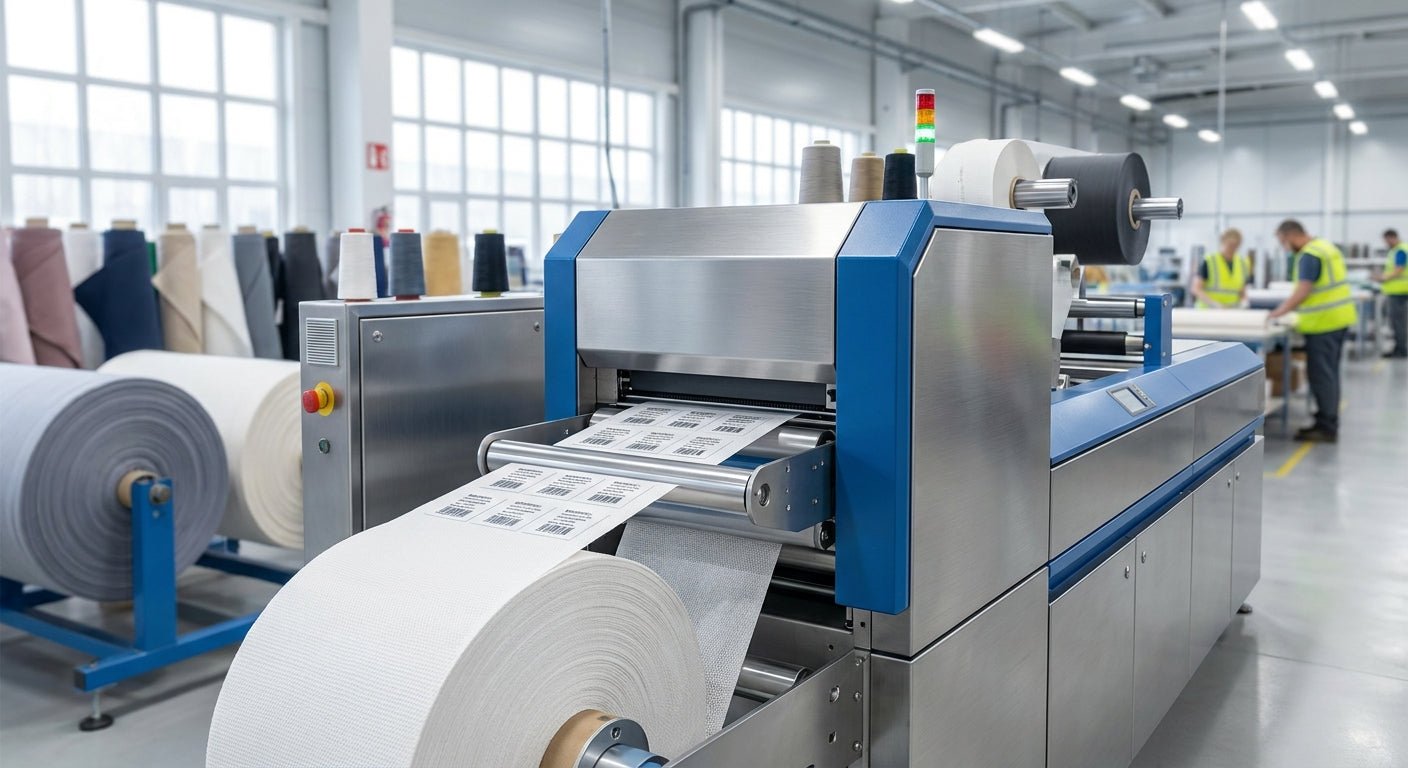
Cutting rooms, sewing lines and finishing departments all print differently — pick the wrong machine and you get smeared barcodes on WIP bundles or care labels that fade after two wash cycles. This guide breaks down what to look for in an industrial label printer for textile manufacturing, with specific picks by production stage.
- GoDEX ZX430i+ wins for hang tags and small barcodes at 300 DPI — Buy for 2026 apparel runs.
- GoDEX RT700i+ covers 203 DPI WIP tracking at $581 — Buy for cut-and-sew floors.
- Direct thermal alone fades under heat presses and dryers — thermal transfer with resin ribbon holds up.
- 3M heavy-duty barcode labels survive repeated tote handling on sewing lines — Buy for bundle tracking.
Why This Matters
Textile and apparel manufacturing runs on paper trails you cannot afford to lose — cut tickets, WIP bundle tags, care labels, hang tags, price tickets. Miss a scan on the sewing floor and a bundle disappears until someone finds it three days later in the wrong bin.
Most desktop label printers were never built for that pace. They choke on eight-hour shifts, they cannot hold resolution fine enough for size-chart text printed at 6-point type, and their ribbons smear the moment a heat press gets near them.
McAuley Labels' industrial printer lineup exists for exactly this gap — machines rated for continuous duty cycles, not office print jobs. Get the print width, resolution or ribbon chemistry wrong and you are reprinting labels on 2026's busiest production days instead of shipping orders.
Who This Is For
This guide is for production managers and plant operators running cut-and-sew floors, screen-print shops finishing garments in-house, or private-label apparel manufacturers shipping to retail with compliance tags attached. If your daily label count runs into the thousands — WIP tickets, care labels, hang tags, carton labels — and a jammed printer stops a line, you are the buyer this is written for.
What to Look for in an Industrial Label Printer for Textile Manufacturing
Print resolution for small text and barcodes
Woven and printed care labels often carry 6-point fiber-content text and a barcode under half an inch tall. A 203 DPI printer blurs that detail into a smudge; 300 DPI holds edges sharp enough for scanners to read on the first pass. A garment tag that ships with an unreadable barcode comes back at the retailer's dock, not yours — a chargeback nobody budgets for in 2026.
Ribbon chemistry and heat resistance
Care labels sit through heat presses, home dryers and industrial wash cycles for years. Direct thermal print — no ribbon, image burned into the label coating — fades within months under that kind of heat exposure. Thermal transfer with a wax/resin ribbon locks the image into the label surface, which is why nearly every garment care label on the market is thermal transfer, not direct thermal.
Duty cycle and print speed
A cut-and-sew floor running two shifts prints WIP tickets continuously, not in bursts. A printer rated for a few hundred labels a day overheats the printhead or wears the platen roller inside a quarter. Match the stated duty cycle in inches per second to your bundle volume, not to the printer's list price.
Print width for hang tags and multi-line labels
Hang tags carry a SKU, size, price and sometimes a QR code stacked on one card. A 2-inch printer forces that information across two labels; a 4-inch head fits it on one pass. Standard industrial printers in this category print at 4 inches wide — enough for most hang tag and care label formats without reformatting art files.
Connectivity across multiple production sites
Multi-location manufacturers running several cut floors need printers that hold the same label template site to site — USB alone does not scale. Ethernet and serial connections let a plant IT team push one barcode format to five printers instead of configuring each by hand, and that matters the moment a second facility comes online in 2026.
Top Picks for Textile and Apparel Manufacturing
The workhorse: GoDEX ZX430i+
The GoDEX ZX430i+ 300 DPI printer prints at 300 DPI across a 4-inch head, sharp enough for size-chart text and small QR codes on hang tags. It ships with a color display for shift changes when three operators share one machine, and it runs resin ribbon without smearing near a heat-press station. Verdict: Buy for any apparel line printing hang tags or care labels with fine barcode detail in 2026.
The budget floor printer: GoDEX RT700i+
The GoDEX RT700i+ runs 203 DPI at $581, and it covers WIP tickets, cut tickets and carton labels where throughput matters more than fine resolution. Put one at every cutting table, not just the label room — $581 per unit makes multi-station deployment realistic on a real budget. Verdict: Buy for WIP and internal tracking; Consider before using it on barcode text under 8-point.
The floor tracking material: 3M heavy-duty barcode labels
3M heavy-duty barcode inventory labels are built for repeated handling — bundle totes get scanned, stacked and rescanned dozens of times a shift, and a standard paper label delaminates under that. The 3M adhesive backing holds through fabric dust, humidity and bin-handling friction on a cutting floor. Verdict: Buy for bundle and tote tracking; Skip for care labels going onto the garment itself, since that job belongs to synthetic thermal transfer stock, not an industrial tag.


What to Avoid
- Direct-thermal-only printers marketed for labels in general. Fine for shipping labels, wrong for anything touching a heat press or a wash cycle — the image fades inside a season.
- Printers rated under 6 IPS for high-volume floors. A slow print speed doesn't show up on a spec-sheet comparison until the line is waiting on labels at 2pm on a Tuesday in 2026.
- Single-printer deployments across multi-line facilities. One printer serving three cutting tables becomes the bottleneck the day it jams.
Cut floors juggling this many SKUs and print jobs usually end up requesting custom label runs and multi-unit printer quotes rather than buying off one product page — once volume moves past a handful of SKUs, teams that automate quoting for manufacturers cut days off the back-and-forth email chain that used to slow down reorders. The same logic applies to printing hang tags for apparel: the printer spec matters less than getting a consistent quote and reorder process locked in before a season ramps up.
Verdict Comparison Table
| Pick | Resolution | Best For | Verdict |
|---|---|---|---|
| GoDEX ZX430i+ | 300 DPI | Hang tags, fine barcodes | Buy |
| GoDEX RT700i+ | 203 DPI | WIP tickets, cartons | Buy |
| 3M Heavy-Duty Barcode Labels | N/A (label stock) | Bundle and tote tracking | Buy |
FAQ
What is the best label printer for textile manufacturing in 2026?
The GoDEX ZX430i+ is the strongest pick for 2026 apparel runs printing hang tags and fine barcodes at 300 DPI. For WIP tickets and carton labels where resolution matters less, the GoDEX RT700i+ at 203 DPI covers the volume at a lower per-unit cost.
Is 300 DPI better than 203 DPI for garment labels?
Yes, for anything with small text or barcodes under half an inch tall, 300 DPI holds sharper edges. 203 DPI is fine for larger WIP tickets and carton labels where scan distance is longer and text is bigger.
Can direct thermal printers handle garment care labels?
Direct thermal print fades under heat press and dryer exposure within months, so it is a poor fit for care labels. Thermal transfer with a wax/resin ribbon is the standard for labels that need to survive wash cycles and ironing.
How much does an industrial label printer cost for a cut-and-sew floor?
A 203 DPI industrial printer like the GoDEX RT700i+ runs around $581 in 2026. A 300 DPI unit like the GoDEX ZX430i+ costs more but pays off on any line printing fine barcode detail.
What print width do apparel hang tags need?
Most hang tags fit on a standard 4-inch print head, which covers SKU, size, price and a QR code on one label. Anything narrower forces a split across two labels and adds a reformatting step to every art file.
Do textile plants need thermal transfer ribbon or direct thermal labels?
Thermal transfer ribbon is the right call for anything that touches heat, moisture or repeated handling, which covers nearly every garment-facing label. Direct thermal works fine for short-life labels like internal routing slips.
How many labels can an industrial printer handle per shift?
Duty cycle depends on the rated inches-per-second speed and print width, not just the printer's price tag. A machine rated for a few hundred labels a day will wear out fast on a two-shift cut floor printing thousands.
What is the difference between WIP tickets and care labels for printing purposes?
WIP tickets are internal, short-life labels that just need to survive one production cycle, so 203 DPI direct or thermal transfer both work. Care labels go onto the finished garment and must survive years of washing, so they need thermal transfer with resin ribbon at 300 DPI.
One Last Thing
One detail trips up more plants than resolution ever does: ribbon width mismatch. A 4-inch printhead paired with a narrower ribbon prints fine for the first roll, then streaks the moment the ribbon core doesn't match the label edge to edge. Match ribbon width to label width before matching DPI to text size — it's the cheaper mistake to catch, and the one nobody checks until the streaking starts on a 2026 production run already behind schedule.